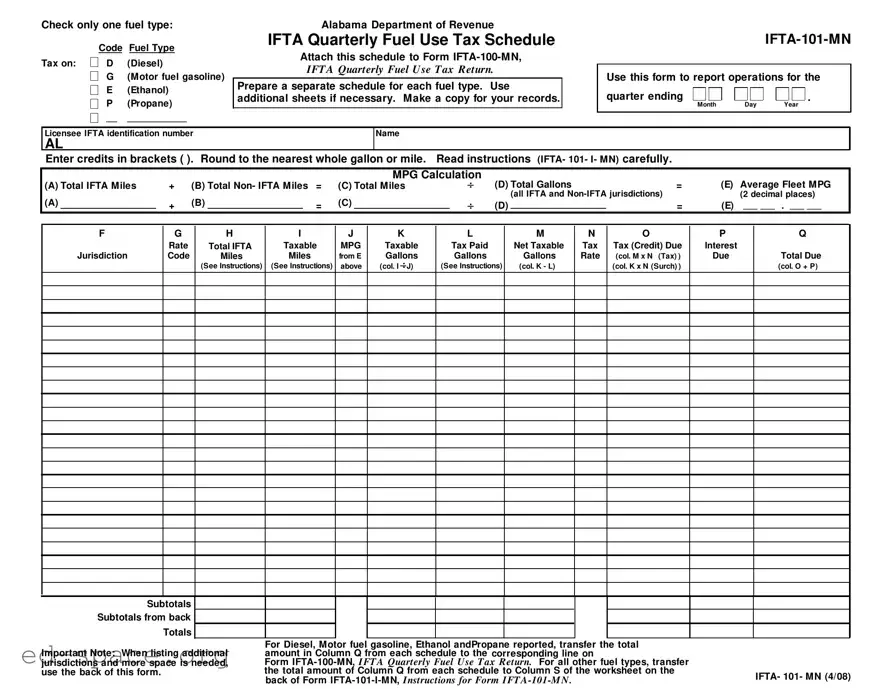
The IFTA Alabama form is a crucial document for those involved in interstate transportation. It helps track fuel usage across different jurisdictions, ensuring compliance with tax regulations. This form is designed to report operations for various fuel types, including diesel, gasoline, ethanol, and propane. Users must select only one fuel type per schedule and prepare separate schedules for each type. The form also includes sections for reporting total IFTA miles and non-IFTA miles, allowing for accurate calculations of total miles driven. Additionally, it requires users to calculate their average fleet miles per gallon (MPG) and report taxable gallons along with the tax due. Each section is clearly laid out, guiding users through the necessary calculations and ensuring all relevant information is captured. It's important to read the instructions carefully to avoid errors. Keeping a copy of the completed form for personal records is also advised. By following these steps, drivers can meet their tax obligations efficiently.
Check only one fuel type: |
|
|
|
|
Alabama Department of Revenue |
|
|
|
|
|
|
|
|
||||||||||||
|
|
Code |
Fuel Type |
|
|
IFTA Quarterly Fuel Use Tax Schedule |
|
|
|
||||||||||||||||
|
|
|
|
Attach this schedule to Form |
|
|
|
|
|
||||||||||||||||
Tax on: |
D |
(Diesel) |
|
|
|
|
|
|
|
|
|||||||||||||||
|
|
|
|
IFT A Quarterly Fuel U se T ax Return. |
|
|
|
|
|
|
|
|
|||||||||||||
|
|
G |
(Motor fuel gasoline) |
|
|
|
|
|
Use this form to report operations for the |
||||||||||||||||
|
|
|
|
|
|
|
|
|
|
|
|
|
|
|
|
||||||||||
|
|
Prepare a separate schedule for each fuel type. Use |
|
||||||||||||||||||||||
|
|
E |
(Ethanol) |
|
|
|
|
|
quarter ending |
|
|
|
|||||||||||||
|
|
|
|
|
additional sheets if necessary. Make a copy for your records. |
|
|
|
|
. |
|||||||||||||||
|
|
P |
(Propane) |
|
|
|
|
|
|
||||||||||||||||
|
|
|
|
|
|
|
|
|
|
|
|
|
|
|
|
|
|
Month |
|
Day |
Year |
||||
|
|
__ |
___________ |
|
|
|
|
|
|
|
|
|
|
|
|
|
|
|
|
|
|
|
|
||
|
|
|
|
|
|
|
|
|
|
|
|
|
|
|
|
|
|
|
|
|
|
||||
|
|
|
|
|
|
|
|
|
|
|
|
|
|
|
|
|
|
|
|
|
|
||||
Licensee IFTA identification number |
|
|
|
|
|
Name |
|
|
|
|
|
|
|
|
|
|
|
|
|||||||
AL |
|
|
|
|
|
|
|
|
|
|
|
|
|
|
|
|
|
|
|
|
|
|
|
|
|
Enter credits in brackets ( ). Round to the nearest whole gallon or mile. |
Read instructions (IFTA- 101- I- MN) carefully. |
|
|
|
|||||||||||||||||||||
|
|
|
|
|
|
|
|
|
|
|
|
|
|
|
|
|
|
|
|
|
|
|
|
|
|
|
|
|
|
|
|
|
|
|
|
|
|
|
MPG Calculation |
|
|
|
|
|
(E) |
Average Fleet MPG |
|||||
(A) Total IFTA Miles |
+ (B) Total Non- IFTA Miles |
= (C) Total Miles |
|
: |
|
(D) Total Gallons |
= |
||||||||||||||||||
(A) |
|
|
|
|
(B) |
|
|
|
(C) |
|
|
|
|
|
(all IFTA and |
|
(2 decimal places) |
||||||||
|
|
|
+ |
|
|
= |
|
|
: |
|
(D) |
|
|
|
= |
(E) |
___ ___ |
. ___ ___ |
|||||||
|
|
|
|
|
|
|
|
|
|
|
|
|
|
|
|
|
|||||||||
F
Jurisdiction
G
Rate Code
H |
I |
J |
Total IFTA |
Taxable |
MPG |
Miles |
Miles |
from E |
(See Instructions) |
(See Instructions) |
above |
|
|
|
K
Taxable Gallons
(col. I : J)
L
Tax Paid
Gallons
(See Instructions)
M
Net Taxable
Gallons
(col. K - L)
N
Tax Rate
O
Tax (Credit) Due
(col. M x N (Tax) ) (col. K x N (Surch) )
P
Interest
Due
Q
Total Due
(col. O + P)
Subtotals
Subtotals from back
Totals
Important Note: When listing additional jurisdictions and more space is needed, use the back of this form.
For Diesel, Motor fuel gasoline, Ethanol andPropane reported, transfer the total |
|
|
amount in Column Q from each schedule to the corresponding line on |
|
|
Form |
|
|
the total amount of Column Q from each schedule to Column S of the worksheet on the |
IFTA- 101- MN (4/08) |
|
back of Form |
||
|
F
Jurisdiction
G
Rate Code
H |
I |
Total IFTA |
Taxable |
Miles |
Miles |
(See Instructions) (See Instructions)
J
MPG
from E on front
K
Taxable
Gallons
(col. I : J)
L
Tax Paid
Gallons
(See Instructions)
M
Net Taxable
Gallons
(col. K - L)
N
Tax Rate
O
Tax (Credit) Due
(col. M x N (Tax)) (col. K x N (Surch))
P
Interest
Due
Q
Total Due
(col. O + P)
Transfer the subtotal am ounts Subtotals
to the front of this schedule.
| Fact Name | Description |
|---|---|
| Purpose | The IFTA Alabama form is used to report fuel use tax for various fuel types, including diesel, gasoline, ethanol, and propane. |
| Filing Requirement | Licensees must prepare a separate schedule for each fuel type and attach it to Form IFTA-100-MN. |
| Governing Law | This form operates under the International Fuel Tax Agreement (IFTA) regulations and Alabama Department of Revenue guidelines. |
| Record Keeping | It is essential for users to make a copy of the completed form for their records after submission. |
Filling out the IRP Alabama form requires careful attention to detail. Each section of the form is designed to capture specific information about your fuel usage and operations. Once completed, the form will need to be submitted alongside any necessary schedules to ensure compliance with reporting requirements.
What is the IRP Alabama form used for?
The IRP Alabama form is used to report fuel usage for commercial vehicles operating in multiple jurisdictions. This form helps you calculate the taxes owed based on the fuel types used during your operations. By completing this form, you ensure compliance with the International Fuel Tax Agreement (IFTA) regulations.
How do I fill out the IRP Alabama form?
To fill out the IRP Alabama form, start by checking the fuel type you use: Diesel, Motor fuel gasoline, Ethanol, or Propane. Then, provide your IFTA identification number and name. You will need to report total miles traveled and total gallons of fuel used for each fuel type. Make sure to read the instructions carefully to avoid mistakes. If you need more space, you can use additional sheets.
What if I made a mistake on the form?
If you realize you made a mistake after submitting the form, you can file an amended return. Make sure to indicate the corrections clearly and provide any necessary supporting documentation. It’s important to correct any errors to avoid potential penalties or interest charges.
How do I calculate my average fleet MPG?
To calculate your average fleet MPG, add your total IFTA miles and total non-IFTA miles to get the total miles. Then, divide the total gallons of fuel used by the total miles. This calculation gives you the average miles per gallon for your fleet, which is essential for completing the form accurately.
What happens if I do not file the IRP Alabama form on time?
Failing to file the IRP Alabama form on time can result in penalties and interest charges. It's crucial to submit your form by the deadline to avoid these additional costs. If you anticipate a delay, consider reaching out to the Alabama Department of Revenue for guidance on your options.
Can I keep a copy of the IRP Alabama form?
Yes, it is important to keep a copy of the IRP Alabama form for your records. This will help you track your fuel usage and tax payments. Having a copy on hand can also assist you in case of audits or inquiries from tax authorities in the future.
Failing to select only one fuel type can lead to confusion and inaccuracies. The form requires that the filer check only one option from the available fuel types: Diesel, Motor fuel gasoline, Ethanol, or Propane.
Not rounding figures to the nearest whole gallon or mile is a common mistake. Accurate reporting requires that all numbers be rounded appropriately, as specified in the instructions.
Overlooking the need to prepare separate schedules for each fuel type can result in incomplete submissions. Each fuel type must have its own dedicated schedule, and additional sheets should be attached if necessary.
Neglecting to read the instructions thoroughly can lead to errors. It is crucial to follow the guidelines provided in the IFTA-101-MN instructions to ensure compliance and accuracy.
The International Fuel Tax Agreement (IFTA) facilitates the reporting of fuel use by motor carriers operating in multiple jurisdictions. In Alabama, the IFTA-related documentation includes various forms and schedules that complement the IRP Alabama form. Below is a list of documents frequently used alongside the IRP Alabama form, each serving a specific purpose in the compliance and reporting process.
Each of these forms and documents plays a crucial role in the accurate reporting and compliance process for fuel taxes under IFTA in Alabama. Proper completion and timely submission of these documents help avoid potential penalties and ensure smooth operations for carriers engaged in interstate travel.
When filling out the IRP Alabama form, it is essential to follow specific guidelines to ensure accuracy and compliance. Here’s a list of what to do and what to avoid:
Understanding the IRP Alabama form can be challenging, especially with the various misconceptions surrounding it. Here are nine common misunderstandings that people often have:
By addressing these misconceptions, individuals can better navigate the IRP Alabama form and ensure compliance with reporting requirements.
When filling out and using the IRP Alabama form, consider the following key takeaways: