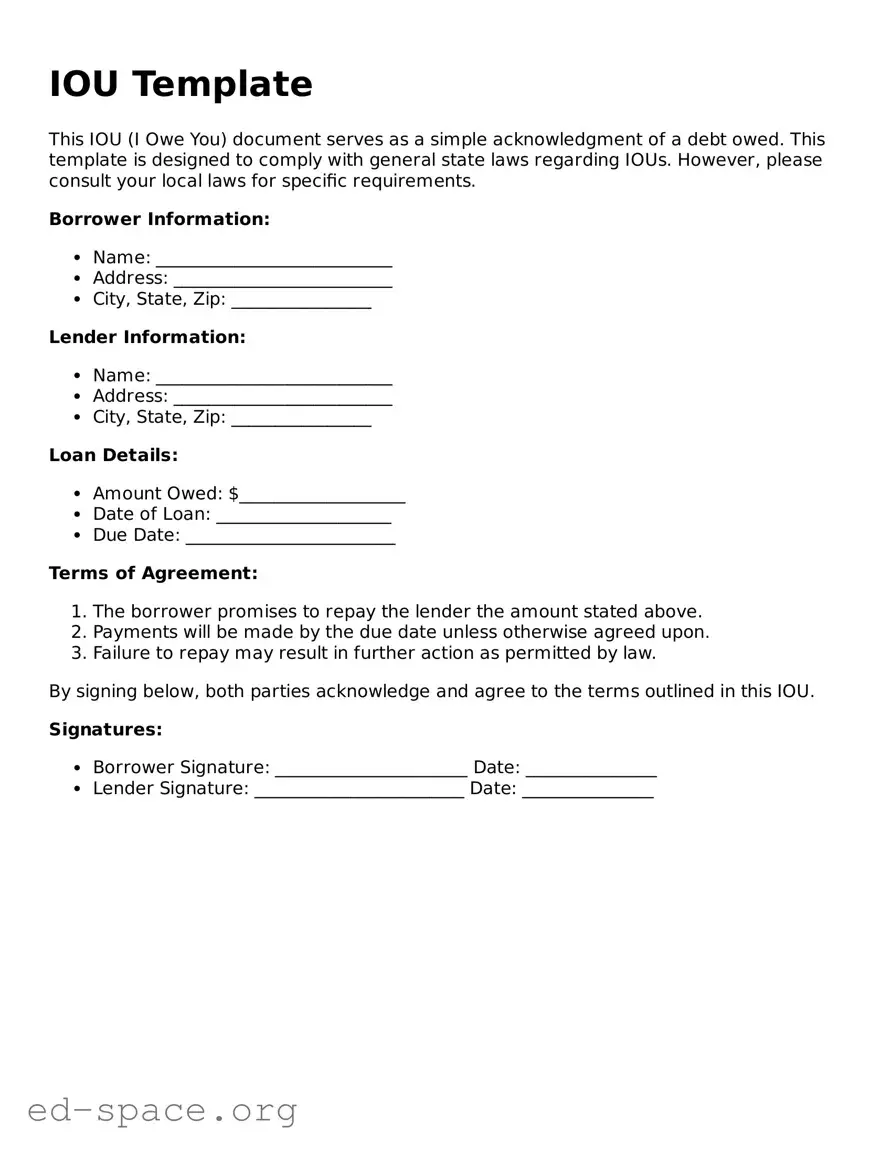
The IOU form is a simple yet important tool for documenting informal loans or debts between individuals. It serves as a written acknowledgment of a borrowed amount, which can help prevent misunderstandings and disputes in the future. This form typically includes key details such as the names of the parties involved, the amount owed, and the date by which repayment is expected. While it may seem casual, an IOU carries weight and can be useful in various situations, from lending money to a friend to settling a small business transaction. Understanding its components can empower individuals to manage their financial interactions more effectively and maintain clear communication with others. By using an IOU, borrowers and lenders can establish a mutual understanding, fostering trust and accountability in their dealings.
IOU Template
This IOU (I Owe You) document serves as a simple acknowledgment of a debt owed. This template is designed to comply with general state laws regarding IOUs. However, please consult your local laws for specific requirements.
Borrower Information:
Lender Information:
Loan Details:
Terms of Agreement:
By signing below, both parties acknowledge and agree to the terms outlined in this IOU.
Signatures:
| Fact Name | Description |
|---|---|
| Definition | An IOU is a simple document acknowledging a debt. It typically states the amount owed and the debtor's promise to repay. |
| Legality | IOUs are generally considered legally binding, provided they contain clear terms and both parties agree to them. |
| State-Specific Forms | Some states may have specific requirements for IOUs, including witness signatures or notarization. |
| Governing Laws | In California, for example, IOUs are governed by the California Civil Code, while New York follows the Uniform Commercial Code. |
| Payment Terms | It’s important to specify payment terms in the IOU, such as due dates and interest rates, if applicable. |
| Informal Nature | IOUs are often informal and can be written on any piece of paper, but clarity is key to avoid disputes. |
After receiving the IOU form, you will need to provide specific information to ensure clarity regarding the loan agreement. Follow the steps below to complete the form accurately.
What is an IOU form?
An IOU form is a simple document that acknowledges a debt between two parties. It serves as a written record of an informal loan or obligation, indicating that one party owes a specific amount of money to another. While it is not a legally binding contract in the same way as a formal loan agreement, it can still be useful for tracking debts and ensuring both parties are aware of the terms involved.
When should I use an IOU form?
Consider using an IOU form when lending or borrowing money informally, such as between friends or family members. It can also be helpful in situations where a more formal loan agreement feels unnecessary. An IOU is particularly useful for small amounts of money or short-term loans, where both parties agree on the repayment terms without the need for legal complexities.
What should be included in an IOU form?
A well-crafted IOU form should include several key elements: the names of both the lender and borrower, the amount of money owed, the date the loan was made, and the repayment terms, if applicable. Additionally, it may be beneficial to include any interest rates or specific conditions for repayment to avoid misunderstandings later on.
Is an IOU legally binding?
While an IOU form can serve as evidence of a debt, it is generally not considered a legally binding contract. This means that if a dispute arises, it may be difficult to enforce the terms outlined in the IOU in a court of law. However, it can still be useful for demonstrating the existence of a debt and the intention to repay it.
Can an IOU form be modified after it is signed?
Yes, an IOU form can be modified after it is signed, but both parties must agree to the changes. It is advisable to document any modifications in writing to maintain clarity and avoid future disputes. This can be done by creating an amendment to the original IOU or by drafting a new IOU that reflects the updated terms.
What happens if the borrower does not repay the IOU?
If the borrower fails to repay the IOU, the lender may face challenges in recovering the debt, as the IOU is not a legally enforceable contract. However, the lender can attempt to resolve the matter through communication or negotiation. In more serious cases, the lender might consider seeking legal advice to explore options for recovering the debt, though this can often be a lengthy and costly process.
Are there any tax implications associated with an IOU?
Generally, an IOU does not have direct tax implications for either party, as it is simply a record of a debt. However, if the loan involves interest, the lender may need to report that interest as income on their tax return. It is always wise to consult with a tax professional to understand any potential tax consequences related to lending or borrowing money.
Can an IOU be used for non-monetary debts?
While IOUs are primarily used for monetary debts, they can also be adapted for non-monetary obligations. For instance, if one person agrees to provide a service or item in exchange for something of value, an IOU can document that agreement. Just be sure to clearly outline the specifics of what is owed in terms of services or goods to avoid confusion.
Where can I find a template for an IOU form?
IOU templates can be found online through various legal document websites or by searching for templates specifically designed for informal loans. Many templates are customizable, allowing you to fill in the necessary details to suit your specific situation. Always ensure that the template you choose includes all essential elements to make it clear and effective.
Failing to include the date of the transaction. This information is crucial for establishing when the debt was incurred.
Not clearly identifying the borrower and lender. Full names and contact information should be provided to avoid confusion.
Leaving out the amount owed. This figure must be accurate and clearly stated to prevent disputes later.
Neglecting to specify the repayment terms. Details regarding when and how the debt will be repaid should be included.
Using vague language. Clear and precise wording helps ensure that both parties understand the terms of the agreement.
Not signing the form. Both parties should sign the IOU to acknowledge their agreement to the terms outlined.
Failing to keep a copy of the IOU. Each party should retain a copy for their records to refer to in case of any future disputes.
Not considering the legal implications. Understanding the enforceability of an IOU can help avoid issues later on.
When dealing with IOU forms, several other documents may be necessary to ensure clarity and protect the interests of both parties involved. Here’s a list of common forms that often accompany an IOU.
Using these forms alongside an IOU can help clarify the terms of the loan and protect both parties involved. Keeping everything documented is always a smart move.
An IOU form is a simple document that acknowledges a debt owed. It is often used in informal situations. Several other documents serve similar purposes in different contexts. Here is a list of ten documents that share similarities with an IOU form:
When filling out an IOU form, it's important to ensure accuracy and clarity. Here are four guidelines to follow:
Following these tips can help avoid disputes and ensure that both parties understand the terms of the agreement.
Understanding the IOU form is crucial for personal and business transactions. However, several misconceptions can lead to confusion. Here are eight common misconceptions about the IOU form:
Being aware of these misconceptions can help individuals and businesses navigate financial agreements more effectively. Understanding the nature and limitations of an IOU is essential for making informed decisions.
When dealing with an IOU form, it’s important to understand its purpose and how to use it effectively. Here are some key takeaways: