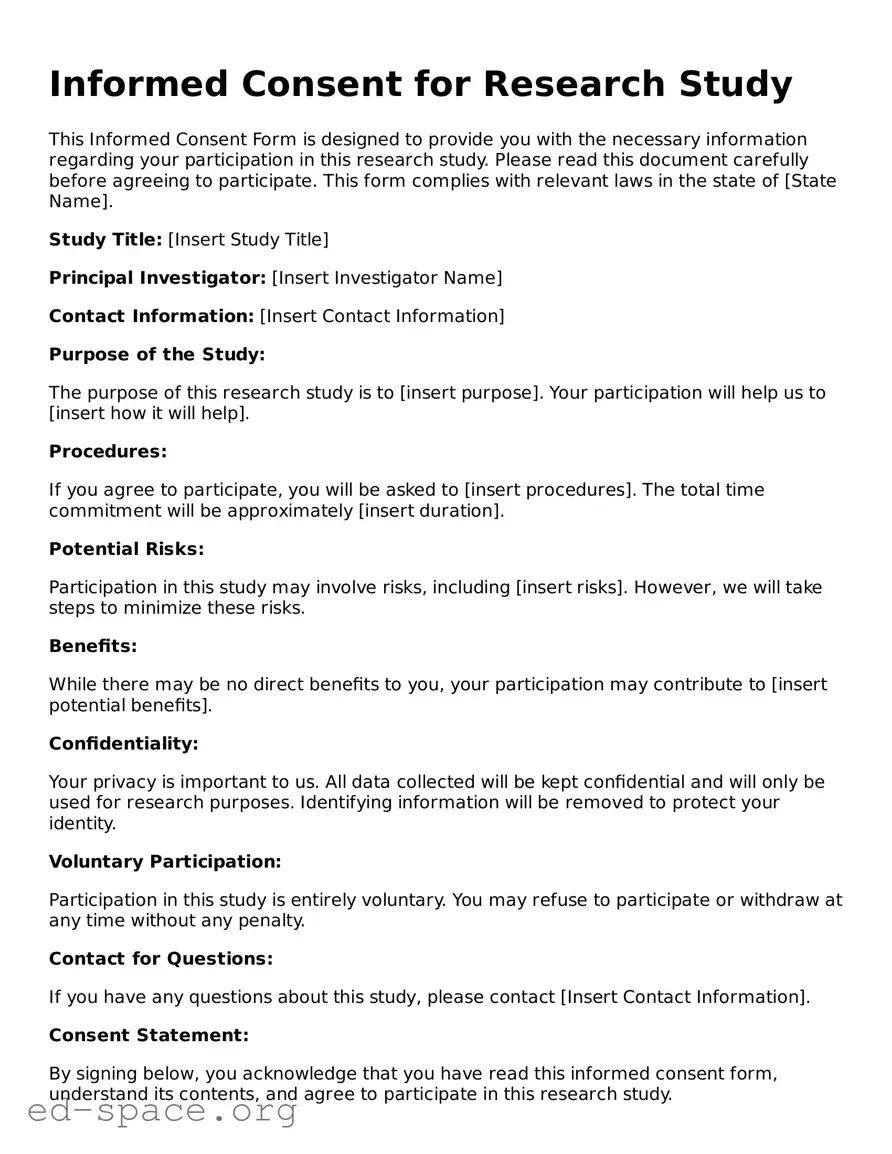
Participating in a research study can be an important decision, and understanding the Informed Consent for Research Study form is crucial for anyone considering involvement. This document outlines key information about the study, including its purpose, procedures, and duration. Participants will learn about potential risks and benefits associated with their involvement, ensuring they are fully aware of what to expect. The form also details confidentiality measures, explaining how personal information will be protected. Additionally, it provides insight into the voluntary nature of participation, emphasizing that individuals can withdraw at any time without penalty. By presenting this information clearly, the Informed Consent form empowers individuals to make informed choices about their participation in research, fostering trust and transparency between researchers and participants.
Informed Consent for Research Study
This Informed Consent Form is designed to provide you with the necessary information regarding your participation in this research study. Please read this document carefully before agreeing to participate. This form complies with relevant laws in the state of [State Name].
Study Title: [Insert Study Title]
Principal Investigator: [Insert Investigator Name]
Contact Information: [Insert Contact Information]
Purpose of the Study:
The purpose of this research study is to [insert purpose]. Your participation will help us to [insert how it will help].
Procedures:
If you agree to participate, you will be asked to [insert procedures]. The total time commitment will be approximately [insert duration].
Potential Risks:
Participation in this study may involve risks, including [insert risks]. However, we will take steps to minimize these risks.
Benefits:
While there may be no direct benefits to you, your participation may contribute to [insert potential benefits].
Confidentiality:
Your privacy is important to us. All data collected will be kept confidential and will only be used for research purposes. Identifying information will be removed to protect your identity.
Voluntary Participation:
Participation in this study is entirely voluntary. You may refuse to participate or withdraw at any time without any penalty.
Contact for Questions:
If you have any questions about this study, please contact [Insert Contact Information].
Consent Statement:
By signing below, you acknowledge that you have read this informed consent form, understand its contents, and agree to participate in this research study.
Participant's Name: ________________________________
Participant's Signature: ________________________________
Date: ________________________________
Witness Name (if applicable): ________________________________
Witness Signature (if applicable): ________________________________
Date: ________________________________
| Fact Name | Description |
|---|---|
| Definition | The Informed Consent for Research Study form is a document that outlines the details of a research study and ensures participants understand what their involvement entails. |
| Purpose | This form aims to protect the rights and welfare of research participants by providing them with essential information about the study. |
| Voluntary Participation | Participants must be informed that their involvement is voluntary, and they can withdraw at any time without penalty. |
| Risks and Benefits | The form must clearly outline any potential risks and benefits associated with participating in the research study. |
| Confidentiality | Participants should be assured that their personal information will be kept confidential and used only for research purposes. |
| Governing Laws | In the U.S., the Common Rule (45 CFR 46) governs the ethical conduct of research involving human subjects, including informed consent. |
| State-Specific Regulations | Some states may have additional regulations that affect informed consent, such as California's Health and Safety Code Section 24170. |
| Language Clarity | The form should be written in clear, understandable language, avoiding complex terms to ensure all participants can comprehend the information. |
| Signature Requirement | Participants are typically required to sign the form to indicate their consent and understanding of the study. |
| Contact Information | The form should provide contact details for the research team, allowing participants to ask questions or express concerns. |
Completing the Informed Consent for Research Study form is an essential step before participating in the study. Follow the steps below carefully to ensure that all required information is provided accurately.
After submitting the form, you will receive further instructions regarding the next steps in the research process. Ensure you keep a copy of the signed form for your records.
What is the purpose of the Informed Consent for Research Study form?
The Informed Consent for Research Study form serves to ensure that participants are fully aware of the nature of the research, including its purpose, procedures, risks, and benefits. This document allows individuals to make an informed decision about their participation. It emphasizes the importance of transparency and respect for the autonomy of each participant.
Who needs to sign the Informed Consent form?
All individuals who choose to participate in a research study must sign the Informed Consent form. This includes adults, minors (with parental consent), and any individuals whose participation is sought. Signing the form indicates that the participant understands the study and agrees to take part in it voluntarily.
What information is typically included in the Informed Consent form?
The Informed Consent form generally includes details about the study's purpose, procedures, potential risks and benefits, confidentiality measures, and the right to withdraw at any time without penalty. Participants should also be informed about who to contact for questions or concerns regarding the research.
Can a participant withdraw from the study after signing the consent form?
Yes, participants have the right to withdraw from the study at any time, even after signing the consent form. It is crucial for participants to know that their decision to withdraw will not affect their relationship with the researchers or any services they may receive.
What should a participant do if they have questions about the study?
If participants have questions or concerns about the study, they should feel encouraged to reach out to the research team. Contact information is typically provided in the Informed Consent form. Open communication is vital for ensuring that participants feel comfortable and informed throughout the research process.
How is participant confidentiality protected?
Participant confidentiality is a top priority in research studies. The Informed Consent form outlines the measures taken to protect personal information, such as using codes instead of names, securing data storage, and limiting access to authorized personnel only. Researchers are committed to maintaining privacy and complying with relevant laws and regulations.
What happens if new information arises during the study?
In the event that new information emerges that may affect a participant's willingness to continue, researchers are obligated to inform participants promptly. This may include new risks or benefits that were not previously disclosed. Participants will then have the opportunity to reconsider their participation based on this updated information.
Is the Informed Consent form the same for all research studies?
No, the Informed Consent form can vary depending on the specific research study, its goals, and the population involved. Each study is unique, and the form is tailored to reflect the particulars of that research. However, all forms must adhere to ethical guidelines and legal requirements regarding informed consent.
What is the role of an Institutional Review Board (IRB) in the consent process?
An Institutional Review Board (IRB) plays a critical role in overseeing research studies involving human participants. The IRB reviews the Informed Consent form to ensure that it meets ethical standards and adequately protects participants' rights and welfare. Their approval is necessary before a study can commence, ensuring that participant safety is prioritized.
Not reading the entire form thoroughly. Participants may overlook important details about the study, such as risks and benefits.
Failing to ask questions. If participants do not understand any part of the form, they should seek clarification from the research team.
Ignoring the section on confidentiality. Participants should pay attention to how their data will be used and protected.
Not providing complete personal information. Missing or incorrect information can delay the research process.
Overlooking the withdrawal process. Participants should understand their right to withdraw from the study at any time without penalty.
Assuming consent is permanent. Participants must recognize that consent can be revoked at any point during the study.
Misunderstanding the risks involved. Participants should carefully consider any potential risks before agreeing to participate.
Not considering the time commitment. Participants should be aware of how much time the study will require and plan accordingly.
Failing to keep a copy of the signed form. Participants should retain a copy for their records, which may be useful later.
When conducting research, obtaining informed consent is just one piece of the puzzle. Several other forms and documents are often used in conjunction with the Informed Consent for Research Study form to ensure that participants are fully informed and protected throughout the research process. Below is a list of commonly associated documents.
These documents work together to create a transparent and ethical research environment. By ensuring that participants are well-informed and their rights are respected, researchers can foster trust and integrity in their studies.
The Informed Consent for Research Study form is an essential document in the research process, ensuring that participants understand what they are agreeing to. Several other documents share similarities with this form in their purpose and function. Below are five such documents, each explained in detail:
When filling out the Informed Consent for Research Study form, it's important to be careful and thorough. Here are some guidelines to help you navigate the process:
Understanding the Informed Consent for Research Study form is crucial for participants. However, several misconceptions can lead to confusion. Here’s a list of common misunderstandings:
Being aware of these misconceptions can help you make informed decisions about participating in research studies.
When participating in a research study, understanding the Informed Consent form is crucial. Here are some key takeaways to keep in mind: