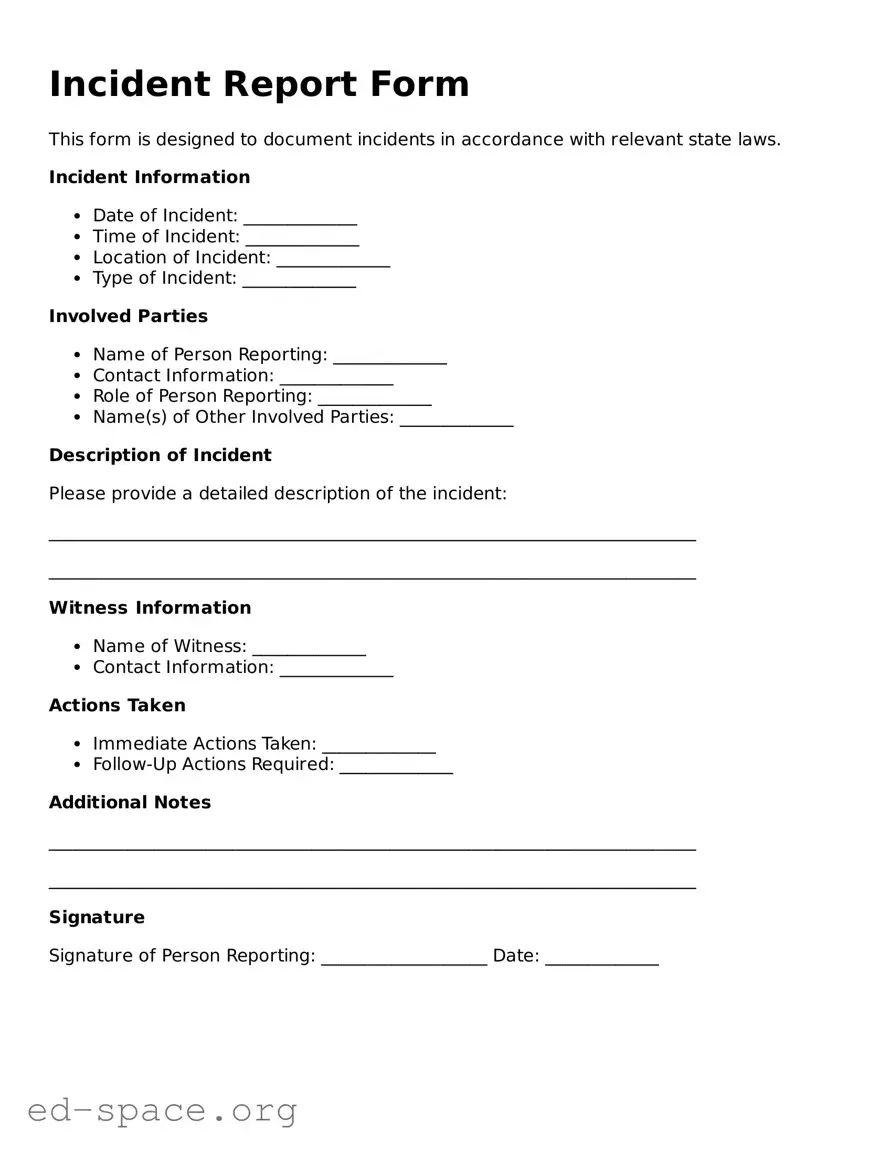
When unexpected events occur, having a clear and concise way to document them becomes essential. The Incident Report Form serves as a crucial tool for individuals and organizations alike, allowing them to capture vital information surrounding an incident. This form typically includes sections for detailing the date, time, and location of the incident, as well as a description of what transpired. Additionally, it often provides space for the names and contact information of witnesses, which can be invaluable for any follow-up investigations. By systematically recording the facts, the form helps ensure that all relevant details are preserved, enabling a thorough review and assessment of the situation. Furthermore, it can assist in identifying trends or recurring issues, ultimately leading to improved safety protocols and preventive measures. Whether used in a workplace, educational setting, or community environment, the Incident Report Form plays a pivotal role in fostering accountability and transparency.
Incident Report Form
This form is designed to document incidents in accordance with relevant state laws.
Incident Information
Involved Parties
Description of Incident
Please provide a detailed description of the incident:
__________________________________________________________________________
__________________________________________________________________________
Witness Information
Actions Taken
Additional Notes
__________________________________________________________________________
__________________________________________________________________________
Signature
Signature of Person Reporting: ___________________ Date: _____________
| Fact Name | Description |
|---|---|
| Purpose | The Incident Report Form is used to document details of incidents, including accidents or injuries, for record-keeping and analysis. |
| Components | This form typically includes sections for date, time, location, individuals involved, and a description of the incident. |
| State-Specific Forms | Some states may have specific requirements for incident reporting forms based on local laws and regulations. |
| Governing Laws | In California, for example, the governing laws include the California Labor Code, which outlines employer responsibilities for workplace safety. |
| Submission | Completed forms should be submitted to the appropriate department or authority, as specified by organizational policies or state regulations. |
After you have gathered all the necessary information, you can start filling out the Incident Report Form. This form is crucial for documenting what happened and ensuring that the right steps are taken moving forward. Follow these steps to complete it accurately.
Once you have completed the form, submit it to the appropriate department or individual as instructed. This will ensure that the incident is properly recorded and addressed.
What is an Incident Report Form?
An Incident Report Form is a document used to record details about an event that has occurred, typically an accident or an unusual occurrence. It helps organizations track incidents, assess risks, and improve safety measures.
Why is it important to complete an Incident Report Form?
Completing this form is crucial for documenting what happened. It provides a clear record that can be used for investigations, insurance claims, or legal purposes. Additionally, it helps identify patterns that may need addressing to prevent future incidents.
Who should fill out the Incident Report Form?
Generally, the person who witnessed or was involved in the incident should complete the form. However, supervisors or managers may also fill it out to ensure all necessary information is captured accurately.
What information is typically required on the form?
The form usually requires details such as the date and time of the incident, location, individuals involved, a description of what happened, and any witnesses. Some forms may also ask for immediate actions taken and follow-up measures.
How soon should an Incident Report Form be completed?
It’s best to complete the form as soon as possible after the incident occurs. This helps ensure that memories are fresh and all relevant details are included. Many organizations have specific timelines for submission, so check your company's policy.
Can the form be filled out electronically?
Many organizations now offer electronic versions of the Incident Report Form. This can make it easier to submit, store, and retrieve the report. Check with your organization to see if an electronic option is available.
What happens to the Incident Report Form after it is submitted?
Once submitted, the form typically goes to a designated department, such as Human Resources or Safety. They will review the report, investigate if necessary, and take any required actions. The information may also be used for training or policy updates.
Is the information on the Incident Report Form confidential?
Generally, the information is treated as confidential and is only shared with those who need to know, such as management or safety personnel. However, it’s important to check your organization’s privacy policies for specific guidelines.
What if I make a mistake on the form?
If you notice a mistake after submitting the form, contact the appropriate department immediately. They can guide you on how to correct the information. It’s important that all details are accurate for proper documentation and follow-up.
Can I request a copy of the completed Incident Report Form?
Yes, you can typically request a copy of the completed form for your records. Contact the department that handles incident reports in your organization to find out the process for obtaining a copy.
Incomplete Information: One of the most common mistakes is not filling out all required fields. Leaving sections blank can delay the investigation process.
Vague Descriptions: Providing unclear or ambiguous details about the incident can lead to misunderstandings. It's essential to be as specific as possible.
Failure to Document Witnesses: Forgetting to include the names and contact information of witnesses can hinder the ability to gather more information later.
Not Reporting in a Timely Manner: Delaying the submission of the report can result in lost details and diminished accuracy. Timeliness is crucial.
Ignoring Company Policy: Not adhering to the specific guidelines set by the organization can result in an invalid report. Always check the company’s procedures.
Neglecting to Review: Failing to proofread the report before submission can lead to errors that could have been easily corrected. A quick review can make a big difference.
When dealing with incidents in various settings, several forms and documents can complement the Incident Report Form. These documents help ensure that all necessary information is collected and processed efficiently. Below is a list of commonly used forms that may accompany an Incident Report Form.
Using these additional documents alongside the Incident Report Form can significantly enhance the understanding and management of incidents. By ensuring that all relevant information is captured, organizations can respond more effectively and improve their safety protocols.
When filling out an Incident Report Form, it’s essential to approach the task with care. Here are ten important dos and don’ts to consider:
Understanding the Incident Report Form is essential for anyone involved in workplace safety or accident management. However, several misconceptions can cloud its purpose and use. Here are ten common misconceptions, along with clarifications to help you navigate this important document.
This is not true. Even minor incidents should be reported. Documenting all occurrences helps identify patterns and prevent future issues.
While injuries are a significant concern, the form can also be used for property damage, near misses, or any event that disrupts normal operations.
In many workplaces, reporting incidents is a requirement. It ensures compliance with safety regulations and promotes a culture of accountability.
While management does review these reports, they may also be analyzed by safety committees or used in training sessions to improve overall workplace safety.
This misconception can discourage reporting. The form is a tool for learning and improving safety, not for assigning blame.
In reality, incident reports are often tracked and analyzed to implement safety improvements. They play a vital role in preventing future incidents.
Typically, the person directly involved in the incident or a witness should complete the report to ensure accuracy and firsthand information.
In some cases, these reports may be required by external regulatory agencies, especially if they involve serious injuries or safety violations.
Most forms are designed to be straightforward and user-friendly. Guidance is often available to assist individuals in completing them accurately.
While many incidents do prompt further investigation, not all reports will lead to formal inquiries. The decision often depends on the severity and context of the incident.
By dispelling these misconceptions, individuals can better appreciate the importance of the Incident Report Form. Accurate reporting contributes to a safer work environment for everyone.
Filling out and using the Incident Report Form is an important process. Here are some key takeaways to keep in mind:
Using these tips can make the reporting process smoother and more effective.