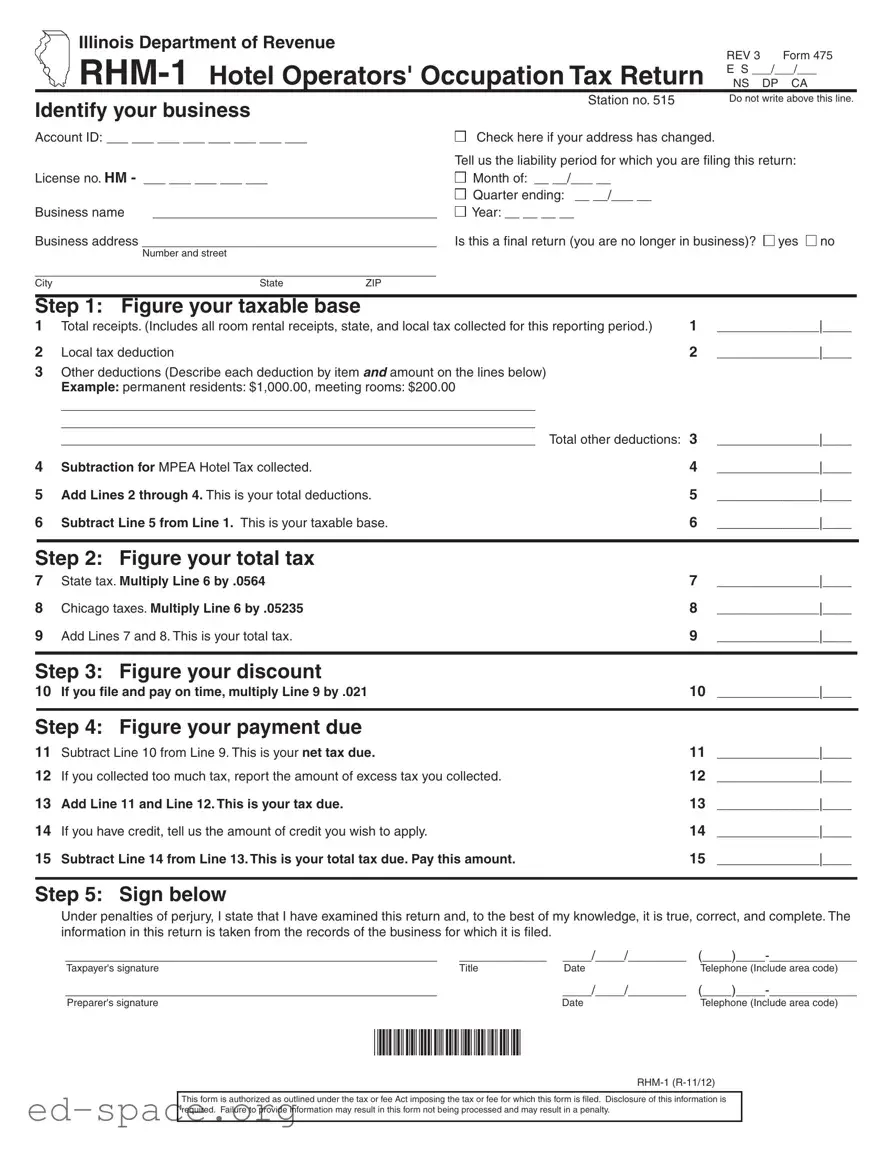
The Illinois RHM-1 form is a crucial document for hotel operators, facilitating the reporting and payment of the Hotel Operators' Occupation Tax. This tax applies to all room rental receipts collected during a specified liability period, which is clearly indicated on the form. Operators must accurately report their total receipts, including any state and local taxes collected. The form also allows for various deductions, such as local tax deductions and other specific exemptions that can be itemized. After calculating the taxable base, the form guides users through determining the total tax owed by applying the appropriate state and local tax rates. Additionally, it includes a provision for a timely filing discount, which can reduce the overall tax liability. Finally, the RHM-1 requires the signature of the taxpayer and preparer, affirming the accuracy of the information provided. This form not only helps ensure compliance with state tax laws but also plays a vital role in the financial management of hotel operations in Illinois.

Illinois Department of Revenue
|
REV 3 |
Form 475 |
||||
|
E S ___/___/___ |
|||||
|
NS |
DP CA |
||||
Identify your business |
|
Station no. 515 |
|
Do not write above this line. |
||
|
|
|
|
|
||
Account ID: ___ ___ ___ ___ ___ ___ ___ ___ |
|
Check here if your address has changed. |
|
|
||
|
|
|
Tell us the liability period for which you are filing this return: |
|||
License no. HM - ___ ___ ___ ___ ___ |
|
Month of: __ __/___ __ |
|
|
|
|
|
|
|
Quarter ending: __ __/___ __ |
|
|
|
Business name _______________________________________ |
Year: __ __ __ __ |
|
|
|
||
Business address ________________________________________ |
Is this a final return (you are no longer in business)? |
yes no |
||||
|
Number and street |
|
|
|
|
|
_______________________________________________________ |
|
|
|
|
||
City |
State |
ZIP |
|
|
|
|
|
|
|
|
|
|
|
Step 1: Figure your taxable base |
|
|
|
|
|
|
1 Total receipts. (Includes all room rental receipts, state, and local tax collected for this reporting period.) |
1 |
______________|____ |
||||
2 |
Local tax deduction |
|
|
2 |
______________|____ |
|
3Other deductions (Describe each deduction by item AND amount on the lines below) Example: permanent residents: $1,000.00, meeting rooms: $200.00
_________________________________________________________________
_________________________________________________________________
|
_________________________________________________________________ |
Total other deductions: 3 |
______________|____ |
4 |
Subtraction for MPEA Hotel Tax collected. |
4 |
______________|____ |
5 |
Add Lines 2 through 4. This is your total deductions. |
5 |
______________|____ |
6 |
Subtract Line 5 from Line 1. This is your taxable base. |
6 |
______________|____ |
Step 2: Figure your total tax
7 |
State tax. Multiply Line 6 by .0564 |
7 |
______________|____ |
8 |
Chicago taxes. Multiply Line 6 by .05235 |
8 |
______________|____ |
9 |
Add Lines 7 and 8. This is your total tax. |
9 |
______________|____ |
|
|
|
|
Step 3: Figure your discount
10 If you file and pay on time, multiply Line 9 by .021 |
10 ______________|____ |
Step 4: Figure your payment due
11 |
Subtract Line 10 from Line 9. This is your net tax due. |
11 |
______________|____ |
12 |
If you collected too much tax, report the amount of excess tax you collected. |
12 |
______________|____ |
13 |
Add Line 11 and Line 12. This is your tax due. |
13 |
______________|____ |
14 |
If you have credit, tell us the amount of credit you wish to apply. |
14 |
______________|____ |
15 |
Subtract Line 14 from Line 13. This is your total tax due. Pay this amount. |
15 |
______________|____ |
Step 5: Sign below
Under penalties of perjury, I state that I have examined this return and, to the best of my knowledge, it is true, correct, and complete. The information in this return is taken from the records of the business for which it is filed.
___________________________________________________ |
____________ ____/____/________ |
||
Taxpayer's signature |
Title |
Date |
Telephone (Include area code) |
___________________________________________________ |
|
____/____/________ |
|
Preparer's signature |
|
Date |
Telephone (Include area code) |
*247501110*
This form is authorized as outlined under the tax or fee Act imposing the tax or fee for which this form is filed. Disclosure of this information is required. Failure to provide information may result in this form not being processed and may result in a penalty.
| Fact Name | Description |
|---|---|
| Purpose | The RHM-1 form is used by hotel operators in Illinois to report their Hotel Operators' Occupation Tax. |
| Filing Frequency | Hotel operators must file the RHM-1 form either monthly or quarterly, depending on their tax liability. |
| Governing Law | This form is governed by the Illinois Compiled Statutes, specifically under the Hotel Operators' Occupation Tax Act (35 ILCS 145). |
| Penalties | Failure to provide accurate information may lead to penalties and the form not being processed. |
Filling out the Illinois RHM-1 form is an important step for hotel operators to report their occupancy tax. Once you have completed the form, you will need to submit it to the Illinois Department of Revenue by the due date specified for your reporting period. Make sure to keep a copy for your records.
What is the Illinois RHM-1 form?
The Illinois RHM-1 form is the Hotel Operators' Occupation Tax Return. It is used by hotel operators to report and pay the tax on room rental receipts collected during a specific liability period. This form must be filed with the Illinois Department of Revenue.
Who needs to file the RHM-1 form?
Any business that operates a hotel, motel, or similar establishment in Illinois and collects room rental receipts is required to file the RHM-1 form. This includes both permanent and transient stays.
What information is required to complete the RHM-1 form?
You will need to provide your business name, address, account ID, and license number. Additionally, you must report total receipts, local tax deductions, other deductions, and the tax collected for the liability period you are filing for.
When is the RHM-1 form due?
The RHM-1 form is typically due on a quarterly basis, depending on your business's reporting period. It is important to check the specific due dates for your liability period to avoid penalties.
What happens if I do not file the RHM-1 form on time?
If you fail to file the RHM-1 form by the due date, you may incur penalties and interest on any taxes owed. It is crucial to file on time to avoid these additional charges.
Can I amend my RHM-1 form after submission?
Yes, if you discover an error after submitting your RHM-1 form, you can file an amended return. Ensure that you provide the correct information and explain the changes made.
Where can I find more information about the RHM-1 form?
For more details, you can visit the Illinois Department of Revenue's website. They provide resources, instructions, and contact information for any questions related to the RHM-1 form.
Not providing a complete business name. Ensure you fill in the full name of your business. Incomplete names can lead to processing delays.
Forgetting to check the box if your address has changed. This step is crucial to keep your records updated and avoid future issues.
Incorrectly calculating total receipts. Make sure to include all room rental receipts and any state or local tax collected during the reporting period.
Neglecting to describe deductions properly. Each deduction must be clearly stated with both item and amount. This helps in verifying your claims.
Failing to sign the form. Both the taxpayer and the preparer must provide their signatures. Without these, the return cannot be processed.
Missing out on the discount for timely filing. If you file and pay on time, remember to calculate the discount and subtract it from your total tax.
Not reporting excess tax collected. If you collected more tax than necessary, you must report that amount. This is important for accurate tax reporting.
The Illinois RHM-1 form is essential for hotel operators to report their occupation tax. Along with this form, several other documents are often required or useful in the process of filing taxes. Below is a list of related forms and documents that may accompany the RHM-1.
These documents play a significant role in ensuring compliance with tax regulations and maintaining accurate financial records. It is advisable for hotel operators to keep these forms organized and readily accessible when filing the RHM-1 and related tax documents.
The Illinois RHM-1 form, which is used for reporting the Hotel Operators' Occupation Tax, shares similarities with several other tax-related documents. Each of these forms serves a specific purpose in the realm of taxation and compliance, often addressing different types of businesses or tax situations. Below is a list of seven documents that are similar to the Illinois RHM-1 form, along with a brief explanation of how they are alike.
When filling out the Illinois RHM-1 form, it is essential to follow certain guidelines to ensure accuracy and compliance. Below is a list of things you should and shouldn’t do during this process.
Understanding the Illinois RHM-1 form can be challenging. Here are ten common misconceptions about this form, clarified for better comprehension.
Being informed about these misconceptions can help ensure accurate and timely filing of the Illinois RHM-1 form.
Filling out the Illinois RHM-1 form can seem daunting, but understanding its key components can simplify the process. Here are some important takeaways:
By keeping these points in mind, you can navigate the RHM-1 form with greater confidence and accuracy.