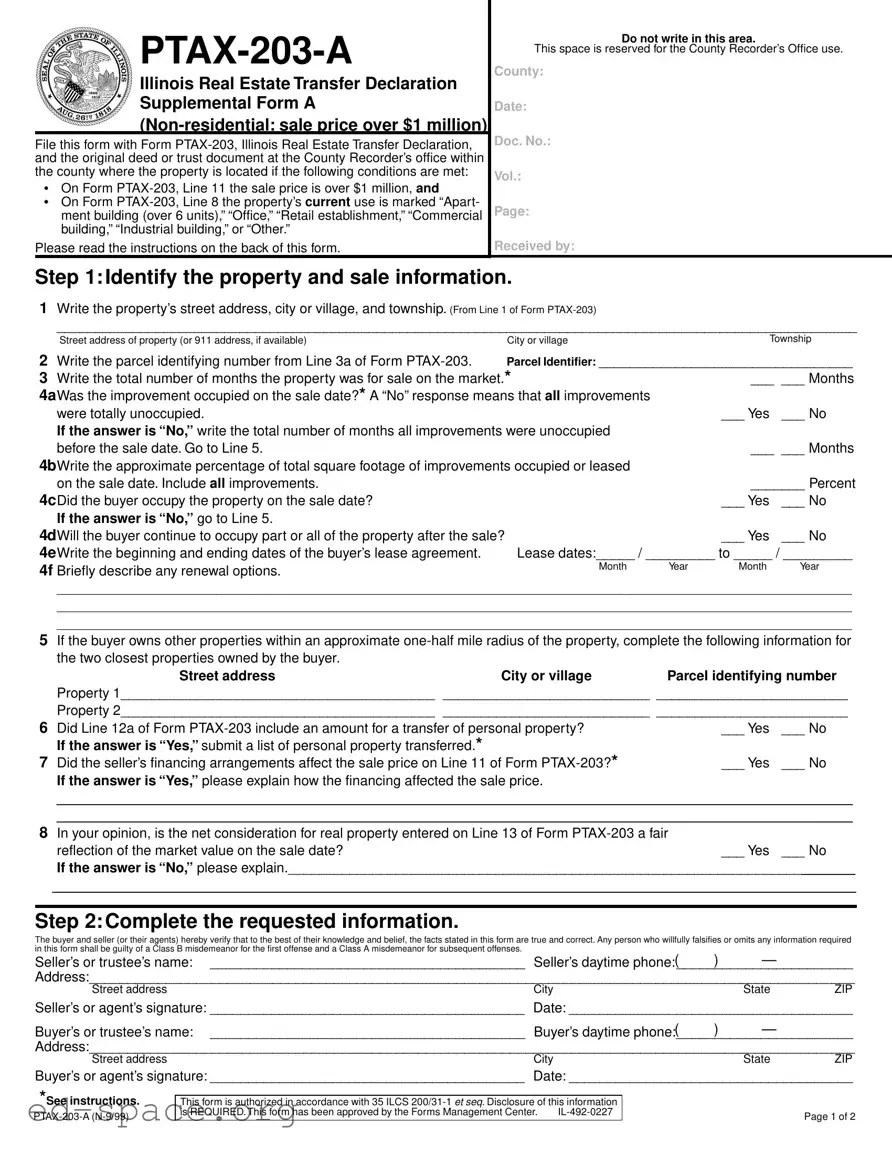
The Illinois PTAX-203 A form is an essential document for anyone involved in non-residential real estate transactions where the sale price exceeds $1 million. This supplemental form accompanies the PTAX-203, the Illinois Real Estate Transfer Declaration, and must be filed at the County Recorder’s office along with the original deed or trust document. To complete this form, specific criteria must be met, including marking the property’s current use as an apartment building (over 6 units), office, retail establishment, commercial building, industrial building, or other designated types. The form requires detailed information about the property, such as its address, parcel identification number, and the duration it was on the market. Additionally, it asks about occupancy status at the time of sale and whether the buyer will continue to occupy the property. Other important sections include inquiries about personal property transfers, financing arrangements, and an assessment of whether the sale price reflects fair market value. Completing the PTAX-203 A accurately is crucial, as it helps ensure compliance with state regulations and provides transparency in real estate transactions.

Illinois Real Estate Transfer Declaration Supplemental Form A
File this form with Form
•On Form
•On Form
Please read the instructions on the back of this form.
Do not write in this area.
This space is reserved for the County Recorder’s Office use.
County:
Date:
Doc. No.:
Vol.:
Page:
Received by:
Step 1: Identify the property and sale information.
1Write the property’s street address, city or village, and township. (From Line 1 of Form
_________________________________________________________________________________________________________
|
Street address of property (or 911 address, if available) |
City or village |
|
|
Township |
2 |
Write the parcel identifying number from Line 3a of Form |
Parcel Identifier: _________________________________ |
|||
3 |
Write the total number of months the property was for sale on the market.* |
|
___ ___ Months |
||
4aWas the improvement occupied on the sale date?* A “No” response means that all improvements |
|
|
|
||
|
were totally unoccupied. |
|
|
___ Yes |
___ No |
|
If the answer is “No,” write the total number of months all improvements were unoccupied |
|
|
|
|
|
before the sale date. Go to Line 5. |
|
|
___ ___ Months |
|
4bWrite the approximate percentage of total square footage of improvements occupied or leased |
|
|
|
||
|
on the sale date. Include all improvements. |
|
|
_______ Percent |
|
4cDid the buyer occupy the property on the sale date? |
|
|
___ Yes |
___ No |
|
|
If the answer is “No,” go to Line 5. |
|
|
|
|
4dWill the buyer continue to occupy part or all of the property after the sale? |
|
|
___ Yes |
___ No |
|
4eWrite the beginning and ending dates of the buyer’s lease agreement. |
Lease dates:_____ / _________ to _____ / _________ |
||||
4f |
Briefly describe any renewal options. |
Month |
Year |
Month |
Year |
|
|
|
|
||
____________________________________________________________________________________________________________________________
____________________________________________________________________________________________________________________________
____________________________________________________________________________________________________________________________
5If the buyer owns other properties within an approximate
|
Street address |
City or village |
Parcel identifying number |
|
|
Property 1_________________________________________ ___________________________ _________________________ |
|||
|
Property 2_________________________________________ ___________________________ _________________________ |
|||
6 |
Did Line 12a of Form |
___ Yes |
___ No |
|
|
If the answer is “Yes,” submit a list of personal property transferred.* |
|
|
|
7 |
Did the seller’s financing arrangements affect the sale price on Line 11 of Form |
___ Yes |
___ No |
|
|
If the answer is “Yes,” please explain how the financing affected the sale price. |
|
|
|
________________________________________________________________________________________________________
________________________________________________________________________________________________________
8In your opinion, is the net consideration for real property entered on Line 13 of Form
reflection of the market value on the sale date?___ Yes ___ No
If the answer is “No,” please explain.__________________________________________________________________________
_________________________________________________________________________________________________________
Step 2: Complete the requested information.
The buyer and seller (or their agents) hereby verify that to the best of their knowledge and belief, the facts stated in this form are true and correct. Any person who willfully falsifies or omits any information required in this form shall be guilty of a Class B misdemeanor for the first offense and a Class A misdemeanor for subsequent offenses.
Seller’s or trustee’s name: |
_________________________________________ |
Seller’s daytime phone:( |
) |
— |
|
Address:____________________________________________________________________________________________________ |
|||||
Street address |
|
City |
|
State |
ZIP |
Seller’s or agent’s signature: _________________________________________ |
Date: _____________________________________ |
||||
Buyer’s or trustee’s name: |
_________________________________________ |
Buyer’s daytime phone:( |
) |
— |
|
Address:____________________________________________________________________________________________________ |
|||||
Street address |
|
City |
|
State |
ZIP |
Buyer’s or agent’s signature: _________________________________________ |
Date: _____________________________________ |
||||
*See instructions.
This form is authorized in accordance with 35 ILCS
is REQUIRED. This form has been approved by the Forms Management Center. |
Page 1 of 2

Instructions for Completing Form
Step 1: Identify the property and sale information.
Line 3
Write the total number of months that the property was advertised for sale by a real estate agent, newspaper, trade publication, radio/electronic media, or a sign. If the property has been advertised for sale for more than 99 months, enter “99.”
Lines 4a through 4f
Line 4a — Answer “Yes” or “No” (indicate with an “X”) depending on whether or not the improvement (i.e., structure) was occupied on the sale date. If the property has more than one improvement, answer “No” only if all the improvements were totally unoccupied on the sale date.
If the answer to Line 4a is “No,” write the total number of months that all improvements were totally unoccupied before the sale date and go to Line 5. If the property has been unoccupied for more than 99 months, enter “99.” If the answer to Line 4a is “Yes,” go to Lines 4b and 4c.
Line 4b — Write the approximate percentage of the total square footage of all the improvements that was occupied or leased on the sale date. This applies to the improvements only, not the land.
Line 4c — Answer “Yes” or “No” (indicate with an “X”) depending on whether or not the buyer was a current occupant of the property at the time of the sale. If the answer is “No,” go to Line 5. If the answer is “Yes,” go to Line 4d.
Line 4d — Answer “Yes” or “No” (indicate with an “X”) depending on whether or not the buyer will continue to occupy part or all of the property after the sale. If the answer is “No,” go to Line 5. If the answer is “Yes,” go to Line 4e.
Line 4e — Write the beginning and ending dates of the buyer’s lease agreement, if applicable.
Line 4f — Briefly describe in the space provided any options to renew the lease agreement between the seller and the buyer.
Example:
Line 5
If the buyer owns other properties within an approximate
Line 6
Answer “Yes” or “No” (indicate with an “X”) depending on whether or not Line 12a of Form
Line 7
Answer “Yes” or “No” (indicate with an “X”) depending on whether or not the amount on Line 11 of the Form
If the answer is “Yes,” please explain, in the space provided, how the financing affected the sale price.
Line 8
Answer “Yes” or “No” (indicate with an “X”) depending on whether or not, in your opinion, the net consideration for real property entered on Line 13 of the Form
Step 2: Complete the requested information.
Write the requested information for the seller and the buyer. Write the addresses and daytime phone numbers where the seller and buyer can be contacted after the sale. The seller and the buyer (or their agents) must sign this form. By signing the form, the parties involved in the real estate transfer verify that
•they have examined the completed Form
•the information provided on this form is true and correct; and
•they are aware of the criminal penalties of law (printed in the instructions for Form
Page 2 of 2 |
| Fact Name | Details |
|---|---|
| Form Purpose | The PTAX-203-A is a supplemental form for the Illinois Real Estate Transfer Declaration, specifically for non-residential properties sold for over $1 million. |
| Filing Requirement | This form must be filed with Form PTAX-203 and the original deed or trust document at the County Recorder’s office in the county where the property is located. |
| Conditions for Use | The form is required when the sale price exceeds $1 million and the property’s current use is marked as specific commercial types, such as “Office” or “Retail establishment.” |
| Governing Law | This form is authorized under 35 ILCS 200/31-1 et seq., which outlines the regulations for real estate transfers in Illinois. |
| Occupancy Information | The form requires details about the occupancy status of the property on the sale date, including whether the buyer will occupy the property post-sale. |
| Penalties for Falsification | Any person who willfully falsifies or omits information on this form may face criminal charges, including misdemeanors for first and subsequent offenses. |
Filling out the Illinois PTAX-203 A form is a crucial step in the real estate transaction process for non-residential properties sold for over $1 million. This form must be submitted alongside the PTAX-203 and the original deed at the County Recorder’s office. To ensure accuracy and compliance, follow the steps outlined below carefully.
What is the purpose of the Illinois PTAX-203 A form?
The Illinois PTAX-203 A form is a supplemental declaration that accompanies the PTAX-203 form, specifically for non-residential property sales where the sale price exceeds $1 million. This form is essential for reporting details about the transaction to the County Recorder’s office. It helps ensure that accurate information is recorded about the property, including its use, sale price, and occupancy status at the time of sale.
When do I need to file the PTAX-203 A form?
You must file the PTAX-203 A form if the sale price of the property exceeds $1 million and the property is classified as an apartment building (over 6 units), office, retail establishment, commercial building, industrial building, or other specified uses. This form should be submitted alongside the PTAX-203 form and the original deed or trust document at the County Recorder’s office within the county where the property is located.
What information do I need to provide on the PTAX-203 A form?
When completing the PTAX-203 A form, you will need to provide details about the property, such as its street address, parcel identifying number, and the total number of months it was on the market. Additionally, you must indicate whether the property was occupied on the sale date and provide information about the buyer's occupancy status and lease agreement if applicable. You will also need to disclose any personal property included in the sale and whether seller financing affected the sale price.
What are the consequences of providing false information on the PTAX-203 A form?
Providing false information or omitting required details on the PTAX-203 A form can lead to serious consequences. If someone willfully falsifies information, they may be charged with a Class B misdemeanor for the first offense and a Class A misdemeanor for any subsequent offenses. It is crucial to ensure that all information is accurate and truthful to avoid legal repercussions.
How can I ensure that my PTAX-203 A form is completed correctly?
To complete the PTAX-203 A form accurately, carefully read the instructions provided on the form. Make sure to gather all necessary information before you start filling it out, including details about the property, sale, and any related agreements. If you have questions or need assistance, consider consulting with a real estate professional or legal expert who can guide you through the process. Double-checking your entries can also help prevent mistakes.
Incomplete Property Information: Failing to provide the full street address, city or village, and township can lead to processing delays. Each of these details is crucial for accurate identification of the property.
Incorrect Parcel Identifier: Entering the wrong parcel identifying number from Form PTAX-203 can result in mismatched records. This mistake can complicate the transaction and may require resubmission.
Misreporting Sale Duration: Inaccurately stating the number of months the property was on the market can affect the assessment of its value. If the property was listed for over 99 months, it is essential to enter “99” to comply with the form’s requirements.
Omitting Buyer Occupancy Details: Not answering the questions regarding whether the buyer occupied the property on the sale date can lead to confusion. This information is vital for understanding the property's usage and valuation.
Failure to Disclose Personal Property: If personal property was included in the sale, neglecting to indicate this on Line 12a can result in penalties. An itemized list of personal property must be submitted if applicable.
The Illinois PTAX-203 A form is an essential document for real estate transactions involving non-residential properties with a sale price over $1 million. Along with this form, several other documents are commonly used to ensure compliance with state regulations and to provide necessary information to the County Recorder’s office. Below is a list of related forms and documents that may be required.
When preparing for a real estate transaction in Illinois, it is crucial to gather these documents to ensure a smooth process. Each document plays a specific role in providing clarity and legal compliance throughout the transaction. Proper preparation can help avoid delays and complications during the closing process.
The Illinois PTAX-203 A form shares similarities with several other documents commonly used in real estate transactions. Each of these documents serves a specific purpose related to property transfer and valuation. Below is a list of eight documents that are comparable to the PTAX-203 A form, detailing their similarities:
When filling out the Illinois PTAX-203 A form, it is essential to approach the process with care. Here are five important things to do and avoid to ensure accuracy and compliance.
By following these guidelines, you can help ensure that your submission is complete and accurate, facilitating a smoother process for your real estate transaction.
Understanding the Illinois PTAX-203 A form is essential for anyone involved in real estate transactions over $1 million. However, several misconceptions exist regarding this form. Below is a list of common misunderstandings:
This form is specifically designed for non-residential properties with a sale price over $1 million.
It is mandatory to file this form along with the original deed or trust document at the County Recorder’s office.
Both the buyer and seller, or their agents, must verify and sign the form, ensuring all information is accurate.
Filing this form is required when the sale price exceeds $1 million and the property falls under specific categories.
Occupancy details, including whether the property was occupied on the sale date, must be provided.
The buyer's occupancy status is relevant, but it does not exempt the requirement to file the form.
If personal property is included in the sale, an itemized list must be submitted with the form.
Falsifying or omitting information on this form can lead to criminal charges, including misdemeanors.
This form must be filed alongside Form PTAX-203 and the original deed or trust document.
Being aware of these misconceptions can help ensure compliance with the requirements associated with the Illinois PTAX-203 A form. Proper understanding and accurate completion of the form are crucial in facilitating smooth real estate transactions.
When filling out and using the Illinois PTAX 203 A form, it is essential to keep several key points in mind:
Following these guidelines will help ensure a smooth process when filing the PTAX 203 A form.