In the state of Illinois, understanding the process of reporting a motor vehicle crash is essential for all drivers involved in such incidents. The Illinois Motorist Report form plays a crucial role in this process, especially when a police officer is not present to document the accident. According to Illinois law, drivers must report any accident that results in injury, death, or property damage exceeding specified amounts. This report must be submitted to the Illinois Department of Transportation (IDOT) within ten days of the incident. The Motorist Report form is designed to capture vital information about the crash, including details about injuries, vehicle damage, and other relevant circumstances. It is important for drivers to complete this form accurately and legibly, using black ink to ensure clarity. The form includes sections for estimating repair costs and describing damages to property beyond the vehicles involved. Additionally, it requires drivers to provide proof of insurance, as failing to do so may lead to assumptions about their coverage status. Completing the form thoroughly and submitting it promptly can help facilitate the necessary follow-up and ensure compliance with state regulations. For those who may not have received a form at the scene, instructions are provided on how to obtain a blank report from IDOT. By following these guidelines, drivers can navigate the reporting process with greater ease and confidence.
Motorist Crash Reporting Instructions
When should a crash be reported?
Illinois law: “The driver of a vehicle that is in any manner involved in an accident within this State, resulting in injury to or death of any person, or in which damage to the property of any one person, including himself, in excess of $1,500 (or $500 if any of the vehicles involved in the accident is subject to Section
The Administrator is the Illinois Department of Transportation (IDOT), Division of Traffic Safety. (625 ILCS
Where should a crash be reported?
If a police officer does not arrive at the scene of the crash to investigate, the involved driver(s) shall “give notice of the accident by the fastest available means of communication to the local police department if such accident occurs within a municipality or otherwise to the nearest office of the county sheriff or nearest headquarters of the Illinois State Police.” (625 ILCS
How should a crash be reported?
Two forms are used to report crashes occurring in Illinois: the blue and white Illinois Traffic Crash Report form (Police Report) and the red and white Illinois Motorist Report form (Motorist Report). The forms start out as a
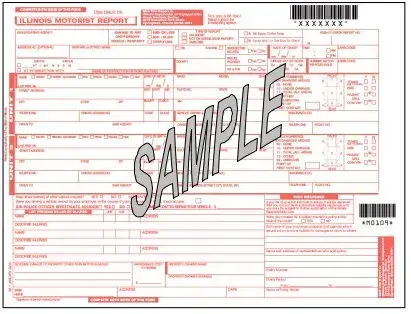
Motorist Report form
How should the Motorist Report be completed?
Using black ink, print legibly and complete all required fields as accurately and completely as possible. If unable to answer any question, mark “NK” for “not known.”
All fields related to motorist proof of insurance must be completed. Failure to provide insurance information will result in the assumption that the motorist does not have automobile liability insurance and may be subject to further application of the Safety Responsibility Law.
Provide clear and complete information about the following:
(1)The nature and extent of all injuries to persons in your vehicle. If a doctor’s statement of injury is immediately available, describe the injuries.
(2)Estimate of repair costs for your vehicle.
If you have an estimate from a body shop or garage, provide that cost. Otherwise, give your own careful estimate.
(3)Damage to property other than vehicles.
Describe the damage and give an estimate of the cost.

Use a second report form or a sheet of paper the same size to report additional vehicles, injured persons, witnesses, or any other information for which there is not sufficient space. Be sure to complete the diagram and narrative on the back of the form and detail all events that occurred.
Providing false information is a class C misdemeanor and can result in a $500 fine and a
Sign the report in the space provided in the lower left corner on the front of the report. Once all fields are completed on the front and back, make a copy of the report to keep for your personal records. Mail the original to:
Illinois Department of Transportation
Crash Records Section
1340 North 9th Street
Springfield, Illinois
If a form was not provided by the investigating agency, or if the form was lost, please contact the investigating agency and obtain the bar code number on the original Police Report. Then call IDOT at (217)
Illinois law does not allow IDOT to provide copies of crash reports or divulge any personal information related to a crash. The law also stipulates that investigating agencies MAY furnish copies of reports to anyone at a fee not to exceed $5 per copy.
If you have questions or comments regarding crash reporting, please call
(217)
| Fact Name | Details |
|---|---|
| Reporting Requirement | Drivers must report a crash resulting in injury, death, or property damage exceeding $1,500 (or $500 if uninsured) within 10 days. |
| Governing Law | Illinois law mandates this under 625 ILCS 5/11-406, which outlines the duty to report an accident. |
| Notification Process | If no police officer is present, drivers must notify local police or the nearest sheriff's office immediately. |
| Forms Used | Crashes are reported using two forms: the Illinois Traffic Crash Report (Police Report) and the Illinois Motorist Report (Motorist Report). |
| Completion Guidelines | Motorists should use black ink, print legibly, and complete all required fields accurately. Mark "NK" for unknown information. |
| Submission Instructions | After completing the Motorist Report, mail the original to IDOT within 10 days, keeping a copy for personal records. |
After a motor vehicle accident in Illinois, it is crucial to complete the Illinois Motorist Report form accurately and submit it promptly. This report must be sent to the Illinois Department of Transportation within ten days of the incident. Following these steps will help ensure that you provide all necessary information in a clear and organized manner.
What is the Illinois Motorist Report form?
The Illinois Motorist Report form is a document that drivers involved in a crash must complete and submit to the Illinois Department of Transportation (IDOT). It is required when an accident results in injury, death, or property damage exceeding certain monetary thresholds. This form helps ensure that all relevant information about the crash is officially recorded.
When should a crash be reported?
According to Illinois law, a crash must be reported as soon as possible, but no later than 10 days after the accident. This applies if the accident results in injury or death or if property damage exceeds $1,500 (or $500 for uninsured vehicles). Failing to report within this timeframe can lead to legal consequences.
Where should a crash be reported?
If a police officer does not arrive at the scene, the involved driver(s) must notify the local police department or, if outside a municipality, the nearest county sheriff or Illinois State Police headquarters. Prompt notification helps ensure that the accident is officially recorded and investigated.
How do I complete the Motorist Report form?
To complete the Motorist Report form, use black ink and print legibly. Fill in all required fields accurately. If you cannot answer a question, mark it as “not known.” Make sure to include your proof of insurance information. Incomplete insurance details may lead to assumptions of lacking coverage, invoking the Safety Responsibility Law.
What information is required on the Motorist Report?
Key information includes details about injuries sustained by passengers in your vehicle, estimates of repair costs for your vehicle, and damage to property other than vehicles. If additional space is needed, use a second report form or a separate sheet of paper. Ensure to complete the diagram and narrative sections to provide a comprehensive account of the events.
What happens if I provide false information on the report?
Providing false information on the Motorist Report is considered a class C misdemeanor. This can result in a fine of up to $500 and a possible 30-day jail sentence. It is crucial to be truthful and accurate when filling out the form.
How do I submit the Motorist Report?
After completing the form, make a copy for your records. Mail the original report to the Illinois Department of Transportation, Crash Records Section, at 1340 North 9th Street, Springfield, Illinois 62766-0001. Ensure that it is sent within the 10-day reporting window to comply with state law.
What if I did not receive a form from the police?
If you did not receive a Motorist Report form from the investigating agency or if it was lost, contact the agency to obtain the bar code number from the original Police Report. Then, call IDOT at (217) 782-2575 to request a blank Motorist Report form. Enter the bar code number in the upper right corner of the new form before completing it.
Can I obtain a copy of the crash report from IDOT?
Illinois law prohibits IDOT from providing copies of crash reports or sharing personal information related to a crash. However, the investigating agency may provide copies of reports for a fee not exceeding $5. Contact them directly for access to this information.
Who can I contact for questions about crash reporting?
If you have questions or comments regarding crash reporting, you can reach IDOT by calling (217) 782-2575 or emailing [email protected]. They can provide guidance and address any concerns you may have about the reporting process.
Incomplete Information: One of the most common mistakes is failing to fill out all required fields on the Motorist Report form. Each section is important, and leaving any part blank can lead to delays or complications in processing your report.
Missing Insurance Details: Many people overlook the insurance information section. This is crucial. If you do not provide your insurance details, authorities may assume you do not have coverage, which can have serious legal implications.
Vague Descriptions: When describing injuries or damages, being vague can create problems. Provide clear and specific details. For instance, instead of saying "the car was damaged," specify the type of damage, such as "the rear bumper was crushed." This clarity helps in processing your report accurately.
Neglecting the Diagram and Narrative: Failing to complete the diagram and narrative section on the back of the form is another frequent error. This part is essential for illustrating the events of the crash. A detailed account helps authorities understand the situation better and can be critical in resolving disputes.
The Illinois Motorist Report form is an essential document for drivers involved in accidents. However, there are other forms and documents that are often used alongside it to ensure proper reporting and compliance with state laws. Below is a list of these documents, each serving a specific purpose in the accident reporting process.
Using these forms and documents alongside the Illinois Motorist Report helps ensure a comprehensive and accurate account of the accident. Proper documentation can facilitate communication with insurance companies and legal entities, ultimately aiding in the resolution of claims and any potential disputes.
When filling out the Illinois Motorist Report form, there are important guidelines to follow. Here’s a list of things you should and shouldn’t do:
Understanding the Illinois Motorist Report form is essential for anyone involved in a vehicle accident. However, several misconceptions often arise. Here are eight common misunderstandings, along with clarifications to help you navigate the process more effectively.
Being informed about these misconceptions can help ensure that you handle the reporting process correctly and avoid potential legal issues. Always take the time to understand your responsibilities following an accident.
Key Takeaways for Filling Out and Using the Illinois Motorist Report Form