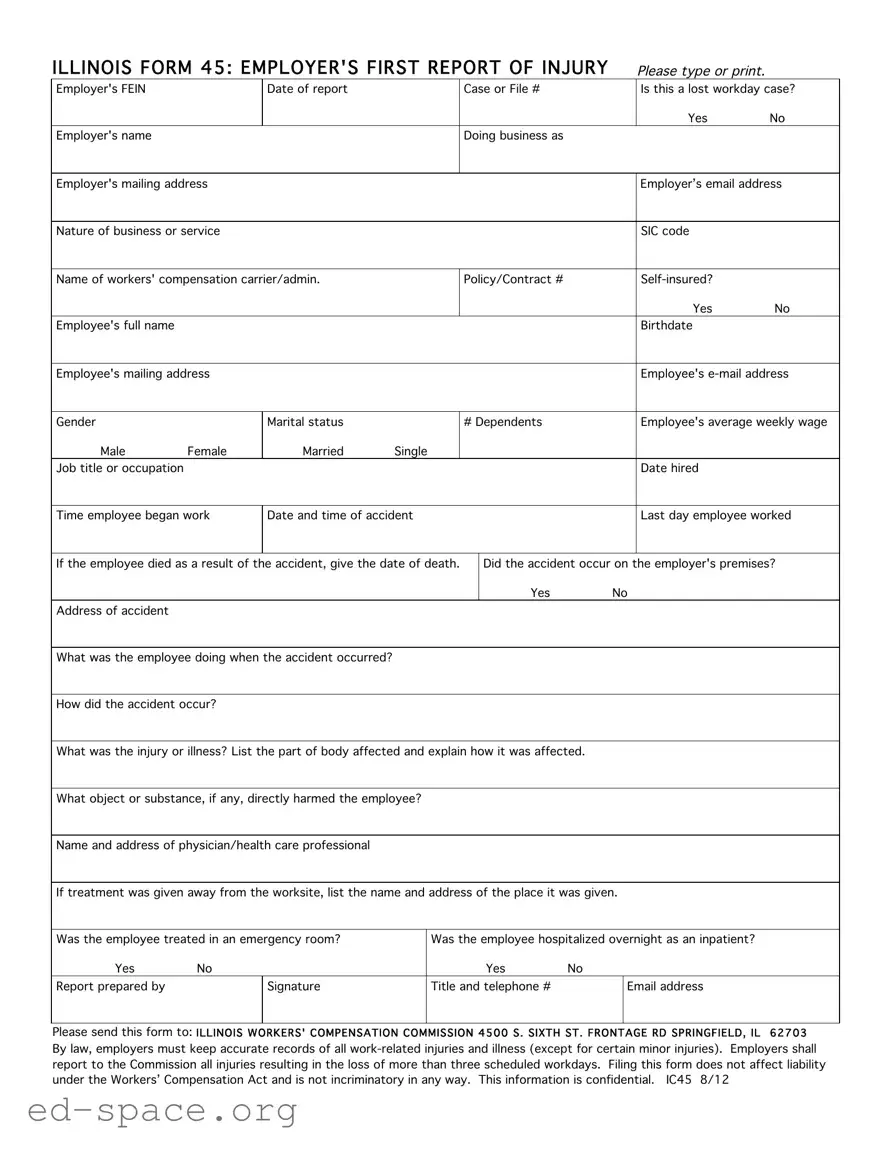
The Illinois First Report 45 form is a crucial document for employers managing workplace injuries. It serves as the official notification to the Illinois Workers' Compensation Commission when an employee sustains a work-related injury or illness. This form collects essential information, including the employer's details, the employee's personal information, and specifics about the incident. Key elements include the date and time of the accident, the nature of the employee's injury, and any medical treatment received. Employers must indicate whether the incident resulted in lost workdays, which is significant for compliance with state regulations. The form also requires details about the employee's average weekly wage and their job title, ensuring that all relevant aspects are captured. Completing and submitting this form is not just a legal requirement; it also plays a vital role in protecting both the employer and the employee under the Workers’ Compensation Act. Confidentiality is maintained throughout the process, emphasizing the importance of accurate reporting while safeguarding sensitive information.

ILLINOIS FORM 45: EMPLOYER'S FIRST REPORT OF INJURY |
|
|
Please type or print. |
|
|||||||||
Employer's FEIN |
|
Date of report |
|
|
|
|
Case or File # |
|
|
|
Is this a lost workday case? |
||
|
|
|
|
|
|
|
|
|
|
|
|
Yes |
No |
Employer's name |
|
|
|
|
|
|
Doing business as |
|
|
|
|
|
|
|
|
|
|
|
|
|
|
|
|
|
|
||
Employer's mailing address |
|
|
|
|
|
|
|
|
|
|
Employer’s email address |
||
|
|
|
|
|
|
|
|
|
|
|
|
|
|
Nature of business or service |
|
|
|
|
|
|
|
|
|
|
SIC code |
|
|
|
|
|
|
|
|
|
|
|
|
|
|
||
Name of workers' compensation carrier/admin. |
|
|
|
|
Policy/Contract # |
|
|
|
|
||||
|
|
|
|
|
|
|
|
|
|
|
|
Yes |
No |
Employee's full name |
|
|
|
|
|
|
|
|
|
|
|
Birthdate |
|
|
|
|
|
|
|
|
|
|
|
|
|
||
Employee's mailing address |
|
|
|
|
|
|
|
|
|
|
Employee's |
||
|
|
|
|
|
|
|
|
|
|
|
|
|
|
Gender |
|
Marital status |
|
|
|
|
# Dependents |
|
|
|
Employee's average weekly wage |
||
Male |
Female |
Married |
Single |
|
|
|
|
|
|
|
|
|
|
Job title or occupation |
|
|
|
|
|
|
|
|
|
|
|
Date hired |
|
|
|
|
|
|
|
|
|
|
|
|
|||
Time employee began work |
Date and time of accident |
|
|
|
|
|
|
|
Last day employee worked |
||||
|
|
|
|
|
|
|
|||||||
If the employee died as a result of the accident, give the date of death. |
|
Did the accident occur on the employer's premises? |
|||||||||||
|
|
|
|
|
|
|
|
Yes |
|
No |
|
||
Address of accident |
|
|
|
|
|
|
|
|
|
|
|
|
|
|
|
|
|
|
|
|
|
|
|
|
|
||
What was the employee doing when the accident occurred? |
|
|
|
|
|
|
|
|
|
|
|
||
|
|
|
|
|
|
|
|
|
|
|
|
|
|
How did the accident occur? |
|
|
|
|
|
|
|
|
|
|
|
|
|
|
|
|
|
|
|
||||||||
What was the injury or illness? List the part of body affected and explain how it was affected. |
|
|
|
|
|||||||||
|
|
|
|
|
|
|
|
|
|
|
|||
What object or substance, if any, directly harmed the employee? |
|
|
|
|
|
|
|
|
|
||||
|
|
|
|
|
|
|
|
|
|
|
|
||
Name and address of physician/health care professional |
|
|
|
|
|
|
|
|
|
|
|
||
|
|
|
|
||||||||||
If treatment was given away from the worksite, list the name and address of the place it was given. |
|
||||||||||||
|
|
|
|
|
|
||||||||
Was the employee treated in an emergency room? |
|
|
Was the employee hospitalized overnight as an inpatient? |
|
|||||||||
Yes |
No |
|
|
|
|
|
|
Yes |
No |
|
|
|
|
Report prepared by |
|
Signature |
|
|
Title and telephone # |
|
|
Email address |
|
||||
|
|
|
|
|
|||||||||
Please send this form to: ILLINOIS WORKERS' COMPENSATION COMMISSION 4500 S. SIXTH ST. FRONTAGE RD SPRINGFIELD, IL |
62703 |
||||||||||||
By law, employers must keep accurate records of all
| Fact Name | Description |
|---|---|
| Form Purpose | The Illinois First Report 45 form is used to report work-related injuries and illnesses to the Illinois Workers' Compensation Commission. |
| Governing Law | This form is governed by the Illinois Workers' Compensation Act. |
| Filing Requirement | Employers must file this report for injuries resulting in the loss of more than three scheduled workdays. |
| Confidentiality | The information provided on the form is confidential and protected by law. |
| Self-Insurance Option | The form includes a question regarding whether the employer is self-insured, which affects liability coverage. |
| Emergency Treatment | Employers must indicate if the employee was treated in an emergency room or hospitalized overnight. |
| Record Keeping | Employers are required to maintain accurate records of all work-related injuries and illnesses, except for certain minor cases. |
| Signature Requirement | The form must be signed by the person preparing the report, including their title and contact information. |
After completing the Illinois First Report 45 form, it must be submitted to the Illinois Workers' Compensation Commission. This report is essential for documenting work-related injuries and illnesses. Follow the steps below to ensure accurate completion.
What is the Illinois First Report 45 form?
The Illinois First Report 45 form is a document that employers must complete to report work-related injuries or illnesses to the Illinois Workers' Compensation Commission. It serves as the initial notification of an injury and collects essential information about the incident, the employee, and the nature of the injury.
When should the First Report 45 form be filed?
This form must be filed whenever an employee experiences a work-related injury that results in the loss of more than three scheduled workdays. Employers are required by law to maintain accurate records of all work-related injuries, regardless of severity.
What information is required on the form?
The form requires various details, including the employer's information, the employee's personal details, the nature of the injury, and specifics about the accident. This includes the time and date of the incident, the employee's job title, and how the injury occurred. Additionally, information about medical treatment received must also be provided.
Is the information on the First Report 45 form confidential?
Yes, the information submitted on the First Report 45 form is confidential. Employers must handle this information with care to protect the privacy of the employee involved.
What happens if the employee dies as a result of the accident?
If the employee dies due to the work-related accident, the form requires you to indicate the date of death. This information is crucial for processing any claims related to the incident and ensuring that the appropriate benefits are provided to the employee's beneficiaries.
Do I need to report minor injuries?
No, employers are not required to report minor injuries. However, they must keep accurate records of all work-related injuries and illnesses, even those that do not result in lost workdays.
Can I file the form electronically?
What is the role of the workers' compensation carrier in this process?
The workers' compensation carrier or administrator plays a vital role in managing claims related to work-related injuries. They will review the information provided on the First Report 45 form to determine eligibility for benefits and ensure that the claim is processed according to the Workers' Compensation Act.
What are the consequences of failing to file the form?
Failure to file the First Report 45 form when required can lead to penalties for the employer. It may also hinder the employee's ability to receive the benefits they are entitled to under the Workers' Compensation Act. Timely and accurate reporting is crucial.
Failing to provide complete information about the employer. This includes the Employer's name, doing business as, and mailing address. Incomplete details can delay the processing of the report.
Omitting critical details about the employee. The employee's full name, birthdate, and mailing address must be accurately filled out. Missing this information can hinder communication and follow-up.
Not specifying the nature of the accident. It is essential to describe what the employee was doing at the time of the accident and how it occurred. This includes detailing the injury or illness and the part of the body affected.
Incorrectly indicating whether the case is a lost workday case. Employers must accurately respond to the question about lost workdays, as this affects reporting requirements and potential claims.
The Illinois First Report 45 form is a crucial document in the workers' compensation process, particularly for reporting workplace injuries. Alongside this form, various other documents play significant roles in ensuring compliance with state regulations and facilitating the claims process. Below is a list of commonly used forms and documents that often accompany the Illinois First Report 45 form.
Each of these documents serves a distinct purpose in the workers' compensation process. Together, they help ensure that all necessary information is collected and that both employers and employees understand their rights and responsibilities. Proper documentation is vital for a smooth claims process and for protecting the interests of all parties involved.
The Illinois First Report 45 form serves as a critical document for employers to report workplace injuries. Several other documents share similar purposes or functions in the realm of workplace injury reporting and employee safety. Below are five such documents, each with a brief explanation of how they relate to the Illinois First Report 45 form.
When filling out the Illinois First Report 45 form, it is important to follow certain guidelines to ensure accuracy and compliance. Here are some key dos and don'ts to consider:
By adhering to these guidelines, you can help ensure that the Illinois First Report 45 form is completed correctly and submitted on time.
Here are five common misconceptions about the Illinois First Report 45 form: