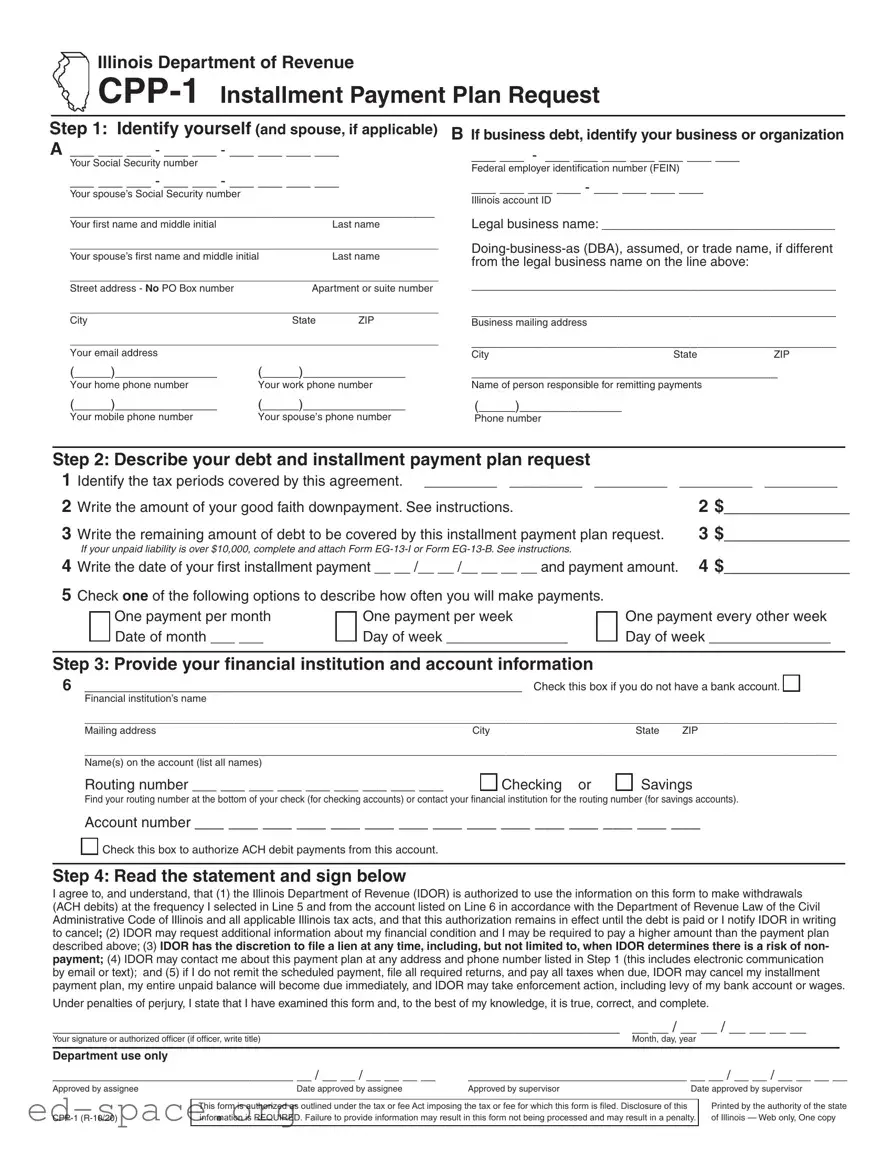
Facing tax debt can be daunting, especially when financial hardships make it difficult to pay in full. The Illinois CPP-1 form, known as the Installment Payment Plan Request, serves as a lifeline for individuals and businesses seeking a manageable way to address their tax liabilities. This form allows you to propose a payment plan to the Illinois Department of Revenue, enabling you to pay off your tax debts through regular, scheduled payments. To complete the CPP-1 form, you will need to provide essential information about yourself, your spouse (if applicable), and your financial situation. You'll detail your tax periods, outline your good faith down payment, and specify the remaining balance you wish to include in your payment plan. Additionally, you will indicate how often you plan to make payments, whether weekly or monthly, and provide your bank account information for automatic withdrawals. Understanding the implications of this form is crucial, as it establishes a formal agreement with the state, detailing your commitment to repay your tax obligations while also acknowledging that interest and penalties may continue to accrue. By filling out the CPP-1 form, you take a proactive step towards regaining control of your financial situation, paving the way for a more manageable path to compliance.
Illinois Department of Revenue
Installment Payment Plan Request
_________________________________________________________________
CityStateZIP
_________________________________________________________________
Your email address
BIf business debt, identify your business or organization
___ ___ - ___ ___ ___ ___ ___ ___ ___
Federal employer identification number (FEIN)
___ ___ ___ ___ - ___ ___ ___ ___
Illinois account ID
Legal business name: ________________________________
__________________________________________________
__________________________________________________
Business mailing address
__________________________________________________
City |
State |
ZIP |
(_____)______________ |
(_____)______________ |
__________________________________________ |
Your home phone number |
Your work phone number |
Name of person responsible for remitting payments |
(_____)______________ |
(_____)______________ |
(_____)______________ |
Your mobile phone number |
Your spouse’s phone number |
Phone number |
Step 2: Describe your debt and installment payment plan request
1 |
Identify the tax periods covered by this agreement. _________ _________ _________ |
_________ _________ |
|
2 |
Write the amount of your good faith downpayment. See instructions. |
2 |
$_____________ |
3 |
Write the remaining amount of debt to be covered by this installment payment plan request. |
3 |
$_____________ |
If your unpaid liability is over $10,000, complete and attach Form
4 Write the date of your first installment payment __ __ /__ __ /__ __ __ __ and payment amount. 4 $_____________
5Check one of the following options to describe how often you will make payments.
One payment per month |
|
One payment per week |
Date of month ___ ___ |
|
Day of week _______________ |
One payment every other week Day of week _______________
Step 3: Provide your financial institution and account information
6 ______________________________________________________ Check this box if you do not have a bank account.
Financial institution’s name
____________________________________________________________________________________________________________________
Mailing addressCityState ZIP
____________________________________________________________________________________________________________________
Name(s) on the account (list all names)
Routing number ___ ___ ___ ___ ___ ___ ___ ___ ___
Checking or
Savings
Find your routing number at the bottom of your check (for checking accounts) or contact your financial institution for the routing number (for savings accounts).
Account number ___ ___ ___ ___ ___ ___ ___ ___ ___ ___ ___ ___ ___ ___ ___
Check this box to authorize ACH debit payments from this account.
Step 4: Read the statement and sign below
I agree to, and understand, that (1) the Illinois Department of Revenue (IDOR) is authorized to use the information on this form to make withdrawals (ACH debits) at the frequency I selected in Line 5 and from the account listed on Line 6 in accordance with the Department of Revenue Law of the Civil Administrative Code of Illinois and all applicable Illinois tax acts, and that this authorization remains in effect until the debt is paid or I notify IDOR in writing to cancel; (2) IDOR may request additional information about my financial condition and I may be required to pay a higher amount than the payment plan described above; (3) IDOR has the discretion to file a lien at any time, including, but not limited to, when IDOR determines there is a risk of non- payment; (4) IDOR may contact me about this payment plan at any address and phone number listed in Step 1 (this includes electronic communication by email or text); and (5) if I do not remit the scheduled payment, file all required returns, and pay all taxes when due, IDOR may cancel my installment payment plan, my entire unpaid balance will become due immediately, and IDOR may take enforcement action, including levy of my bank account or wages.
Under penalties of perjury, I state that I have examined this form and, to the best of my knowledge, it is true, correct, and complete.
______________________________________________________________________ |
__ __ / __ __ / __ __ __ __ |
|
||
Your signature or authorized officer (if officer, write title) |
|
|
Month, day, year |
|
|
|
|
|
|
Department use only |
|
|
|
|
_________________________________ __ / __ __ / __ __ __ __ |
______________________________ __ __ / __ __ / __ __ __ __ |
|||
Approved by assignee |
Date approved by assignee |
Approved by supervisor |
Date approved by supervisor |
|
This form is authorized as outlined under the tax or fee Act imposing the tax or fee for which this form is filed. Disclosure of this information is REQUIRED. Failure to provide information may result in this form not being processed and may result in a penalty.
Printed by the authority of the state of Illinois — Web only, One copy
See instructions on next page.

Instructions for Form
General Information
Who should file this form?
You should file Form
What is an installment payment plan?
An installment payment plan is an agreement between you and the Illinois Department of Revenue to pay your tax delinquencies using regularly scheduled payments. Your scheduled payment amount and the length of time that you have to pay is based on your financial condition.
When is this form due?
There is no specific due date. We recommend that you file this form when you receive a bill or notice which you are unable to pay because of a financial hardship. Once you receive the bill or notice, you should complete and return this form within 10 days. Note: Even when you enter into an installment payment plan, you continue to accrue interest and applicable penalties and fees on the delinquent tax you owe.
When will my installment payment plan request be approved?
Approval of your request for an installment payment plan will depend upon the completeness of the information you provide on this form. If additional information is needed to process your request, we will contact you.
If our review finds that you
•can pay in full, then we will require you to do so.
•qualify for an installment payment plan, we will send you a letter of
approval and the conditions of the installment payment plan.
How must I make my installment plan payments?
ACH debit — If you have a checking or savings account, you may be required to make your installment payments using the ACH debit program. It is the recommended form of payment for installment payments. The ACH debit program allows you to have the installment payments automatically withdrawn from a savings or checking account.
Note: If we approve your installment payment plan request, your plan approval letter will describe the requirements for your payments.
How must I make my first payment or extra payments?
To make your first payment or if you would like to make payments IN ADDITION to your regular installment payments, you may use one of the following options.
•MyTax Illinois — This is the Department’s online account management system. You may use MyTax Illinois to make electronic
payments as well as file returns for most taxes. Go TO mytax.illinois.gov.
•“Pay by Phone” — Call
1
•Mail — You may mail your remittance to
INSTALLMENT CONTRACT UNIT ILLINOIS DEPARTMENT OF REVENUE PO BOX 19035
SPRINGFIELD IL
•Credit card (This payment method is only available for Individual Income Tax liability.) — You
may make payments using your Visa, Discover, MasterCard, or American Express. The credit card service provider will assess a convenience fee. Each service provider charges its own rate. The rates can vary daily. The Department of Revenue receives no money from these fees. Please note that this is the only payment option where you will be charged a convenience fee. To make a credit card payment, visit our website at tax.illinois.gov or call 1
Where do I send my completed form?
Please fax your completed form to us at 217
INSTALLMENT CONTRACT UNIT ILLINOIS DEPARTMENT OF REVENUE PO BOX 19035
SPRINGFIELD IL
Where do I get help?
•Visit our website at tax.illinois.gov
•Call our Installment Contract Unit at 217
•Write to
INSTALLMENT CONTRACT UNIT ILLINOIS DEPARTMENT OF REVENUE PO BOX 19035
SPRINGFIELD IL
Step 1: Debtor identification
Line A Complete all lines. If you have a spouse who is also liable, complete the lines about your spouse.
Line B If business debt, complete all lines to identify the business or organization.
Step 2: Describe your debt and installment payment plan request
Line 1 Identify all tax periods (i.e., month, quarter, or year) for which the liability exists. For individual or business income tax liabilities, write the tax year covered by the return.
If you need additional space, write the tax period beside the line provided or list the tax periods on a separate sheet of paper and attach it to this form.
If you have both individual income tax and other tax debt, submit a separate Form
If you are requesting an installment payment plan for more than one type of tax other than individual income tax (i.e., sales, withholding, excise, or business income tax), you may combine the tax types on your Form
Line 2 Write the amount of your good faith down payment (which is due with your completed Form
Line 3 Write the amount of debt to be included in your installment payment plan. If your unpaid liability is over $10,000, complete Form
Information Statement for Individuals, or Form
Line 4 For your regular installment plan payments, write the date payments will begin and the amount of each payment. Please make the payment amount as large as possible to reduce additional interest accrual. Interest accrues on the tax until paid.
Line 5 Check one box to tell us how frequently you will make your installment plan payments as identified on Line 4.
Step 3: Provide your financial institution and account information
Complete all lines about your account. Check the box to authorize the Illinois Department of Revenue to utilize the ACH debit method of payment from this account.
Step 4: Read the statement and sign the form
You (or in the case of a business, the person responsible for remitting payments) must sign the statement. If you do not, processing of your request will be delayed and we may take collection action to collect the unpaid debt.
We will contact you if we do not approve the installment payment plan as you request or if we need additional information from you.
By signing the application, you agree to the following:
(1)the Illinois Department of Revenue (IDOR) is authorized to use the information on this form to make withdrawals (ACH debits) at the frequency you selected in Line 5 and from the account listed on Line 6 in accordance with the Department of Revenue Law of the Civil Administrative Code of Illinois and all applicable Illinois tax acts,
and that this authorization remains in effect until the debt is paid or you notify IDOR in writing to cancel;
(2)IDOR may request additional information about your financial condition and you may be required to pay a higher amount than the payment plan described on this form;
(3)IDOR has the discretion to file a lien at any time, including, but not limited to, when IDOR determines there is a risk of
(4)IDOR may contact you about this payment plan at any address and phone number listed in Step 1 (this includes electronic communication by email or text); and
(5)if you do not remit the scheduled payment, file all required returns, and pay all taxes when due, IDOR may cancel the installment payment plan, the entire unpaid balance will become due immediately, and IDOR may take enforcement action, including levy of your bank account or wages.
| Fact Name | Fact Description |
|---|---|
| Form Purpose | The Illinois CPP-1 form is used to request an installment payment plan for tax delinquencies due to financial hardship. |
| Governing Law | This form is governed by the Department of Revenue Law of the Civil Administrative Code of Illinois and applicable Illinois tax acts. |
| Eligibility Criteria | Taxpayers experiencing financial hardship may file this form to enter into a payment plan. |
| Down Payment Requirement | A good faith down payment is required when submitting the CPP-1 form to demonstrate commitment to the payment plan. |
| Payment Frequency | Taxpayers can choose to make payments weekly, bi-weekly, or monthly based on their financial situation. |
| Contact Information | Taxpayers must provide their contact details, including phone numbers and email addresses, for communication regarding the payment plan. |
| Approval Process | Approval of the installment payment plan depends on the completeness of the information provided in the form. |
| Consequences of Non-Payment | If scheduled payments are not made, the Illinois Department of Revenue may cancel the plan and pursue collection actions. |
Filling out the Illinois CPP-1 form is an important step in managing your tax obligations. After you complete the form, you will submit it to the Illinois Department of Revenue. They will review your request for an installment payment plan based on the information you provide. Make sure to follow the steps carefully to ensure your application is processed smoothly.
What is the Illinois CPP-1 form?
The Illinois CPP-1 form is a request to enter into an installment payment plan with the Illinois Department of Revenue. If you have tax delinquencies that you cannot pay in full due to financial hardship, this form allows you to propose a plan to pay off your tax debt over time through regular payments.
Who should file the CPP-1 form?
This form is intended for individuals or businesses facing tax debts they cannot pay in full. If you find yourself in a situation where paying your tax bill is a challenge, filing the CPP-1 can help you manage your financial obligations without overwhelming stress.
When should I submit the CPP-1 form?
While there is no specific due date for the CPP-1 form, it is advisable to file it as soon as you receive a bill or notice that you cannot pay. Completing and submitting the form within 10 days of receiving the notice can help you avoid further penalties and interest on your outstanding tax debt.
What information do I need to provide on the CPP-1 form?
You will need to provide personal information, including your name, address, and Social Security number. If applicable, you should also include your spouse's details. Additionally, you must describe your tax debt, including the tax periods involved, the amount of your good faith down payment, and how much you intend to pay in installments. Lastly, you will need to provide your bank account information if you choose to authorize automatic withdrawals for your payments.
How will I know if my installment payment plan request is approved?
Your request will be reviewed based on the information you provide. If everything is complete and you qualify, you will receive a letter of approval outlining the terms of your payment plan. If further information is needed or if you can pay the full amount, the Department will contact you directly.
What happens if I miss a payment or fail to comply with the payment plan?
If you miss a scheduled payment or do not file all required tax returns, the Illinois Department of Revenue may cancel your installment payment plan. This means your entire unpaid balance could become due immediately. The Department may also take enforcement actions, such as levying your bank account or wages, to collect the owed amount.
Incomplete Personal Information: Failing to fill out all required personal details, such as your spouse’s name or Social Security number, can lead to delays. Ensure every section is complete, including contact information.
Incorrect Tax Periods: Not accurately identifying the tax periods covered by your request can cause confusion. Double-check that you list all relevant periods correctly to avoid processing issues.
Missing Good Faith Down Payment: Forgetting to include the down payment amount can result in your application being rejected. Make sure to enter a reasonable down payment, as it helps reduce interest accrual.
Signature and Authorization Issues: Neglecting to sign the form or authorize ACH debit payments can lead to processing delays. Always review the form for a signature before submission.
When dealing with the Illinois Cpp 1 form, several other forms and documents may be necessary to help manage tax obligations. Below is a list of commonly used forms that can assist in the process.
Gathering these forms and documents can facilitate a smoother process when addressing tax obligations. Each document serves a specific purpose and helps ensure compliance with tax regulations.
When filling out the Illinois CPP-1 form, it's essential to follow specific guidelines to ensure your application is processed smoothly. Below is a list of things you should and shouldn't do:
By adhering to these dos and don'ts, you can facilitate a more efficient review process for your installment payment plan request.
This form can be used by both individuals and businesses facing tax delinquencies. If a business has tax debts, it must provide its legal name and Federal Employer Identification Number (FEIN) on the form.
Approval is not automatic. The Illinois Department of Revenue reviews the information provided and will only approve the plan if the applicant qualifies based on their financial condition.
While there is no specific due date, it is advisable to submit the form within 10 days of receiving a tax bill or notice that cannot be paid in full.
While the initial terms are set upon approval, if circumstances change, you can contact the Department of Revenue to discuss potential modifications to your payment plan.
Interest and applicable penalties continue to accrue on the unpaid tax amount until it is fully paid, even if an installment plan is in place.
Only basic information is required at the time of submission. However, if your unpaid liability exceeds $10,000, additional forms (EG-13-I or EG-13-B) must be completed and submitted.
Completed forms should be faxed or mailed to the specified address. Electronic submission is not an option for the CPP-1 form.
Payments must typically be made via the ACH debit program, which allows automatic withdrawals from a designated bank account. Other payment methods are available for the first payment or additional payments.
They may reach out for additional information or clarification regarding your financial condition or to discuss your payment plan status.
Signing the CPP-1 form is a serious commitment. It authorizes the Department of Revenue to withdraw payments and indicates your understanding of the consequences of non-payment.
Here are some key takeaways for filling out and using the Illinois CPP-1 form: