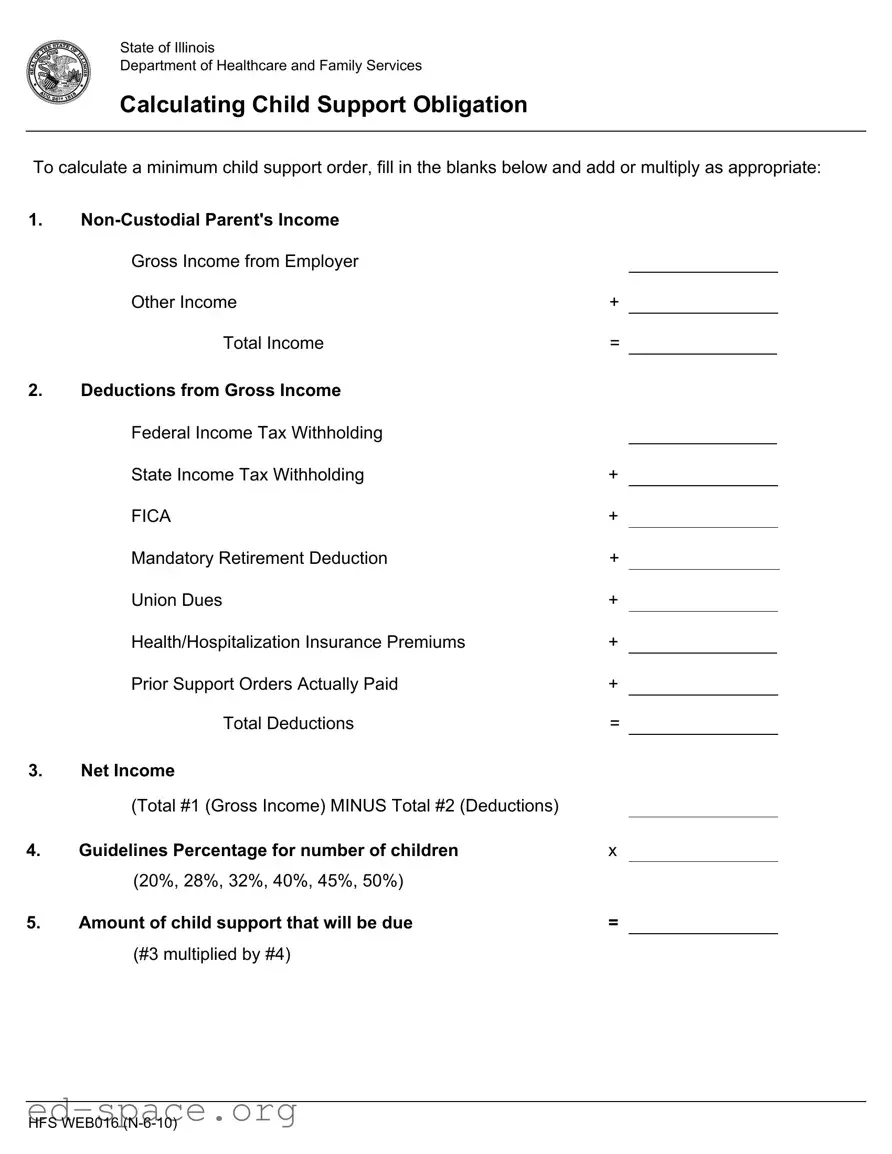
The Illinois Calculating Support form is a crucial tool designed to help determine child support obligations for non-custodial parents. This form guides users through a straightforward process to arrive at a fair support amount based on income and necessary deductions. It begins by requiring the non-custodial parent to input their gross income, which includes earnings from employment and any additional sources of income. Next, it prompts for various deductions that can be subtracted from the gross income, such as federal and state tax withholdings, FICA contributions, and health insurance premiums. Once these figures are calculated, the form helps determine the net income by subtracting the total deductions from the gross income. The guidelines percentage, which varies depending on the number of children, is then applied to this net income to establish the amount of child support due. By following these steps, parents can ensure they meet their financial responsibilities while also considering their individual circumstances.

State of Illinois
Department of Healthcare and Family Services
Calculating Child Support Obligation
To calculate a minimum child support order, fill in the blanks below and add or multiply as appropriate:
1. |
|
|
|
Gross Income from Employer |
|
|
Other Income |
+ |
|
Total Income |
= |
2.Deductions from Gross Income
|
Federal Income Tax Withholding |
|
|
State Income Tax Withholding |
+ |
|
FICA |
+ |
|
Mandatory Retirement Deduction |
+ |
|
Union Dues |
+ |
|
Health/Hospitalization Insurance Premiums |
+ |
|
Prior Support Orders Actually Paid |
+ |
|
Total Deductions |
= |
3. |
Net Income |
|
|
(Total #1 (Gross Income) MINUS Total #2 (Deductions) |
|
4. |
Guidelines Percentage for number of children |
x |
|
(20%, 28%, 32%, 40%, 45%, 50%) |
|
5. |
Amount of child support that will be due |
= |
|
(#3 multiplied by #4) |
|
HFS WEB016
| Fact Name | Details |
|---|---|
| Governing Law | The Illinois Calculating Support form is governed by the Illinois Marriage and Dissolution of Marriage Act (IMDMA). |
| Purpose | This form is used to calculate the minimum child support obligation for non-custodial parents. |
| Income Calculation | The form requires the non-custodial parent's gross income from employment and other income sources to be totaled. |
| Deductions | Various deductions can be subtracted from gross income, including taxes, retirement contributions, and health insurance premiums. |
| Net Income | Net income is calculated by subtracting total deductions from gross income. |
| Guidelines Percentage | The percentage of income to be allocated for child support depends on the number of children, ranging from 20% to 50%. |
| Final Calculation | The final child support amount is determined by multiplying net income by the guidelines percentage. |
| Form Reference | The form is identified as HFS WEB016 (N-6-10) by the Illinois Department of Healthcare and Family Services. |
| Filing Requirements | Completion of this form may be required during child support hearings or modifications in Illinois. |
| Updates | The form and guidelines are subject to change, reflecting updates in state law or child support policies. |
Once you have gathered the necessary financial information, you can proceed to fill out the Illinois Calculating Support form. This form will help you determine the minimum child support obligation based on the income of the non-custodial parent. Follow these steps carefully to ensure accuracy.
What is the purpose of the Illinois Calculating Support form?
The Illinois Calculating Support form is designed to help determine the minimum child support obligation for non-custodial parents. By filling out this form, parents can calculate their financial responsibility based on their income and deductions. The form provides a clear method for assessing how much support is needed to meet the child's needs.
How do I calculate my total income on the form?
To calculate total income, start by entering the gross income from your employer. This includes wages, salaries, bonuses, and any other employment-related income. Next, add any other sources of income, such as rental income, dividends, or interest. The sum of these amounts will give you your total income, which is the first step in the calculation process.
What types of deductions should I include when filling out the form?
When completing the form, you should include various deductions from your gross income. These may consist of federal and state income tax withholdings, FICA (Federal Insurance Contributions Act) taxes, mandatory retirement contributions, union dues, and health or hospitalization insurance premiums. If you are already paying support for other children, include those amounts as well. Adding these deductions together will help you determine your net income.
How do I calculate my net income?
To find your net income, subtract your total deductions from your total income. This calculation will provide you with the amount of income available for child support obligations. The formula is straightforward: Net Income = Total Income - Total Deductions. This net income figure is essential for determining the appropriate child support amount.
What is the guidelines percentage, and how is it determined?
The guidelines percentage is a predetermined percentage of your net income that is used to calculate child support obligations based on the number of children involved. For one child, the percentage is typically 20%, for two children it is 28%, and it increases for additional children. This percentage is applied to your net income to determine the amount of child support that will be due.
How do I find out the final child support amount?
To calculate the final child support amount, multiply your net income by the guidelines percentage that corresponds to the number of children. For example, if your net income is $3,000 and you have one child, you would multiply $3,000 by 20% (0.20), resulting in a child support obligation of $600. This final amount represents the minimum support that should be paid to ensure the child's needs are met.
Neglecting to Include All Sources of Income: Many individuals forget to account for all forms of income. This includes not just salary from a job, but also bonuses, freelance work, rental income, and any other financial contributions. Omitting these can lead to an inaccurate calculation of total income.
Incorrectly Calculating Deductions: Some people miscalculate their deductions from gross income. This can happen when they fail to include mandatory deductions like federal and state taxes, FICA, or union dues. Each of these deductions plays a crucial role in determining net income, and overlooking any can skew the final support amount.
Misunderstanding the Guidelines Percentage: The guidelines percentage varies based on the number of children involved. A common mistake is applying the wrong percentage. For instance, using 20% for one child instead of the appropriate percentage for the number of children can lead to significant discrepancies in the support calculation.
Failing to Update Information: Life circumstances can change, affecting income and expenses. Some individuals do not update their information on the form when these changes occur. This can result in outdated calculations that do not reflect the current financial situation.
Not Double-Checking Calculations: Errors in basic arithmetic can happen to anyone. Failing to double-check calculations can lead to incorrect totals for both income and deductions. A simple mistake in addition or multiplication can have a significant impact on the final child support obligation.
When navigating child support calculations in Illinois, several forms and documents complement the Illinois Calculating Support form. Each of these documents serves a specific purpose and is essential for ensuring accurate and fair support determinations. Below is a list of commonly used forms that work alongside the Calculating Support form.
Understanding these forms can help ensure that the child support process is handled smoothly and fairly. Each document plays a vital role in providing the necessary information to support the needs of the children involved.
The Illinois Calculating Support form is an important tool for determining child support obligations. It shares similarities with several other legal documents that serve related purposes. Here are five documents that are comparable:
When filling out the Illinois Calculating Support form, it’s important to be accurate and thorough. Here’s a list of things you should and shouldn't do:
By following these tips, you can ensure that your calculations are accurate and reflect your true financial situation.
When dealing with the Illinois Calculating Support form, misunderstandings can lead to confusion. Here are seven common misconceptions:
Understanding these misconceptions can help parents navigate the child support process more effectively and ensure they are fulfilling their obligations appropriately.
When filling out the Illinois Calculating Support form, it is essential to understand the steps involved in determining child support obligations. Here are key takeaways to keep in mind: