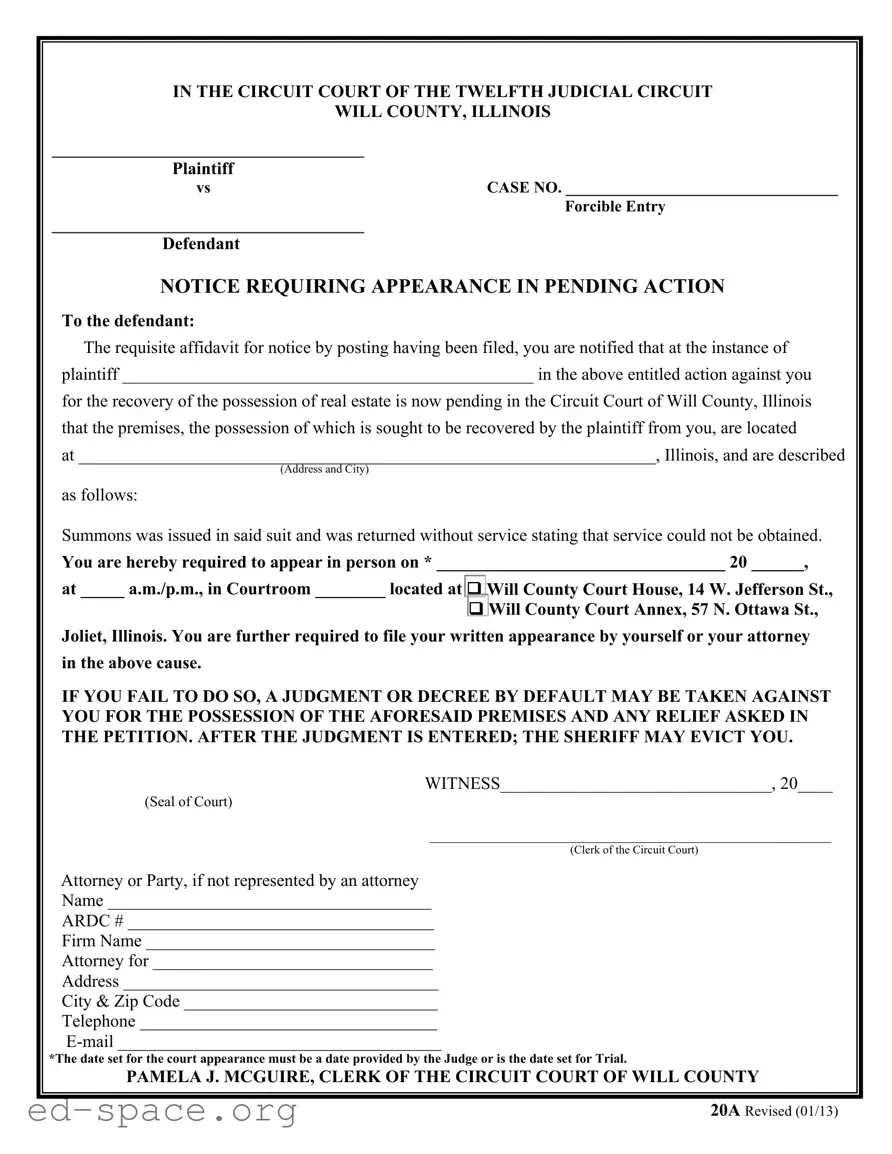
The Illinois 20A form plays a crucial role in the legal process surrounding forcible entry and detainer actions, particularly in Will County. This form serves as a notice requiring the defendant to appear in court regarding a case initiated by the plaintiff for the recovery of possession of real estate. It outlines essential details, including the case number, the parties involved, and the specific location of the property in question. The form also indicates that an affidavit for notice by posting has been filed, which is a procedural requirement when the defendant cannot be served personally. Additionally, it specifies the date and time for the court appearance, emphasizing the importance of compliance. Failure to appear can result in a default judgment, allowing the plaintiff to obtain possession of the property and potentially leading to eviction by the sheriff. The form is formally issued by the Clerk of the Circuit Court and includes spaces for the attorney's information, ensuring that all parties are appropriately notified and represented in the proceedings.

IN THE CIRCUIT COURT OF THE TWELFTH JUDICIAL CIRCUIT
WILL COUNTY, ILLINOIS
_______________________________________
Plaintiff
vs |
CASE NO. __________________________________ |
|
Forcible Entry |
_______________________________________ |
|
Defendant |
|
NOTICE REQUIRING APPEARANCE IN PENDING ACTION
To the defendant:
The requisite affidavit for notice by posting having been filed, you are notified that at the instance of plaintiff _______________________________________________ in the above entitled action against you
for the recovery of the possession of real estate is now pending in the Circuit Court of Will County, Illinois that the premises, the possession of which is sought to be recovered by the plaintiff from you, are located
at __________________________________________________________________, Illinois, and are described
(Address and City)
as follows:
Summons was issued in said suit and was returned without service stating that service could not be obtained.
You are hereby required to appear in person on * _________________________________ 20 ______,
at _____ a.m./p.m., in Courtroom ________ located atWill County Court House, 14 W. Jefferson St.,
Will County Court Annex, 57 N. Ottawa St.,
Joliet, Illinois. You are further required to file your written appearance by yourself or your attorney
in the above cause.
IF YOU FAIL TO DO SO, A JUDGMENT OR DECREE BY DEFAULT MAY BE TAKEN AGAINST YOU FOR THE POSSESSION OF THE AFORESAID PREMISES AND ANY RELIEF ASKED IN THE PETITION. AFTER THE JUDGMENT IS ENTERED; THE SHERIFF MAY EVICT YOU.
WITNESS_______________________________, 20____
(Seal of Court)
_______________________________________________________
(Clerk of the Circuit Court)
Attorney or Party, if not represented by an attorney
Name _____________________________________
ARDC # ___________________________________
Firm Name _________________________________
Attorney for ________________________________
Address ____________________________________
City & Zip Code _____________________________
Telephone __________________________________
*The date set for the court appearance must be a date provided by the Judge or is the date set for Trial.
PAMELA J. MCGUIRE, CLERK OF THE CIRCUIT COURT OF WILL COUNTY
20A Revised (01/13)
| Fact Name | Details |
|---|---|
| Governing Law | The Illinois 20A form is governed by the Illinois Code of Civil Procedure, specifically 735 ILCS 5/9-107. |
| Purpose | This form serves as a notice requiring the defendant to appear in court regarding a forcible entry action. |
| Filing Requirement | An affidavit for notice by posting must be filed before using this form. |
| Service of Summons | The summons may be returned without service if the defendant cannot be located. |
| Appearance Requirement | The defendant must appear in person or through an attorney on the specified court date. |
| Consequences of Non-Appearance | If the defendant fails to appear, a judgment by default may be entered against them. |
| Eviction Process | Following a judgment, the sheriff may proceed with the eviction of the defendant from the premises. |
Completing the Illinois 20A form is an important step in the legal process. It is essential to ensure that all required information is filled out accurately and clearly. This will help facilitate the proceedings and ensure that all parties are properly notified of the court date.
After completing the form, review it carefully to ensure all information is accurate. Once confirmed, the form should be submitted as required. This will help ensure that the legal process moves forward without unnecessary delays.
What is the Illinois 20A form?
The Illinois 20A form is a legal document used in eviction cases. It serves as a notice to the defendant, informing them of a court action for the recovery of possession of real estate. This form is filed in the Circuit Court of Will County, Illinois, and outlines the necessary details for the defendant regarding their required court appearance.
Who is the plaintiff and who is the defendant?
The plaintiff is the person or entity that initiates the lawsuit, seeking to recover possession of a property. The defendant is the individual or party being sued, who currently occupies the property in question. The form clearly identifies both parties involved in the case.
What happens if the defendant does not appear in court?
If the defendant fails to appear in court on the specified date, a judgment or decree by default may be entered against them. This means the court may grant the plaintiff the possession of the property without the defendant's input. Additionally, the sheriff may carry out an eviction after the judgment is entered.
How is the court date determined?
The court date listed on the 20A form is either set by the judge or is the date scheduled for the trial. It is important for the defendant to pay attention to this date and attend the court hearing as required.
Where is the court located?
The court for cases filed under the Illinois 20A form is located at the Will County Courthouse, specifically at 14 W. Jefferson St. and the Will County Court Annex at 57 N. Ottawa St., Joliet, Illinois. This information is crucial for the defendant to know where to go for their court appearance.
What information must the defendant provide in their appearance?
The defendant must file a written appearance either personally or through an attorney. This document formally notifies the court of their intention to contest the case. It is essential to provide accurate information, including the defendant's name and any legal representation details.
What is the significance of the notice by posting?
The notice by posting indicates that the plaintiff has made efforts to serve the defendant with the court summons but was unable to do so. This method allows the court to proceed with the case even if the defendant is not personally served, ensuring that the legal process continues.
What is included in the property description?
The property description in the 20A form includes the address and city where the premises are located. This information helps identify the specific property involved in the eviction action, ensuring clarity for all parties.
What is the role of the Clerk of the Circuit Court?
The Clerk of the Circuit Court is responsible for maintaining court records and managing the filing of legal documents. In the context of the 20A form, the clerk’s signature and seal validate the notice and confirm that it has been officially filed with the court.
How can the defendant contact their attorney?
If the defendant is represented by an attorney, their contact information will be included on the 20A form. This allows the defendant to reach out for guidance or assistance regarding their case. It is important for defendants to stay in communication with their legal representatives throughout the process.
Incomplete Information: One common mistake is failing to fill in all required fields. Ensure that every section, including the plaintiff's and defendant's names, addresses, and case number, is complete. Missing details can lead to delays or dismissal of the case.
Incorrect Dates: Entering the wrong date for the court appearance is another frequent error. Double-check that the date you provide is accurate and matches the one set by the judge. An incorrect date may result in a missed court date and potential default judgment.
Signature Issues: Failing to sign the form or having an improper signature can invalidate the document. Make sure that the form is signed in the appropriate place, whether by the attorney or the party involved. A missing signature can lead to complications in the legal process.
Not Filing on Time: Submitting the form after the deadline is a critical mistake. Be aware of the timeline for filing and ensure that the form is submitted promptly. Late filings can result in losing the right to contest the case.
The Illinois 20A form is a critical document in the eviction process, specifically for cases involving forcible entry. However, it is often accompanied by several other forms and documents that play essential roles in the legal proceedings. Below is a list of these documents, each serving a specific purpose in the context of eviction and property recovery.
Understanding these documents can help both landlords and tenants navigate the eviction process more effectively. Each form plays a vital role in ensuring that the legal proceedings are conducted fairly and in accordance with the law. Properly managing these documents can make a significant difference in the outcome of an eviction case.
The Illinois 20A form serves a specific purpose in the legal process, particularly in eviction cases. Several other documents share similarities with the 20A form, often relating to court appearances, notifications, or legal proceedings. Here’s a list of ten documents that are similar to the Illinois 20A form, along with a brief explanation of how they compare:
When filling out the Illinois 20A form, it's important to follow certain guidelines to ensure your submission is accurate and effective. Here are four things you should and shouldn't do:
Misconceptions about the Illinois 20A form can lead to confusion and missteps in the legal process. Here are five common misconceptions, along with clarifications to help you better understand this important document.
Understanding these misconceptions can help individuals navigate the legal landscape more effectively and ensure that their rights are protected during the process.
When dealing with the Illinois 20A form, it’s important to understand its purpose and implications. Here are key takeaways to guide you through the process:
Understanding these points can help ensure that you respond appropriately and protect your rights throughout the legal proceedings.