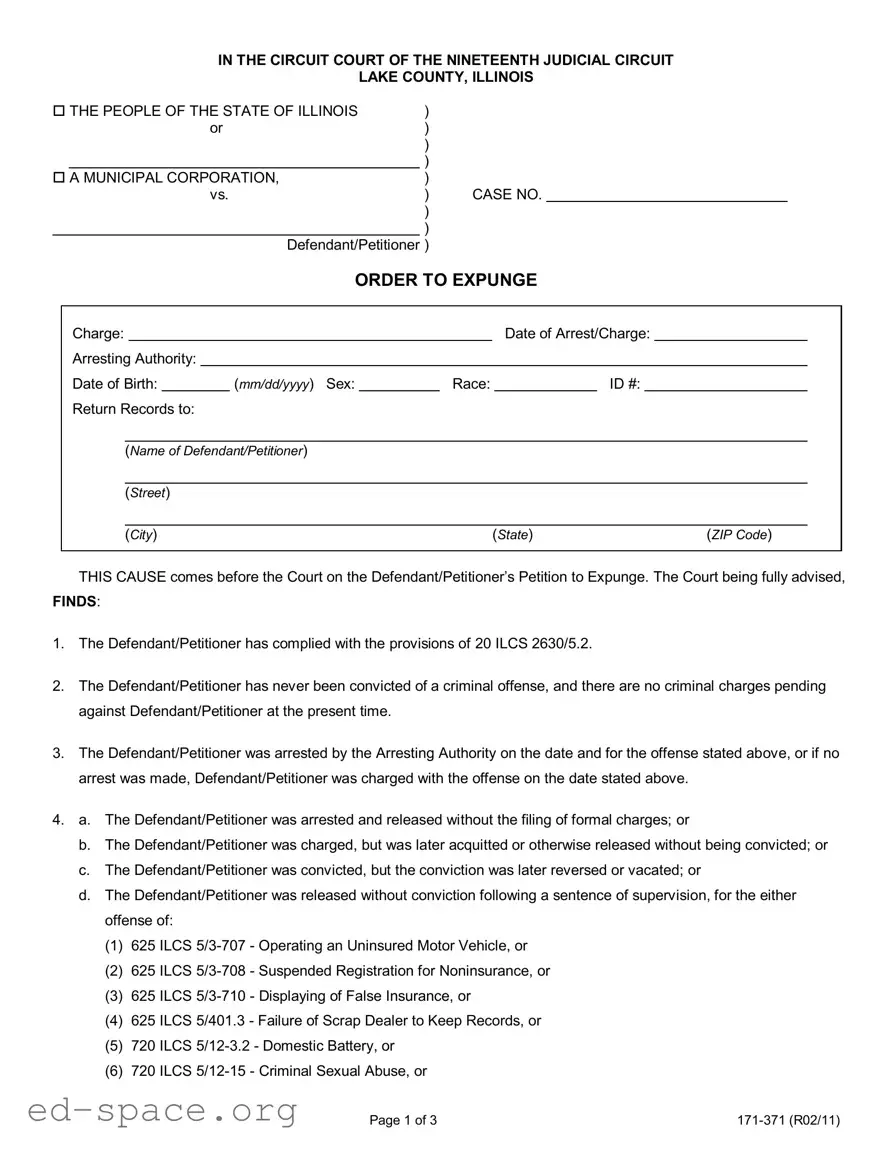
The Illinois 171 371 form plays a crucial role in the process of expunging criminal records in Lake County, Illinois. This form is used when a defendant or petitioner seeks to have their arrest records cleared from public view. It includes essential details such as the case number, the charges, and the arresting authority, along with personal information about the individual, including their date of birth, sex, and race. The form outlines the requirements that must be met for the expungement to be granted. These include stipulations about prior convictions, the nature of the arrest, and the time elapsed since any supervision or probation. The court must find that the petitioner has complied with the relevant laws and that no objections have been raised by the necessary authorities. Upon approval, the court orders that all related records be destroyed or returned to the petitioner, ensuring that their name is removed from official indexes and public records. This process is vital for individuals seeking to move forward without the stigma of past arrests affecting their future opportunities.
IN THE CIRCUIT COURT OF THE NINETEENTH JUDICIAL CIRCUIT
LAKE COUNTY, ILLINOIS
THE PEOPLE OF THE STATE OF ILLINOIS |
) |
|
|
|
or |
) |
|
|
|
) |
|
|
|
) |
|
A MUNICIPAL CORPORATION, |
) |
|
|
|
vs. |
) |
CASE NO. |
|
|
) |
|
|
|
) |
|
Defendant/Petitioner )
ORDER TO EXPUNGE
Charge: |
|
|
|
|
|
|
Date of Arrest/Charge: |
|
|||
Arresting Authority: |
|
|
|
|
|
|
|
|
|
||
Date of Birth: |
|
|
(mm/dd/yyyy) Sex: |
|
Race: |
|
|
ID #: |
|
||
Return Records to: |
|
|
|
|
|
|
|
|
|
||
(Name of Defendant/Petitioner)
(Street)
(City) |
(State) |
(ZIP Code) |
THIS CAUSE comes before the Court on the Defendant/Petitioner’s Petition to Expunge. The Court being fully advised,
FINDS:
1.The Defendant/Petitioner has complied with the provisions of 20 ILCS 2630/5.2.
2.The Defendant/Petitioner has never been convicted of a criminal offense, and there are no criminal charges pending against Defendant/Petitioner at the present time.
3.The Defendant/Petitioner was arrested by the Arresting Authority on the date and for the offense stated above, or if no arrest was made, Defendant/Petitioner was charged with the offense on the date stated above.
4.a. The Defendant/Petitioner was arrested and released without the filing of formal charges; or
b.The Defendant/Petitioner was charged, but was later acquitted or otherwise released without being convicted; or
c.The Defendant/Petitioner was convicted, but the conviction was later reversed or vacated; or
d.The Defendant/Petitioner was released without conviction following a sentence of supervision, for the either offense of:
(1)625 ILCS
(2)625 ILCS
(3)625 ILCS
(4)625 ILCS 5/401.3 - Failure of Scrap Dealer to Keep Records, or
(5)720 ILCS
(6)720 ILCS
Page 1 of 3 |
(7) 720 ILCS
and it has been FIVE years since the successful discharge and dismissal from supervision; or
5.The Defendant/Petitioner was released without conviction following a sentence of supervision for an offense which is not set forth above, and it has been TWO years since the successful discharge and dismissal from supervision, or
6.The Defendant/Petitioner was released without conviction following a sentence of probation under:
a.720 ILCS 550/10 - Section 10 of the Cannabis Control Act, or
b.720 ILCS 570/410 - Section 410 of the Illinois Controlled Substances Act, or
c.720 ILCS
d.20 ILCS
e.20 ILCS
f.Section 10 of the Steroid Control Act (repealed); or
g.720 ILCS 646/70 - Section 70 of the Methamphetamine Control and Community Protection Act; and it has been FIVE years since the successful termination of probation.
7.In the case sought to be expunged, the Defendant/Petitioner was not granted court supervision for (1) driving under the influence; (2) reckless driving; or (3) any sexual offense committed against a minor under 18 years of age as a result of this arrest.
8.The Defendant/Petitioner has paid all costs and fees for the filing of this Petition, or has been granted a fee waiver by the Court.
9.The Circuit Clerk has served notice on the Arresting Authority, the Department of the State Police, the State’s
Attorney and the Chief Legal Officer of the unit of local government affecting the arrest and
a.neither of said agencies has filed an objection to the Petition to Expunge within 60 days from the date of service; or
b.following the filing of an objection, this Court, having heard evidence in the matter, finds that the records should be expunged.
IT IS THEREFORE ORDERED as follows:
That the Petition to Expunge the Defendant/Petitioner’s arrest record is GRANTED, and that the official records be EXPUNGED as follows:
1.All records relating to arrest or charges, or both, shall be physically destroyed or return to the petitioner, and the petitioner’s name must be obliterated from any official index or public record, or both. Nothing in this Act shall require the physical destruction of the circuit court file, but such records relating to arrests or charges, or both, ordered expunged, shall be impounded. Said records shall be expunged by the arresting agency, the Department, and any other agency as ordered by the court, within 60 days of the date of service of this order, unless a motion to vacate, modify, or reconsider the order is filed. In response to an inquiry for expunged records, the Circuit Clerk
Page 2 of 3 |

of the Court, the Department, or the agency receiving such inquiry, shall reply as it does in response to inquiries when no records ever existed.
2.The records of the Circuit Court Clerk shall be impounded until further order of the court upon good cause shown and the name of the petitioner obliterated on the official index required to be kept by the circuit court clerk under Section 16 of the Clerks of Courts Act, but the order shall not affect any index issued by the circuit court clerk before the entry of the order.
3.Nothing in this Order shall prevent the Department of State Police from maintaining all records of any person who is admitted to probation upon terms and conditions and who fulfills those terms and conditions pursuant to Section 10 of the Cannabis Control Act, Section 410 of the Illinois Controlled Substances Act, Section 70 of the Methamphetamine Control and Community Protection Act, Section
4.The Clerk of the Circuit Court shall provide copies of this order to the petitioner, to the Department of State Police (in the form and manner prescribed), to the State's Attorney or prosecutor charged with the duty of prosecuting the offense, to the arresting agency, to the chief legal officer of the unit of local government effecting the arrest, and to such other criminal justice agencies as may be ordered by the court.
5.Further, the Department may charge the petitioner a fee equivalent to the cost of processing any order before expunging the records. Notwithstanding any provision of the Clerks of Courts Act to the contrary, the Circuit Court Clerk may also charge a fee equivalent to the cost associated with the expungement of the records.
6.This order becomes a final and appealable order 30 days after service of the order on the petitioner and all parties entitled to notice of the petition.
IT IS SO ORDERED.
Dated this |
|
day of |
|
, 20___ |
ENTER:
Judge
Prepared by: |
|
|
|
|
|||
Name: |
|
Telephone: |
|
||||
Attorney for: |
|
ADRC: |
|
||||
Address: |
|
City/State/Zip: |
|
||||
Page 3 of 3 |
| Fact Name | Details |
|---|---|
| Governing Law | The Illinois 171 371 form is governed by 20 ILCS 2630/5.2. |
| Purpose | This form is used to petition the court for expungement of an arrest record. |
| Eligibility Criteria | Applicants must not have any pending criminal charges or convictions. |
| Timeframe for Expungement | Records must be expunged within 60 days of the court's order. |
| Notice Requirement | The Circuit Clerk must notify relevant authorities about the expungement petition. |
| Fee Waiver | Applicants may be granted a fee waiver for filing the petition. |
| Record Destruction | All records related to the arrest must be destroyed or returned to the petitioner. |
| Finality of Order | The expungement order becomes final 30 days after service to all parties. |
Completing the Illinois 171 371 form requires careful attention to detail. After filling out the form, it will need to be submitted to the appropriate court for consideration. Ensure that all information is accurate and complete to facilitate the process.
What is the Illinois 171 371 form used for?
The Illinois 171 371 form is used to request the expungement of an arrest record. This means that if you have been arrested but not convicted, or if your conviction has been reversed, you can use this form to have your record cleared. The goal is to help individuals move forward without the burden of a past arrest affecting their future opportunities.
Who can file the Illinois 171 371 form?
Any individual who has an arrest record in Illinois that meets specific criteria can file this form. To qualify, you must not have any convictions or pending criminal charges. Additionally, you must meet other conditions related to your arrest or previous charges, as outlined in the form.
What are the eligibility requirements for expungement?
To be eligible for expungement, you must have never been convicted of a crime, or you must have been acquitted or had your conviction reversed. You can also qualify if you completed a sentence of supervision for specific offenses and a certain amount of time has passed. For example, it must be five years since your supervision ended for some offenses, or two years for others.
How do I complete the Illinois 171 371 form?
To complete the form, fill in your personal information, including your name, date of birth, and the details of your arrest. Make sure to indicate the charges and the arresting authority. You will also need to check the appropriate boxes that apply to your situation, confirming your eligibility for expungement.
What happens after I submit the form?
Once you submit the form, the Circuit Clerk will serve notice to relevant authorities, including the arresting agency and the Department of State Police. They will have 60 days to respond. If no objections are filed, the court will grant the expungement. If there is an objection, a hearing may take place to determine the outcome.
Is there a fee to file the Illinois 171 371 form?
Yes, there may be fees associated with filing the form. You are responsible for paying any costs related to the expungement process. However, if you cannot afford the fees, you may request a fee waiver from the court.
How long does the expungement process take?
The expungement process can vary in duration. Typically, once the court grants the expungement, the arrest records should be cleared within 60 days. However, if there are complications or objections, the process may take longer.
What should I do if my expungement is denied?
If your expungement request is denied, you may have the option to appeal the decision. You will need to consult with a legal professional to understand your options and the steps you can take to pursue an appeal.
Incorrect Case Number: Failing to enter the correct case number can lead to delays or rejection of the petition.
Missing Signature: Not signing the form can result in the petition being deemed incomplete.
Incorrect Personal Information: Providing inaccurate details such as date of birth or race can complicate the process.
Omitting Arrest Details: Leaving out specifics about the arrest, such as the date or arresting authority, can hinder the court's ability to process the petition.
Failure to Meet Eligibility Criteria: Not ensuring compliance with the eligibility requirements for expungement may lead to denial.
Neglecting to Pay Fees: Forgetting to include payment for filing fees or not applying for a fee waiver can stall the process.
Not Serving Notice: Failing to serve notice to the required parties can result in objections or delays.
Inadequate Documentation: Not providing necessary supporting documents can weaken the petition's validity.
Ignoring Deadlines: Missing deadlines for filing or responding to objections can lead to the dismissal of the petition.
The Illinois 171 371 form is an essential document used in the expungement process within the state of Illinois. However, several other forms and documents often accompany it to facilitate the legal proceedings. Below is a list of these related documents, each serving a specific purpose in the expungement process.
Understanding these documents is crucial for anyone navigating the expungement process in Illinois. Each plays a vital role in ensuring that the request is properly considered by the court and that all parties are informed and involved in the proceedings.
The Illinois 171 371 form, used for petitioning the expungement of criminal records, shares similarities with several other legal documents that serve various purposes in the criminal justice system. Here are seven documents that are comparable to the Illinois 171 371 form:
When filling out the Illinois 171 371 form, it is essential to follow specific guidelines to ensure accuracy and compliance. Below is a list of things you should and shouldn't do:
Following these guidelines will help streamline the process and increase the likelihood of a successful expungement petition.
Misconceptions about the Illinois 171 371 form can lead to confusion and missteps in the expungement process. Here are six common misconceptions:
Understanding these misconceptions is crucial for anyone considering expungement. Proper knowledge can help navigate the legal landscape more effectively.
When filling out and using the Illinois 171 371 form, there are several important points to keep in mind. Here are key takeaways: