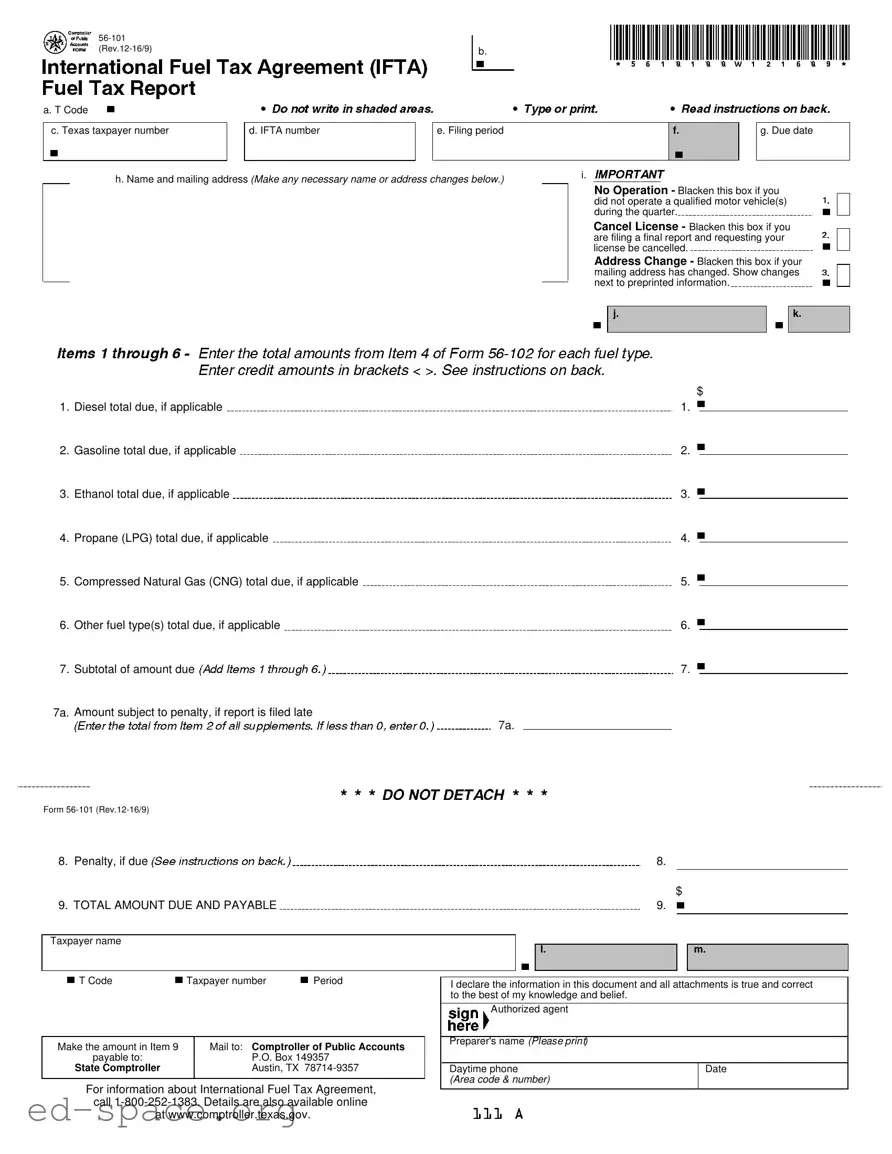
The IFTA Texas Form 56-101 is a crucial document for any entity operating qualified motor vehicles across state lines. This form serves as the International Fuel Tax Agreement (IFTA) Fuel Tax Report, which licensees must submit quarterly to their designated base state. Key elements of the form include the taxpayer's identification information, such as the Texas taxpayer number and IFTA number, along with the filing period and due date. Licensees must indicate if they did not operate any qualified vehicles during the quarter or if they wish to cancel their license by checking specific boxes. The form also requires detailed reporting of fuel types, including diesel, gasoline, ethanol, propane, and compressed natural gas, with corresponding amounts due for each. Additionally, it calculates any penalties for late filing or underpayment, ensuring compliance with tax obligations. The total amount due is clearly outlined, and taxpayers must affirm the accuracy of the provided information. Filing can be done electronically, streamlining the process for users. For further assistance, contact details are provided, as well as links to online resources.
|
|
|
|
|
|
|
|
|
|
|
. |
|
|
||
a. T Code |
|
|
|
|
|
|
|
|
|
|
|
|
|
|
|
|
|
|
|
|
|
|
|
c. T xas taxpayer n mber |
|
d. IFTA number |
|
e. iling period |
f. |
||
|
|
|
|
|
|
|
|
. Name and mailing add ess (Make ny neces ary name or address changes below.) |
i. |
|
g. Due date
No Operation - Blacken this box if you did not o erate a qualified motor vehicle(s) d ring the quarter.
Cancel License - Blacken this box if you are fi ing a final report and requesting your license be cancelled.
Address Change - Blacken this box if your mailing address has changed. Show changes next to preprinted information.
j.
k.
$
1. |
Dies l otal due, if applicable |
1. |
|||
2. |
Gasoline |
due, if applicable |
2. |
||
3. |
Ethanol total due, if applicable |
3. |
|||
4. |
Propane (LPG) t tal due, if app icable |
4. |
|||
5. |
Compressed Natural Gas (CNG) total due, if applicable |
5. |
|||
6. |
Other fuel |
ype s) total due, if pplicable |
6. |
||
7. |
Subtotal of amount due |
7. |
|||
7a. |
Amount subject to pe alty, if rep rt is filed late |
|
|
|
|
|
|
|
7a. |
|
|
Form
8. Penalty, if due |
8. |
|
|
$ |
|
9. TOTAL AMOUNT DUE AND PAYABLE |
9. |
|
|
|
|
Taxpayer name
l.
m.
T Code |
Taxpayer number |
Period |
|
|
|
|
|
Make the amount in Item 9 |
|
Mail to: Comptroller of Public Accounts |
|
payable to: |
|
P.O. Box 149357 |
|
State Comptroller |
|
Austin, TX |
|
|
|
|
|
For information about International Fuel Tax Agreement, call
I declare the information in this document and all attachments is true and correct to the best of my knowledge and belief.
Authorized agent
Preparer's name (Please print)
Daytime phone |
Date |
(Area code & number) |
|
|
|

Form
under Chapt rs 552 and 559, Government Code,
to review, request and correct information we have on file about you. Contact us at the addr ss or phone numbers listed on this form.
Electronic Tax Filing
You can file yo |
terna ion |
Tax Ag |
t (IFTA) r port using our online webfile syst m. |
your IFTA |
port is fast, easy and |
co veni nt w h we file. Please visit |
|
www.comptroll |
.tex s.gov/t |
||
If you have any webfile questions, pl ase call Elect onic Repor ing at
G neral Information
Who Must File - Each licensee h lding a icense under the International Fuel Tax Agre |
ment (IFTA) is quired to file, on a quarterly basis, an |
||
Int rnational Fuel Tax Agreem |
(IFTA) Fuel Tax Repo t, Form |
||
Failure to file this return and pay the applicab e tax may result in collection action as prescri |
d by Title 2 of the Tax Code. |
||
Form |
nt of the various fuel types computed on each Form |
||
the to al amount due/overpaym |
t, incl |
ding any appropriate penalty. Interest is calculated on Form |
|
Specific Instructions
Item 1 - Enter the total amount from Item 4 of Form
Item 2 - Enter the total amount from Item 4 of Form
Item 3 - Enter the total amount from Item 4 of Form
Item 4 - Enter the total amount from Item 4 of Form
U.S./Metric Conversion Factors
1 liter = 0.2642 gallons |
1 kilometer = 0.62137 miles |
3.785 liters = 1 gallon |
1.6093 kilometers = 1 mile |
Item 5 - Enter the total amount from Item 4 of Form
Item 6 - Other fuel types are:
Methanol.
Item 7a - Amount subject to penalty - Enter the sum of the total Tax Due from Item 2 of all supplements, Form
Item 8 - Penalty - A penalty of $50.00 or 10 percent of delinquent taxes, whichever is greater, is imposed for the failure to file a report, for filing a late report, or for underpayment of taxes due. To determine which is greater, use the worksheet below:
(a) Enter amount from Item 7a of this report. |
. |
(b) Multiply (a) by 10% (.10). |
. |
If Item (b) is greater than $50.00, enter (b) as penalty. If (b) is less than $50.00, enter $50.00 as penalty.
| Fact Name | Details |
|---|---|
| Form Number | 56-101 (Rev. 12-16/9) |
| Purpose | This form is used to report fuel tax under the International Fuel Tax Agreement (IFTA). |
| Filing Frequency | Licensees must file this report quarterly. |
| Governing Law | Regulated under Title 2 of the Texas Tax Code. |
| Due Date | The due date for filing is specified for each quarterly period. |
| Penalties | A penalty of $50.00 or 10% of delinquent taxes applies for late filings. |
| Contact Information | For assistance, call 1-800-252-1383 or visit www.comptroller.texas.gov. |
Filling out the IFTA Texas form requires careful attention to detail. You will provide information about your fuel usage and any applicable taxes. After completing the form, you will submit it to the Texas Comptroller of Public Accounts along with any payment due.
What is the IFTA Texas Form 56-101?
The IFTA Texas Form 56-101 is a quarterly report required for licensees under the International Fuel Tax Agreement (IFTA). It summarizes the fuel tax amounts for various fuel types and helps determine the total amount due or any overpayment. This form must be submitted to the designated base state to remain compliant with tax regulations.
Who needs to file the IFTA Texas Form 56-101?
Every licensee holding an IFTA license must file Form 56-101 quarterly. This requirement applies to those who operate qualified motor vehicles across state lines. Failure to file can lead to penalties and collection actions as outlined in Texas tax laws.
What information is required on the form?
When completing Form 56-101, you must provide your Texas taxpayer number, IFTA number, filing period, and your name and mailing address. Additionally, you will need to report the total fuel amounts due for diesel, gasoline, ethanol, propane, compressed natural gas, and other fuel types.
What happens if I did not operate any qualified vehicles during the quarter?
If you did not operate any qualified motor vehicles during the quarter, you should blacken the "No Operation" box on the form. This indicates that you are filing a report even though no operations occurred, which is necessary to maintain your license status.
How are penalties calculated for late filing?
If you file your report late, a penalty is imposed. The penalty is either $50 or 10% of the delinquent taxes, whichever amount is greater. To calculate, take the total tax due from the previous reports and apply the 10% rule. If the calculated penalty is less than $50, you will owe $50.
Where do I send my completed IFTA Texas Form 56-101?
Your completed Form 56-101 should be mailed to the Comptroller of Public Accounts at P.O. Box 149357, Austin, TX 78714-9357. Ensure that your payment is included and made payable to the State Comptroller.
Can I file my IFTA report electronically?
Yes, you can file your IFTA report electronically using the online webfile system provided by the Texas Comptroller's office. This option is fast and convenient. For more information on electronic filing, visit the Texas Comptroller's website or call the Electronic Reporting line for assistance.
Incorrect Taxpayer Information: Many individuals fail to enter their Texas taxpayer number or IFTA number correctly. This can lead to delays or issues in processing the form.
Missing Filing Period: It is essential to specify the correct filing period. Omitting this information can result in penalties or the form being rejected.
Neglecting to Indicate No Operation: If a qualified motor vehicle did not operate during the quarter, it is crucial to blacken the "No Operation" box. Failing to do so may lead to unnecessary tax assessments.
Improper Payment Amount: People often miscalculate the total amount due. It is vital to ensure that all fuel types are accurately accounted for to avoid underpayment or overpayment issues.
The International Fuel Tax Agreement (IFTA) Texas form is a crucial document for businesses operating qualified motor vehicles. However, it is often accompanied by other forms that help streamline the reporting and payment process. Understanding these additional documents can ensure compliance and avoid potential penalties. Below is a list of four forms commonly used alongside the IFTA Texas form.
Being proactive about filing these forms can save time and prevent costly mistakes. Each document plays a vital role in ensuring that your business remains compliant with tax regulations. Always verify that you have the most current versions of these forms and consult with a tax professional if you have questions about your specific situation.
The IFTA Texas form, also known as Form 56-101, shares similarities with several other documents commonly used in tax reporting and compliance. Below is a list of five such documents, highlighting their similarities:
When filling out the IFTA Texas form, there are important dos and don'ts to keep in mind. Here’s a list to help guide you through the process.
By following these guidelines, you can ensure that your IFTA Texas form is completed correctly and submitted on time.
Understanding the IFTA Texas Form can be tricky, and misconceptions can lead to mistakes. Here are ten common misunderstandings clarified:
By debunking these myths, you can navigate the IFTA Texas Form more confidently and ensure compliance with the regulations.
When filling out the IFTA Texas form, there are several important points to keep in mind to ensure compliance and accuracy.
Following these guidelines can help in successfully completing the IFTA Texas form, thereby avoiding potential issues with tax authorities.