The Idaho Transfer-on-Death Deed form serves as a valuable tool for individuals looking to simplify the process of transferring real estate upon their passing. This form allows property owners to designate a beneficiary who will automatically receive the property without the need for probate, thus streamlining the transfer process and potentially saving time and money for loved ones. The deed must be properly executed and recorded with the county recorder’s office to ensure its validity. It is important to note that the transfer only takes effect upon the owner’s death, meaning that the property owner retains full control and ownership during their lifetime. Additionally, the form can be revoked or modified at any time, offering flexibility as personal circumstances change. Understanding the nuances of this form can empower property owners in Idaho to make informed decisions about their estate planning and ensure their wishes are honored after they are gone.
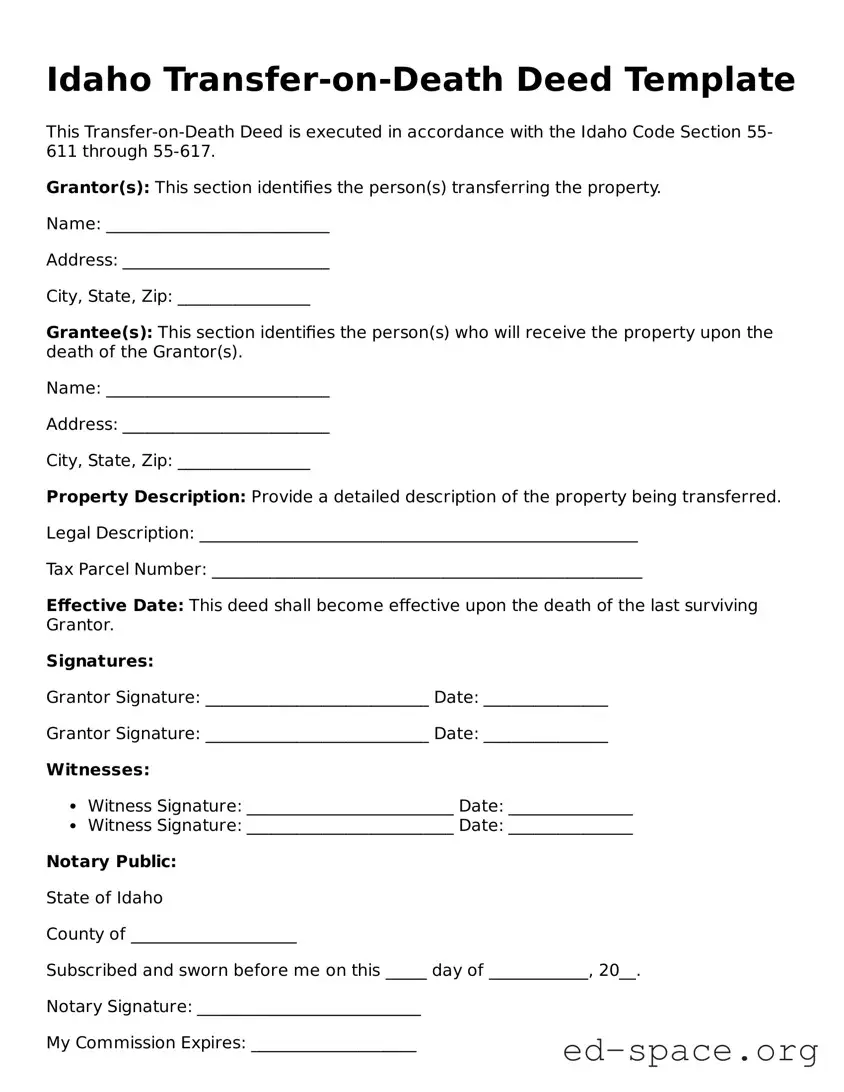
Idaho Transfer-on-Death Deed Template
This Transfer-on-Death Deed is executed in accordance with the Idaho Code Section 55-611 through 55-617.
Grantor(s): This section identifies the person(s) transferring the property.
Name: ___________________________
Address: _________________________
City, State, Zip: ________________
Grantee(s): This section identifies the person(s) who will receive the property upon the death of the Grantor(s).
Name: ___________________________
Address: _________________________
City, State, Zip: ________________
Property Description: Provide a detailed description of the property being transferred.
Legal Description: _____________________________________________________
Tax Parcel Number: ____________________________________________________
Effective Date: This deed shall become effective upon the death of the last surviving Grantor.
Signatures:
Grantor Signature: ___________________________ Date: _______________
Grantor Signature: ___________________________ Date: _______________
Witnesses:
Notary Public:
State of Idaho
County of ____________________
Subscribed and sworn before me on this _____ day of ____________, 20__.
Notary Signature: ___________________________
My Commission Expires: ____________________
This document must be recorded in the office of the County Recorder in the county where the property is located to be effective.
| Fact Name | Description |
|---|---|
| Definition | The Idaho Transfer-on-Death Deed allows property owners to transfer real estate to beneficiaries upon their death without going through probate. |
| Governing Law | This deed is governed by Idaho Code § 55-611 through § 55-619. |
| Eligibility | Any individual who owns real property in Idaho can create a Transfer-on-Death Deed. |
| Beneficiary Designation | Property owners can designate one or more beneficiaries, and they can also specify alternate beneficiaries. |
| Revocation | The Transfer-on-Death Deed can be revoked at any time by the property owner, provided a new deed is executed. |
| Filing Requirements | The deed must be recorded with the county recorder's office in the county where the property is located to be effective. |
| Tax Implications | Beneficiaries typically receive the property at its current market value, which may have tax implications when they sell it. |
| No Immediate Transfer | The property does not transfer to the beneficiary until the owner's death, allowing the owner to retain full control during their lifetime. |
| Legal Assistance | While not required, consulting with a legal professional is advisable to ensure that the deed meets all legal requirements and reflects the owner's wishes. |
Filling out the Idaho Transfer-on-Death Deed form is a straightforward process that can provide peace of mind regarding the transfer of your property upon your passing. Once completed, this form will need to be signed and recorded with the appropriate county office to ensure its validity.
Once you have filed the deed, it will be recorded in the public records, ensuring that your wishes regarding the property transfer are legally recognized. This process provides clarity and security for your beneficiaries, allowing for a smoother transition of ownership.
What is a Transfer-on-Death Deed in Idaho?
A Transfer-on-Death Deed (TODD) in Idaho allows an individual to transfer real estate to a designated beneficiary upon their death. This deed does not take effect until the property owner passes away. It is a useful estate planning tool that helps avoid probate, making the process simpler and quicker for the beneficiary.
Who can use a Transfer-on-Death Deed?
Any individual who owns real estate in Idaho can use a Transfer-on-Death Deed. This includes homeowners, landowners, and individuals holding property in their name. However, it is important to ensure that the deed is executed properly to be valid.
How do I create a Transfer-on-Death Deed?
To create a Transfer-on-Death Deed, the property owner must complete the deed form, which includes the owner’s name, the beneficiary’s name, and a legal description of the property. After filling out the form, it must be signed in front of a notary public and recorded with the county recorder’s office where the property is located.
Can I change or revoke a Transfer-on-Death Deed?
Yes, a Transfer-on-Death Deed can be changed or revoked at any time before the property owner’s death. To do this, the owner must complete a new deed form or a revocation form, sign it, and record it with the county recorder’s office. This ensures that the most current intentions are documented and legally recognized.
Are there any limitations to using a Transfer-on-Death Deed?
There are some limitations to consider. For instance, if the property is subject to a mortgage, the lender may have rights that affect the transfer. Additionally, a Transfer-on-Death Deed cannot be used for all types of property, such as personal property or property held in a trust. It is advisable to consult with a legal professional to understand any specific limitations that may apply.
What happens if the beneficiary predeceases the property owner?
If the designated beneficiary passes away before the property owner, the Transfer-on-Death Deed does not automatically transfer the property. In this case, the property owner may need to update the deed to designate a new beneficiary or decide how the property will be handled according to their estate plan.
Incomplete Information: One of the most common mistakes is failing to provide all necessary details. Individuals often leave out important information, such as the legal description of the property. This can lead to confusion and potential disputes in the future.
Improper Signatures: Signatures must be executed correctly. People sometimes overlook the requirement for the grantor's signature to be notarized. Without proper notarization, the deed may not be valid.
Incorrect Property Description: The property must be described accurately. Errors in the legal description can result in the deed being deemed invalid. This includes failing to include the parcel number or using vague language.
Not Understanding the Effects: Many individuals do not fully grasp how a Transfer-on-Death Deed works. They might mistakenly believe that it functions like a will, not realizing that it only transfers property upon death and not during their lifetime.
Failure to Record the Deed: After completing the form, it is crucial to record the deed with the county recorder’s office. Some people neglect this step, which can lead to complications when the property owner passes away.
When preparing to execute a Transfer-on-Death Deed in Idaho, there are several other forms and documents that may be beneficial to consider. These documents help clarify intentions, ensure proper execution, and facilitate a smooth transfer of property upon death. Below is a list of commonly used documents that accompany the Transfer-on-Death Deed.
Utilizing these documents alongside the Transfer-on-Death Deed can enhance clarity and ensure that the property transfer process aligns with the individual’s wishes. It is always wise to consider legal advice when navigating these forms to ensure compliance with all applicable laws and regulations.
The Transfer-on-Death Deed (TOD) form allows individuals to transfer property to beneficiaries upon their death without going through probate. Several other documents serve similar purposes in estate planning and property transfer. Below are five documents that share similarities with the Transfer-on-Death Deed:
When filling out the Idaho Transfer-on-Death Deed form, it is essential to approach the process with care. Here are some important dos and don'ts to consider.
Following these guidelines can help ensure that the transfer process goes smoothly and that your wishes are carried out as intended. Taking the time to complete the form correctly can save your loved ones from potential complications in the future.
Understanding the Idaho Transfer-on-Death Deed can help individuals make informed decisions regarding their estate planning. However, several misconceptions persist about this legal tool. Below are four common misunderstandings:
This is not entirely accurate. While the deed allows for the transfer of property to a designated beneficiary upon the owner’s death, it does not take effect until the owner passes away. Until that time, the owner retains full control over the property.
While this deed can help avoid probate for the property it covers, it does not eliminate the need for probate entirely. Other assets not covered by the deed may still require probate, depending on the overall estate.
This is misleading. In Idaho, the Transfer-on-Death Deed can only be used for real estate, such as land or homes. Personal property, like vehicles or bank accounts, cannot be transferred using this deed.
This is incorrect. The property owner can revoke or modify the deed at any time before their death. Changes can be made by creating a new deed or by explicitly revoking the existing one.
When considering the Idaho Transfer-on-Death Deed form, there are several important aspects to keep in mind. This form allows property owners to transfer their real estate to beneficiaries upon their death without going through probate. Here are some key takeaways:
Understanding these key points can empower property owners to make informed decisions about their estate planning in Idaho.