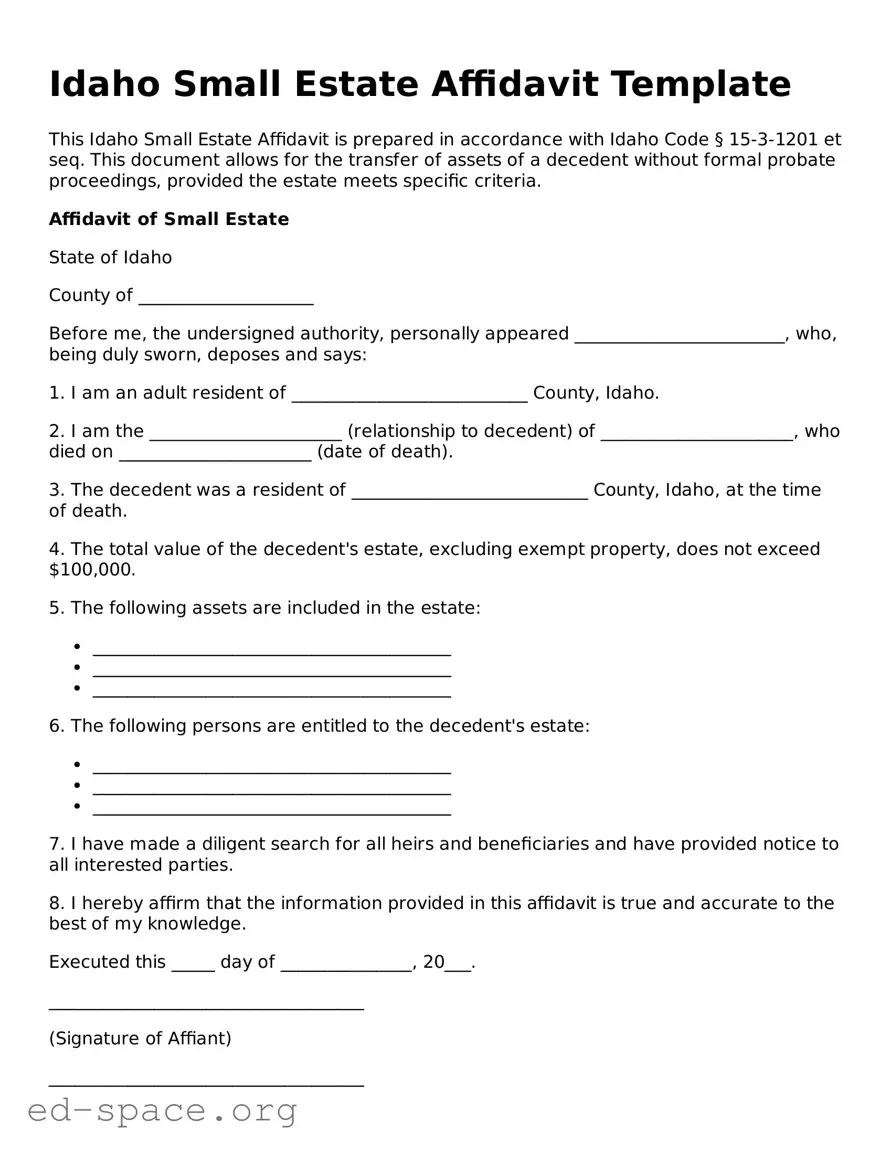
The Idaho Small Estate Affidavit form serves as a valuable tool for individuals seeking to settle the estates of deceased persons without the need for formal probate proceedings. This form simplifies the process for estates with a total value that does not exceed a specific threshold, allowing heirs to claim assets directly. By using this affidavit, eligible individuals can efficiently transfer property, including bank accounts, vehicles, and personal belongings, while minimizing the time and costs typically associated with probate. The affidavit requires the completion of specific information, including the decedent’s details, a list of assets, and the names of the heirs. Additionally, it must be signed under penalty of perjury, ensuring that the information provided is accurate and truthful. Understanding the requirements and implications of this form is crucial for those navigating the estate settlement process in Idaho.
Idaho Small Estate Affidavit Template
This Idaho Small Estate Affidavit is prepared in accordance with Idaho Code § 15-3-1201 et seq. This document allows for the transfer of assets of a decedent without formal probate proceedings, provided the estate meets specific criteria.
Affidavit of Small Estate
State of Idaho
County of ____________________
Before me, the undersigned authority, personally appeared ________________________, who, being duly sworn, deposes and says:
1. I am an adult resident of ___________________________ County, Idaho.
2. I am the ______________________ (relationship to decedent) of ______________________, who died on ______________________ (date of death).
3. The decedent was a resident of ___________________________ County, Idaho, at the time of death.
4. The total value of the decedent's estate, excluding exempt property, does not exceed $100,000.
5. The following assets are included in the estate:
6. The following persons are entitled to the decedent's estate:
7. I have made a diligent search for all heirs and beneficiaries and have provided notice to all interested parties.
8. I hereby affirm that the information provided in this affidavit is true and accurate to the best of my knowledge.
Executed this _____ day of _______________, 20___.
____________________________________
(Signature of Affiant)
____________________________________
(Printed Name of Affiant)
____________________________________
(Address of Affiant)
____________________________________
(Phone Number of Affiant)
Sworn to and subscribed before me this _____ day of _______________, 20___.
____________________________________
(Notary Public)
My commission expires: _______________
| Fact Name | Description |
|---|---|
| Purpose | The Idaho Small Estate Affidavit allows heirs to claim property without going through formal probate, simplifying the transfer process for small estates. |
| Eligibility | To use the affidavit, the total value of the estate must not exceed $100,000, excluding certain exempt property. |
| Governing Law | The use of the Small Estate Affidavit is governed by Idaho Code § 15-3-1201 through § 15-3-1206. |
| Filing Requirements | The affidavit must be signed by the heir and filed with the appropriate county clerk, along with a certified death certificate. |
| Limitations | Not all assets can be transferred using this affidavit; certain types of property may require different procedures. |
After gathering the necessary information and documentation, you are ready to fill out the Idaho Small Estate Affidavit form. Completing this form accurately is crucial for the efficient transfer of assets. Follow these steps carefully to ensure compliance with Idaho state requirements.
What is the Idaho Small Estate Affidavit?
The Idaho Small Estate Affidavit is a legal document that allows individuals to settle the estate of a deceased person without going through the formal probate process. This form is typically used when the total value of the estate is below a certain threshold, making it a simpler and quicker option for heirs and beneficiaries.
Who can use the Small Estate Affidavit in Idaho?
Any individual who is entitled to inherit property from a deceased person can use the Small Estate Affidavit. This includes heirs, beneficiaries named in a will, or those entitled to inherit under state law if there is no will. However, the total value of the estate must not exceed $100,000 in Idaho for this form to be applicable.
What assets are included in the Small Estate Affidavit?
The Small Estate Affidavit can cover various types of assets, including bank accounts, personal property, and real estate. However, certain assets, like life insurance policies or retirement accounts with designated beneficiaries, are typically excluded since they pass directly to the named beneficiaries outside of the estate.
How do I complete the Small Estate Affidavit?
To complete the Small Estate Affidavit, you will need to provide information about the deceased, including their name, date of death, and a description of the assets. You must also include a statement affirming that the estate qualifies as a small estate under Idaho law. It's important to ensure that all information is accurate and complete to avoid any delays in the process.
Do I need to file the Small Estate Affidavit with the court?
In Idaho, you do not need to file the Small Estate Affidavit with the court unless a specific asset requires it. Instead, you can present the affidavit directly to financial institutions or other entities holding the deceased's assets to facilitate the transfer of ownership.
Is there a waiting period before I can use the Small Estate Affidavit?
There is no mandatory waiting period before using the Small Estate Affidavit. However, it is advisable to wait until you have gathered all necessary information and documentation regarding the deceased's assets. This preparation ensures a smoother process when presenting the affidavit.
Can multiple heirs use the Small Estate Affidavit?
Yes, multiple heirs can use the Small Estate Affidavit, but they must all agree on how the assets will be distributed. The affidavit should include the names and signatures of all heirs involved, confirming their consent to the distribution outlined in the document.
What happens if the estate exceeds the small estate limit?
If the estate's total value exceeds the $100,000 limit, you will need to go through the formal probate process. This process can be more complex and time-consuming, requiring the appointment of a personal representative to manage the estate's distribution according to Idaho probate laws.
Are there any fees associated with filing the Small Estate Affidavit?
There are generally no filing fees for the Small Estate Affidavit itself, as it is not filed with the court. However, you may encounter fees when obtaining certified copies of the affidavit or when dealing with financial institutions that may have their own processing fees.
Where can I find the Idaho Small Estate Affidavit form?
You can find the Idaho Small Estate Affidavit form online through the Idaho state government website or at your local county clerk's office. It is important to ensure you are using the most current version of the form to comply with state requirements.
Inaccurate Information: One common mistake occurs when individuals provide incorrect details about the deceased. This can include misspelling names, providing the wrong date of death, or failing to include all relevant heirs. Such inaccuracies can lead to delays in the estate settlement process.
Missing Signatures: Another frequent error is neglecting to obtain necessary signatures. The affidavit must be signed by all heirs or beneficiaries. If even one signature is missing, the affidavit may be considered incomplete, which can hinder the distribution of assets.
Failure to Meet Asset Limits: Individuals sometimes overlook the specific asset limits set by Idaho law. If the total value of the estate exceeds the threshold for small estates, the affidavit cannot be used. This mistake can result in the need for a more complex probate process.
Not Including Required Documentation: Lastly, many people forget to attach necessary supporting documents. This can include a certified copy of the death certificate or proof of the deceased’s assets. Without these documents, the affidavit may be rejected by the court or financial institutions.
When dealing with small estates in Idaho, several forms and documents may be necessary to ensure a smooth process. These documents help clarify the distribution of assets and provide legal backing to the claims made by heirs or beneficiaries. Below is a list of commonly used forms alongside the Idaho Small Estate Affidavit.
Each of these documents plays a vital role in the estate settlement process. Having them prepared and organized can significantly ease the burden on heirs and ensure that the deceased's wishes are honored. Understanding these forms will help facilitate a smoother transition during a difficult time.
The Small Estate Affidavit is a useful legal document that helps individuals settle the affairs of a deceased loved one without going through the lengthy probate process. Several other documents serve similar purposes, each designed to simplify the management of an estate. Below is a list of documents that share similarities with the Small Estate Affidavit:
When filling out the Idaho Small Estate Affidavit form, it is important to follow certain guidelines to ensure the process is smooth and compliant with state requirements. Below are some recommendations on what to do and what to avoid.
Understanding the Idaho Small Estate Affidavit can help streamline the process of settling a loved one's estate. However, several misconceptions often arise regarding this form. Here are eight common misunderstandings:
This is not true. The Small Estate Affidavit is designed for estates with a total value below a certain threshold, making it accessible for many individuals, regardless of their wealth.
While the affidavit simplifies the process, it does not completely eliminate the probate process for all estates. It only applies to qualifying small estates.
Only certain individuals, typically heirs or beneficiaries, are eligible to file this affidavit. There are specific requirements that must be met.
Each state has its own regulations and forms. The Idaho Small Estate Affidavit is unique to Idaho and may differ from those in other states.
While the affidavit can expedite the process, there may still be waiting periods or additional steps required before assets are accessible.
This is a common misconception. While debts should be addressed, the Small Estate Affidavit allows for the transfer of assets without the full settlement of all debts.
This form is typically limited to certain types of assets, such as personal property or bank accounts. Real estate and other complex assets may require different processes.
This is incorrect. If circumstances change, such as the discovery of additional assets or debts, it may be possible to revoke or amend the affidavit.
By addressing these misconceptions, individuals can better navigate the process of settling small estates in Idaho.
Filling out and using the Idaho Small Estate Affidavit form can be a straightforward process if you keep a few key points in mind. This form allows for the efficient transfer of assets without going through the lengthy probate process. Here are some essential takeaways to consider:
By understanding these key aspects, you can navigate the process of using the Idaho Small Estate Affidavit more effectively, ensuring a smoother transition of assets.