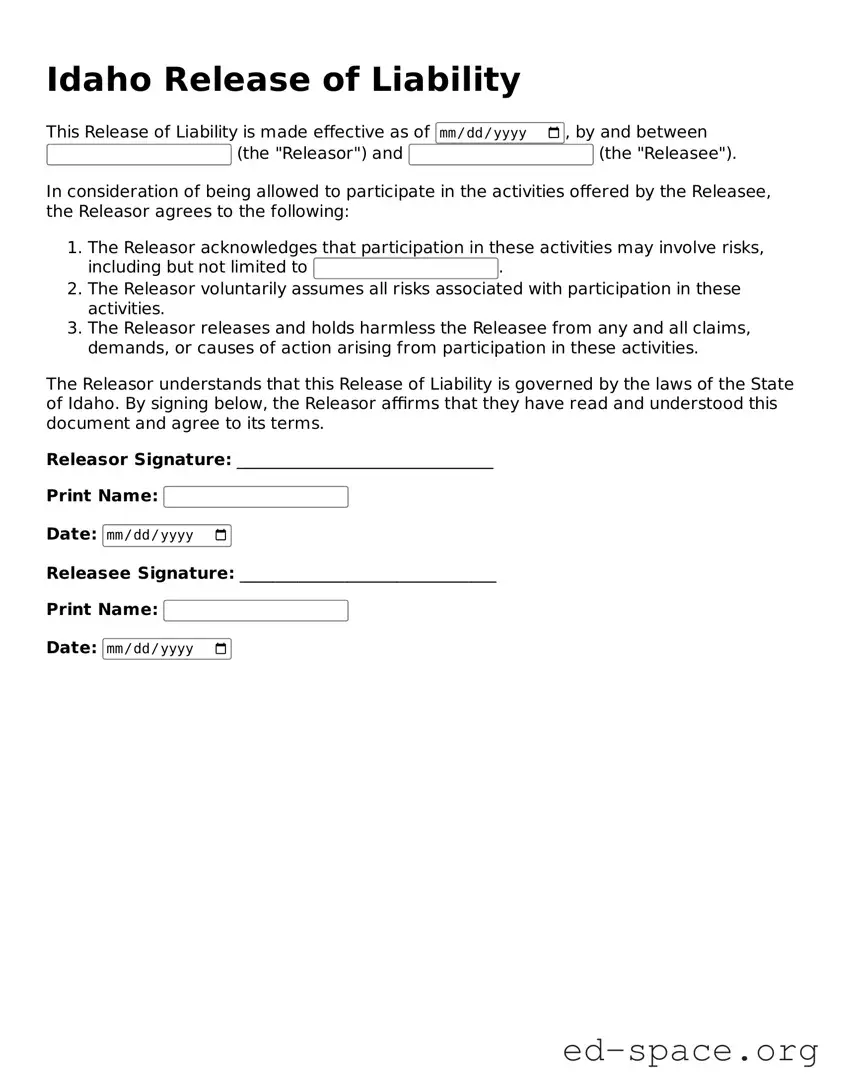
The Idaho Release of Liability form serves as a critical document designed to protect individuals and organizations from legal claims arising from injuries or damages that may occur during specific activities. This form is commonly utilized in various contexts, including recreational events, sports activities, and other potentially hazardous undertakings. By signing the form, participants acknowledge the inherent risks associated with the activity and agree to waive their right to hold the organization or individuals responsible for any injuries sustained. The document typically outlines the nature of the activity, the risks involved, and the rights being relinquished. Additionally, it often includes provisions for minors, requiring parental consent to ensure that guardians are aware of the risks their children may face. Understanding the nuances of this form is essential for both participants and organizers, as it establishes a clear understanding of liability and responsibility, ultimately fostering a safer environment for all involved.
Idaho Release of Liability
This Release of Liability is made effective as of , by and between (the "Releasor") and (the "Releasee").
In consideration of being allowed to participate in the activities offered by the Releasee, the Releasor agrees to the following:
The Releasor understands that this Release of Liability is governed by the laws of the State of Idaho. By signing below, the Releasor affirms that they have read and understood this document and agree to its terms.
Releasor Signature: _______________________________
Print Name:
Date:
Releasee Signature: _______________________________
Print Name:
Date:
| Fact Name | Details |
|---|---|
| Purpose | The Idaho Release of Liability form is designed to protect individuals and organizations from legal claims arising from participation in activities. |
| Governing Law | This form is governed by Idaho state law, particularly under the principles of contract law and liability waivers. |
| Participants | It is commonly used by organizations hosting events, such as sports leagues, recreational facilities, and adventure companies. |
| Voluntary Agreement | Participants must voluntarily agree to the terms outlined in the form before engaging in the activity. |
| Scope of Release | The form typically releases the organization from liability for injuries or damages that may occur during the activity. |
| Consideration | In legal terms, consideration refers to something of value exchanged; in this case, participation in the activity serves as consideration. |
| Minors | If a participant is a minor, a parent or guardian must sign the form on their behalf to ensure its validity. |
| Enforceability | For the form to be enforceable, it must be clear, specific, and not unconscionable or against public policy. |
| Legal Review | It is advisable for organizations to have the form reviewed by a legal professional to ensure compliance with Idaho laws. |
| Retention | Organizations should retain signed forms for a specified period, typically for several years, in case of future claims. |
Filling out the Idaho Release of Liability form is straightforward. Once completed, you can submit it as required for your specific situation. Ensure that all information is accurate to avoid any potential issues.
What is an Idaho Release of Liability form?
The Idaho Release of Liability form is a legal document designed to protect individuals and organizations from liability for injuries or damages that may occur during specific activities. By signing this form, participants acknowledge the risks involved and agree not to hold the organizers or property owners responsible for any accidents that may occur.
When should I use a Release of Liability form?
This form is commonly used in situations involving recreational activities, events, or programs where there is a potential for injury. Examples include sports events, outdoor adventures, and community gatherings. If you are organizing such an event, it is advisable to have participants sign this form to mitigate potential legal claims.
Who should sign the Release of Liability form?
All participants in the activity should sign the form. If a participant is a minor, a parent or legal guardian must sign on their behalf. This ensures that the responsible adult acknowledges the risks involved and agrees to the terms of the release.
Does signing the Release of Liability form mean I cannot sue?
While signing the form does limit your ability to sue for injuries related to the activity, it does not completely eliminate your rights. If negligence or willful misconduct can be proven, a lawsuit may still be possible. The form primarily protects against claims arising from inherent risks associated with the activity.
Is the Release of Liability form legally binding?
Yes, the form is generally considered legally binding if it is properly drafted and signed. However, enforceability can depend on various factors, including clarity of language, the context in which it was signed, and state laws. It is crucial to ensure that the form is clear and comprehensive to uphold its validity.
Can the Release of Liability form be modified?
Yes, the form can be modified to fit the specific needs of the event or activity. However, any changes should be carefully considered and clearly communicated to participants. It is advisable to consult with a legal professional to ensure that modifications do not compromise the form’s effectiveness.
Where can I obtain a Release of Liability form for Idaho?
Release of Liability forms can often be found online through legal document websites, or they can be drafted by a legal professional to ensure compliance with Idaho laws. It is important to use a form that is specific to Idaho to ensure that it meets all legal requirements.
Failing to read the entire form carefully. Understanding all sections is crucial before signing.
Not providing accurate personal information. Double-check names, addresses, and contact details for errors.
Leaving out important details about the activity. Clearly describe the nature of the activity to avoid ambiguity.
Not signing the form. A signature is necessary to validate the release of liability.
Ignoring the date. Ensure the form is dated correctly to reflect when the release is executed.
Not having a witness or notary when required. Some situations may require additional verification.
Overlooking the consequences of the release. Understand what rights are being waived before signing.
Using unclear or vague language. Be specific to avoid misunderstandings about the terms of the release.
Assuming the form is standard. Each situation may require specific wording or clauses tailored to the activity.
Not keeping a copy of the signed form. Retain a copy for personal records and future reference.
The Idaho Release of Liability form is an essential document used to protect individuals and organizations from legal claims related to activities that may result in injury or damage. However, it is often accompanied by other forms and documents that serve complementary purposes. Below is a list of commonly used forms that may be relevant when executing a Release of Liability.
Utilizing these forms alongside the Idaho Release of Liability can help create a safer environment for all parties involved. Each document plays a vital role in clarifying expectations and responsibilities, ultimately fostering a sense of security and understanding among participants.
A Release of Liability form is a common document used to protect individuals and organizations from legal claims. It is similar to several other documents that serve similar purposes. Here’s a list of seven documents that share similarities with a Release of Liability form:
Each of these documents plays a crucial role in managing risk and protecting parties involved in various activities or agreements. Understanding their similarities can help you choose the right form for your needs.
When filling out the Idaho Release of Liability form, it’s essential to approach the task with care. Here are ten important dos and don’ts to consider:
By following these guidelines, you can ensure that your Release of Liability form is completed correctly and effectively. This helps protect your interests and clarifies your intentions regarding the activity involved.
When it comes to the Idaho Release of Liability form, several misconceptions often arise. Understanding the truth behind these misunderstandings can help individuals make informed decisions. Here are four common misconceptions:
By dispelling these misconceptions, individuals can better understand the purpose and limitations of the Idaho Release of Liability form. Always consider seeking professional advice to ensure that your rights and interests are adequately protected.
When filling out and using the Idaho Release of Liability form, consider the following key takeaways: