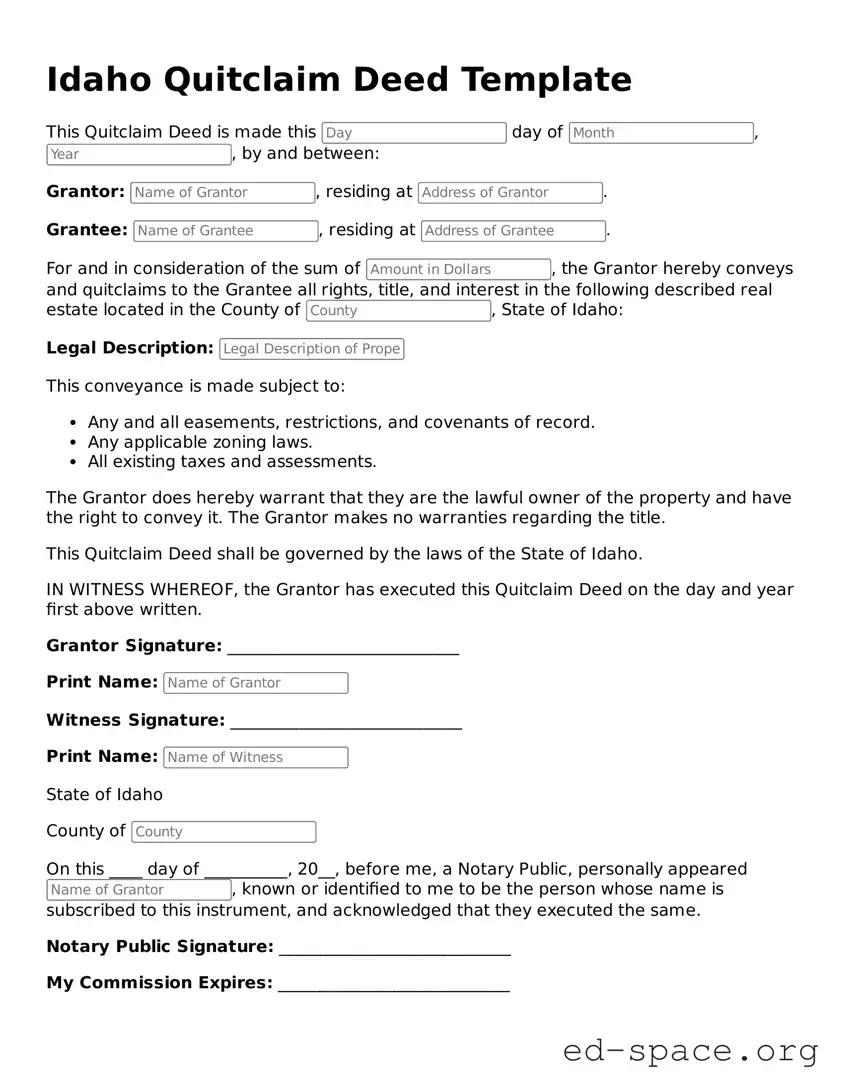
The Idaho Quitclaim Deed form serves as a crucial tool for property transfers, allowing individuals to relinquish their interest in real estate without guaranteeing any title rights. This form is particularly useful in situations where the transferor may not hold a clear title, such as when property is gifted between family members or during divorce settlements. It simplifies the process by enabling the transfer of ownership without the complexities associated with warranties or guarantees. The form must include essential details such as the names of the grantor and grantee, a legal description of the property, and the date of execution. Additionally, it requires the signature of the grantor, and while notarization is not mandatory, it is highly recommended to ensure the document's validity. Understanding the implications of using a Quitclaim Deed is vital, as it may affect future claims to the property and the rights of the parties involved.
Idaho Quitclaim Deed Template
This Quitclaim Deed is made this day of , , by and between:
Grantor: , residing at .
Grantee: , residing at .
For and in consideration of the sum of , the Grantor hereby conveys and quitclaims to the Grantee all rights, title, and interest in the following described real estate located in the County of , State of Idaho:
Legal Description:
This conveyance is made subject to:
The Grantor does hereby warrant that they are the lawful owner of the property and have the right to convey it. The Grantor makes no warranties regarding the title.
This Quitclaim Deed shall be governed by the laws of the State of Idaho.
IN WITNESS WHEREOF, the Grantor has executed this Quitclaim Deed on the day and year first above written.
Grantor Signature: ____________________________
Print Name:
Witness Signature: ____________________________
Print Name:
State of Idaho
County of
On this ____ day of __________, 20__, before me, a Notary Public, personally appeared , known or identified to me to be the person whose name is subscribed to this instrument, and acknowledged that they executed the same.
Notary Public Signature: ____________________________
My Commission Expires: ____________________________
| Fact Name | Details |
|---|---|
| Definition | A quitclaim deed is a legal document that transfers ownership of property from one party to another without any warranties. |
| Purpose | This form is typically used to clear up title issues or transfer property between family members. |
| Governing Law | The Idaho Quitclaim Deed is governed by Idaho Code § 55-601 through § 55-607. |
| Signature Requirement | The grantor must sign the deed in front of a notary public for it to be valid. |
| Recording | It is recommended to record the quitclaim deed with the county recorder's office to provide public notice of the transfer. |
| No Guarantees | The quitclaim deed does not guarantee that the grantor has clear title to the property. |
| Consideration | While a nominal consideration is often stated, it is not required for the deed to be valid. |
| Use Cases | Commonly used for transfers between spouses, family members, or in divorce settlements. |
After completing the Idaho Quitclaim Deed form, you will need to file it with the appropriate county recorder’s office. This process officially transfers the property rights as indicated on the form. Ensure that you have all necessary information ready for submission.
What is a Quitclaim Deed in Idaho?
A Quitclaim Deed is a legal document used to transfer ownership of real estate in Idaho. Unlike a warranty deed, a quitclaim deed does not guarantee that the grantor (the person transferring the property) has clear title to the property. Instead, it simply conveys whatever interest the grantor may have in the property, if any. This type of deed is often used between family members or in situations where the property title is not in dispute.
When should I use a Quitclaim Deed?
Quitclaim Deeds are commonly used in various scenarios. They are particularly useful for transferring property between family members, such as when a parent transfers property to a child. They can also be employed to clear up title issues, such as when a co-owner wants to relinquish their interest in a property. Additionally, they may be used in divorce settlements where one spouse is granted full ownership of a property.
How do I complete a Quitclaim Deed in Idaho?
To complete a Quitclaim Deed in Idaho, you will need to gather specific information, including the names of the grantor and grantee, a legal description of the property, and the date of the transfer. After filling out the form, it must be signed by the grantor in the presence of a notary public. Once notarized, the deed should be filed with the county recorder's office where the property is located to ensure that the transfer is officially recorded.
Is a Quitclaim Deed the same as a Warranty Deed?
No, a Quitclaim Deed is not the same as a Warranty Deed. A Warranty Deed provides a guarantee that the grantor holds clear title to the property and has the right to transfer it. In contrast, a Quitclaim Deed offers no such guarantees. It simply transfers whatever interest the grantor may have, which could be nothing at all. This makes Quitclaim Deeds less secure for the grantee.
Do I need an attorney to prepare a Quitclaim Deed in Idaho?
What are the tax implications of using a Quitclaim Deed?
Using a Quitclaim Deed may have tax implications, particularly concerning property taxes and capital gains taxes. In Idaho, transferring property through a Quitclaim Deed does not typically trigger a reassessment of property taxes, but it is essential to consult a tax professional for specific advice. Additionally, if the property is sold later, the grantee may be subject to capital gains taxes based on the original purchase price and the sale price.
Can a Quitclaim Deed be revoked?
A Quitclaim Deed, once executed and recorded, cannot be unilaterally revoked by the grantor. However, the grantor may create a new deed to transfer the property back or to another party. It is important to note that any new transfer must also be properly executed and recorded to be legally effective.
How do I find a Quitclaim Deed form for Idaho?
Quitclaim Deed forms for Idaho can be obtained from various sources. Many county recorder's offices provide templates online. Additionally, legal websites often offer downloadable forms. It is crucial to ensure that the form used complies with Idaho state laws and includes all necessary information for a valid property transfer.
Incorrect Grantee Information: Failing to provide the full legal name of the person or entity receiving the property can lead to issues with ownership transfer.
Missing Signatures: Both the grantor and the grantee must sign the document. Omitting one or both signatures invalidates the deed.
Improper Notarization: The deed must be notarized correctly. Without a notary’s signature and seal, the document may not be legally binding.
Incorrect Property Description: A vague or incomplete description of the property can create confusion. Always include the exact address and legal description.
Failure to Record the Deed: After completing the deed, it must be recorded with the appropriate county office. Neglecting this step can lead to disputes over ownership.
Omitting the Date: Failing to date the document can raise questions about when the transfer occurred, leading to potential legal challenges.
Not Understanding the Implications: Some individuals do not fully grasp that a quitclaim deed offers no guarantees about the property title. This can lead to unexpected liabilities.
Using an Incorrect Form: Utilizing an outdated or incorrect version of the quitclaim deed form can result in rejection by the county office.
Neglecting to Consult a Professional: Some people attempt to fill out the form without seeking legal advice. This can lead to mistakes that may have been easily avoided.
When completing a property transfer in Idaho using a Quitclaim Deed, several additional forms and documents may be required to ensure a smooth transaction. Each of these documents serves a specific purpose in the process, providing necessary information and legal protections for all parties involved.
Gathering these documents ahead of time can streamline the property transfer process and help avoid potential delays. Each form plays a vital role in ensuring that the transaction is legally sound and that both parties are protected.
The Quitclaim Deed is a specific type of legal document used to transfer ownership of property. It shares similarities with several other documents in real estate transactions. Below are four documents that are similar to the Quitclaim Deed:
When filling out the Idaho Quitclaim Deed form, attention to detail is crucial. Here are some key dos and don'ts to ensure a smooth process.
Following these guidelines will help ensure that the Quitclaim Deed form is filled out correctly and efficiently.
When it comes to real estate transactions in Idaho, the Quitclaim Deed form often stirs up confusion. Here are eight common misconceptions about this type of deed, along with clarifications to help you understand its purpose and limitations.
This is not true. A Quitclaim Deed transfers whatever interest the grantor has in the property, but it does not guarantee that the title is clear or free from claims. It’s essential to conduct a title search for assurance.
While they are commonly used in family transfers, Quitclaim Deeds can be used for any type of property transfer. They are often employed in divorce settlements or to clear up title issues.
Though it’s wise to consult an attorney for complex transactions, you can fill out and file a Quitclaim Deed without legal assistance. Just ensure you follow the correct procedures.
This is misleading. While the deed transfers ownership, it does not remove any existing liens or mortgages. The new owner may still be responsible for these financial obligations.
Quitclaim Deeds are used in many states across the U.S., not just Idaho. However, the specific requirements and implications can vary by state, so it’s important to understand local laws.
This is incorrect. While you can use a Quitclaim Deed to transfer property to a trust, it’s important to ensure that the trust is properly established and recognized under Idaho law.
Actually, you can sell property acquired through a Quitclaim Deed. However, the buyer may want to conduct a title search to ensure there are no hidden issues.
This is a common misunderstanding. A Warranty Deed offers guarantees about the title, while a Quitclaim Deed does not. The differences are significant and can affect your rights as a property owner.
Filling out and using the Idaho Quitclaim Deed form requires attention to detail and an understanding of its purpose. Here are some key takeaways to consider: