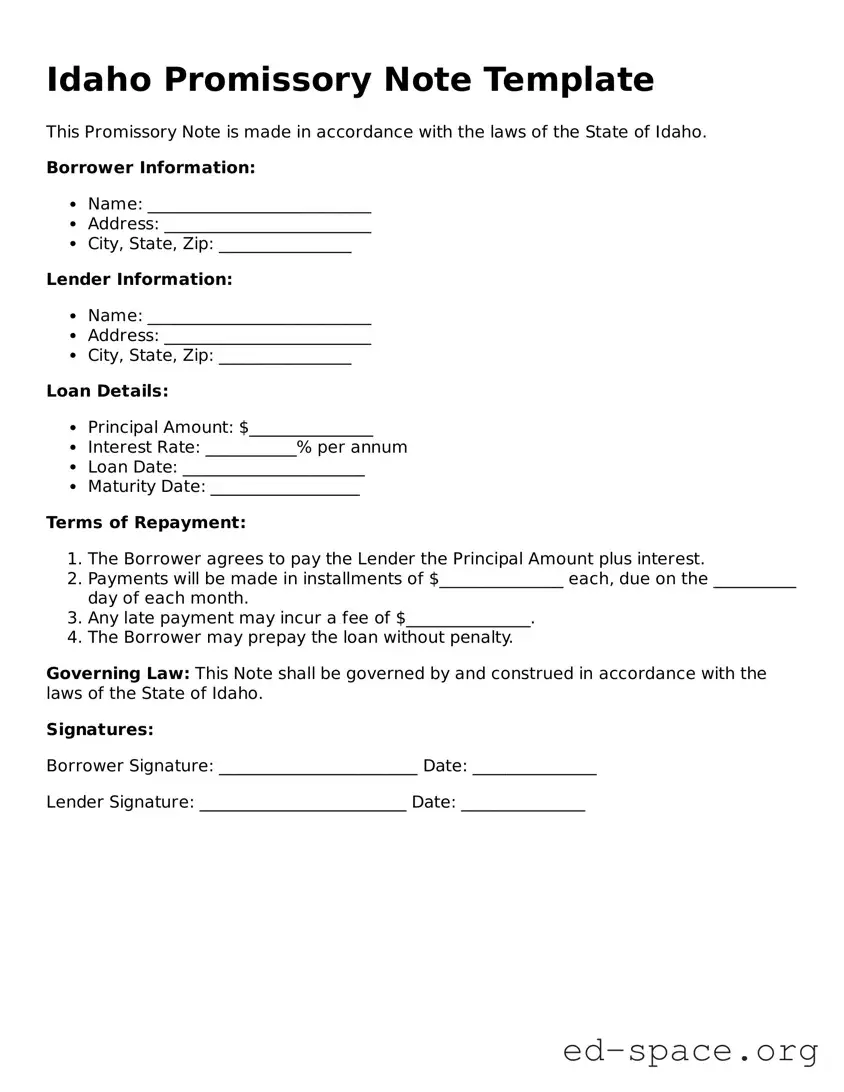
In Idaho, the Promissory Note serves as a crucial financial instrument that formalizes a borrower's commitment to repay a loan under specified terms. This document outlines the principal amount borrowed, the interest rate applicable, and the repayment schedule, ensuring clarity for both parties involved. Additionally, it may include provisions for late fees, default conditions, and any collateral securing the loan. Understanding the nuances of this form is essential for both lenders and borrowers, as it establishes legal rights and obligations. By detailing the terms in a straightforward manner, the Promissory Note helps prevent misunderstandings and disputes down the line, making it an indispensable tool in personal and commercial finance within the state.
Idaho Promissory Note Template
This Promissory Note is made in accordance with the laws of the State of Idaho.
Borrower Information:
Lender Information:
Loan Details:
Terms of Repayment:
Governing Law: This Note shall be governed by and construed in accordance with the laws of the State of Idaho.
Signatures:
Borrower Signature: ________________________ Date: _______________
Lender Signature: _________________________ Date: _______________
| Fact Name | Details |
|---|---|
| Definition | An Idaho Promissory Note is a written promise to pay a specific amount of money to a designated person or entity at a specified time. |
| Governing Law | The laws governing promissory notes in Idaho are primarily found in the Idaho Uniform Commercial Code (UCC), specifically under Title 28. |
| Parties Involved | Typically, there are two parties: the borrower (maker) who promises to pay, and the lender (payee) who receives the payment. |
| Interest Rate | The interest rate can be specified in the note, and it must comply with Idaho state laws regarding usury limits. |
| Payment Terms | Payment terms can vary; the note may require a lump sum payment or installment payments over a specified period. |
| Signatures | The promissory note must be signed by the borrower to be legally binding, and it is advisable for the lender to also sign. |
| Enforceability | If properly executed, a promissory note is enforceable in a court of law, meaning the lender can seek legal remedies if the borrower defaults. |
| Default Conditions | Default conditions should be clearly outlined in the note, detailing what constitutes a default and the consequences that follow. |
After obtaining the Idaho Promissory Note form, you will need to complete it accurately. Ensure that all information is provided as required. This document will serve as a formal agreement between the lender and the borrower.
Once completed, review the form for accuracy. Ensure that all parties have copies of the signed document for their records.
What is a promissory note?
A promissory note is a written promise to pay a specific amount of money to a designated person or entity at a defined time. It outlines the terms of the loan, including the interest rate, repayment schedule, and any penalties for late payments. This document serves as a legal record of the agreement between the borrower and the lender.
Why would I need a promissory note in Idaho?
In Idaho, a promissory note is essential for formalizing a loan agreement. It protects both parties by providing clear terms and conditions. If a dispute arises, having a written note can serve as evidence in court, ensuring that the lender's rights are upheld and the borrower's obligations are clear.
What information should be included in an Idaho promissory note?
An Idaho promissory note should include the following details: the names and addresses of the borrower and lender, the principal amount being borrowed, the interest rate, the repayment schedule, any late fees or penalties, and the date of the agreement. Additionally, it should specify whether the note is secured or unsecured.
Is it necessary to have a witness or notarization for a promissory note in Idaho?
While Idaho law does not require a promissory note to be notarized or witnessed, having one can add an extra layer of security. A notarized document can help prove the authenticity of the signatures and the agreement, which may be beneficial if disputes arise later.
Can I use a promissory note for personal loans?
Yes, promissory notes are commonly used for personal loans. Whether borrowing from a friend, family member, or a financial institution, having a written note helps clarify the terms of the loan and ensures that both parties understand their rights and responsibilities.
What happens if I default on a promissory note?
If a borrower defaults on a promissory note, the lender has several options. They may pursue legal action to recover the owed amount, including filing a lawsuit. The specifics of the consequences will depend on the terms outlined in the note and the laws governing such agreements in Idaho.
Can I modify the terms of a promissory note after it has been signed?
Yes, the terms of a promissory note can be modified, but both parties must agree to the changes. It is advisable to document any amendments in writing and have both parties sign the modified agreement to ensure clarity and enforceability.
Are there different types of promissory notes?
Yes, there are various types of promissory notes, including secured and unsecured notes. A secured promissory note is backed by collateral, such as property or assets, while an unsecured note does not require collateral. The choice between the two depends on the lender's preferences and the borrower's situation.
How long is a promissory note valid in Idaho?
In Idaho, the statute of limitations for enforcing a promissory note is typically five years. This means that the lender has five years from the date of default to take legal action. However, it is always best to address any outstanding payments as soon as possible to avoid complications.
Where can I find a promissory note template for Idaho?
Promissory note templates can be found online through various legal websites or document preparation services. It's important to ensure that the template complies with Idaho laws and meets your specific needs. Consulting with a legal professional can also provide tailored guidance for your situation.
Incomplete Information: One of the most common mistakes is failing to provide all necessary details. Ensure that all fields, such as the names of the borrower and lender, loan amount, and interest rate, are filled out completely. Missing information can lead to confusion or disputes later.
Incorrect Loan Terms: Misunderstanding the terms of the loan can lead to serious issues. Double-check the interest rate, repayment schedule, and any penalties for late payments. These details should be clear and accurate to avoid future complications.
Failure to Sign: A promissory note is not valid unless it is signed by both parties. Many people overlook this step, thinking that simply filling out the form is enough. Remember, both the borrower and lender must sign to make the agreement legally binding.
Not Keeping Copies: After completing the promissory note, it’s essential to keep copies for your records. Failing to do so can create problems if disputes arise. Each party should retain a signed copy to reference if needed in the future.
The Idaho Promissory Note is a crucial document for recording a borrower's promise to repay a loan under specified terms. Alongside this form, several other documents may be necessary to ensure the transaction is legally sound and clearly understood by all parties involved. Below is a list of additional forms and documents often used in conjunction with the Idaho Promissory Note.
Each of these documents plays a significant role in the lending process, ensuring clarity and protection for both lenders and borrowers. By using them in conjunction with the Idaho Promissory Note, parties can navigate their financial agreements with greater confidence.
A Promissory Note is a financial document that establishes a promise to pay a specified amount of money to a designated person or entity under agreed-upon terms. Several other documents share similarities with a Promissory Note. Below are nine such documents, each with a brief explanation of their relation to a Promissory Note.
When filling out the Idaho Promissory Note form, it's essential to be thorough and accurate. Here’s a list of ten things you should and shouldn't do to ensure the process goes smoothly.
By following these guidelines, you can help ensure that your Idaho Promissory Note is completed correctly and serves its intended purpose effectively.
Understanding the Idaho Promissory Note form is essential for anyone involved in lending or borrowing money. However, several misconceptions can lead to confusion. Here are seven common misconceptions:
By clearing up these misconceptions, individuals can better navigate the lending process and understand their rights and responsibilities when using the Idaho Promissory Note form.
When filling out and using the Idaho Promissory Note form, it is essential to keep several key points in mind. Understanding these takeaways will help ensure clarity and compliance.
By paying attention to these aspects, both parties can protect their interests and maintain a clear understanding of the agreement.