In the state of Idaho, the Power of Attorney for a Child form serves as a vital legal document that enables parents or legal guardians to designate another individual to make decisions on behalf of their child. This form is particularly useful in various situations, such as when parents are traveling, working long hours, or otherwise unable to provide direct care. The designated individual, often referred to as the agent or attorney-in-fact, gains the authority to make important decisions regarding the child's health, education, and welfare. It is essential that the form is completed accurately and signed in accordance with Idaho laws to ensure its validity. This document not only outlines the scope of authority granted to the agent but also specifies the duration of the power, which can be temporary or more long-term, depending on the needs of the family. Additionally, the form may include provisions for the agent to make medical decisions, enroll the child in school, or manage day-to-day activities, all aimed at safeguarding the child's best interests while the parents are unavailable.
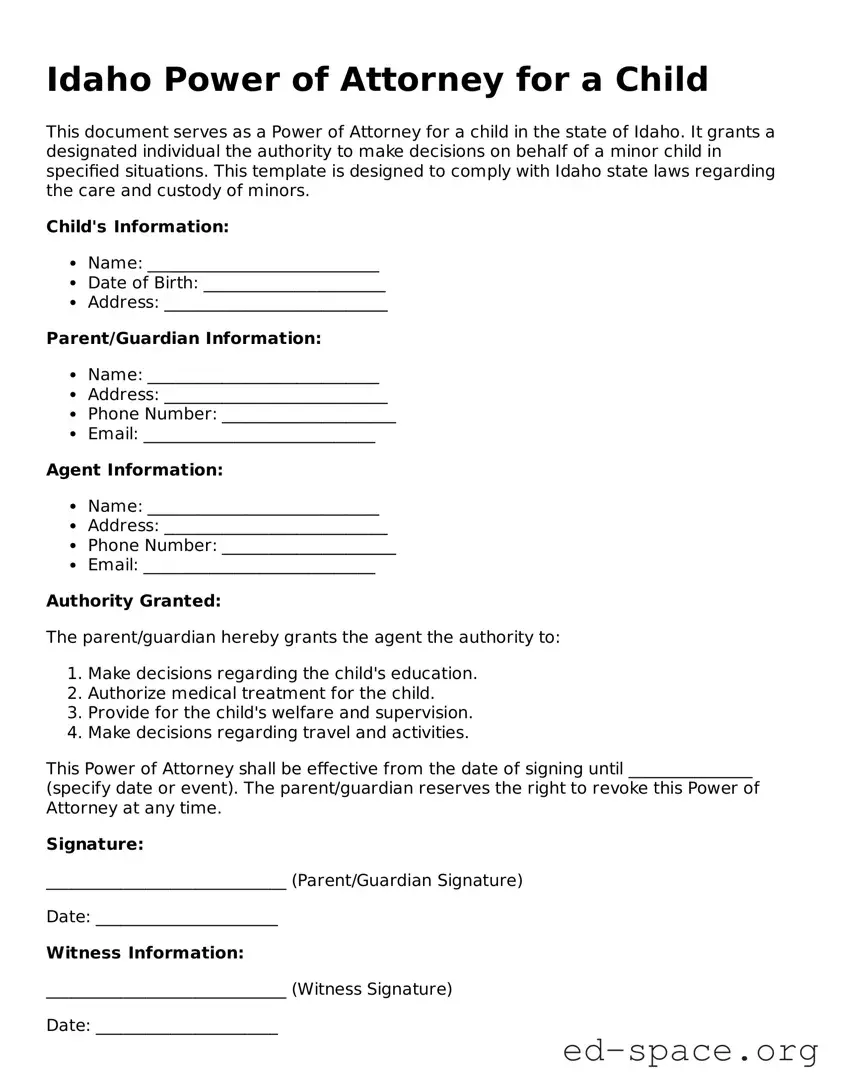
Idaho Power of Attorney for a Child
This document serves as a Power of Attorney for a child in the state of Idaho. It grants a designated individual the authority to make decisions on behalf of a minor child in specified situations. This template is designed to comply with Idaho state laws regarding the care and custody of minors.
Child's Information:
Parent/Guardian Information:
Agent Information:
Authority Granted:
The parent/guardian hereby grants the agent the authority to:
This Power of Attorney shall be effective from the date of signing until _______________ (specify date or event). The parent/guardian reserves the right to revoke this Power of Attorney at any time.
Signature:
_____________________________ (Parent/Guardian Signature)
Date: ______________________
Witness Information:
_____________________________ (Witness Signature)
Date: ______________________
| Fact Name | Description |
|---|---|
| Purpose | The Idaho Power of Attorney for a Child form allows a parent or legal guardian to designate another adult to make decisions for their child temporarily. |
| Governing Law | This form is governed by Idaho Code § 15-5-501 through § 15-5-505. |
| Duration | The power of attorney can be set for a specific period, or it can remain in effect until revoked by the parent or guardian. |
| Eligibility | Any adult can be appointed as an agent, provided they are willing to take on the responsibilities outlined in the form. |
| Signature Requirement | The form must be signed by the parent or guardian in the presence of a notary public to ensure its validity. |
| Revocation | The parent or guardian can revoke the power of attorney at any time, as long as they provide proper notice to the agent. |
| Limitations | The agent cannot make decisions that are outside the scope of authority granted in the form, such as permanent adoption. |
| Health Care Decisions | The form does not automatically grant the agent authority to make health care decisions unless explicitly stated. |
| Filing Requirements | There are no specific filing requirements with the state; however, keeping a copy of the signed form is advisable for reference. |
Filling out the Idaho Power of Attorney for a Child form is an important step in designating someone to make decisions on behalf of your child when you are unable to do so. This process ensures that your child's needs are met in your absence. Follow these steps to complete the form accurately.
After completing the form, make sure to keep a copy for your records. You may also want to discuss the arrangement with the person you designated to ensure they understand their responsibilities. This proactive step can help ensure your child's well-being in your absence.
What is a Power of Attorney for a Child in Idaho?
A Power of Attorney for a Child in Idaho is a legal document that allows a parent or guardian to grant another adult the authority to make decisions on behalf of their child. This can include decisions related to education, healthcare, and general welfare. It is often used when a parent is unavailable due to travel, work commitments, or other reasons.
Who can be designated as an agent in the Power of Attorney for a Child?
Any responsible adult can be designated as an agent in the Power of Attorney for a Child. This includes relatives, family friends, or other trusted individuals. It is crucial to choose someone who is willing and able to take on the responsibilities outlined in the document.
What decisions can the agent make on behalf of the child?
The agent can make a variety of decisions concerning the child's welfare. This typically includes decisions about medical care, educational needs, and general daily activities. However, the specific powers granted can be tailored in the document, so it is important to clearly outline what the agent is authorized to do.
Is the Power of Attorney for a Child valid in other states?
While the Power of Attorney for a Child is valid in Idaho, its acceptance in other states may vary. Many states recognize out-of-state powers of attorney, but some may have specific requirements. It is advisable to check the laws of the state where the child will be located to ensure the document is honored.
How long does the Power of Attorney for a Child remain in effect?
The Power of Attorney for a Child remains in effect until the specified expiration date outlined in the document or until it is revoked by the parent or guardian. If no expiration date is included, it typically lasts until the child reaches the age of 18, but it is best to clearly define the duration in the document.
Can the Power of Attorney for a Child be revoked?
Yes, the Power of Attorney for a Child can be revoked at any time by the parent or guardian. To revoke it, a written notice should be provided to the agent and any relevant parties. It is advisable to formally document the revocation to avoid any confusion regarding the authority of the agent.
Do I need a lawyer to create a Power of Attorney for a Child?
While it is not legally required to have a lawyer to create a Power of Attorney for a Child, consulting with one can be beneficial. A lawyer can help ensure that the document meets all legal requirements and accurately reflects your intentions. This can provide peace of mind and help prevent potential issues in the future.
Failing to clearly identify the child. It's essential to provide the child's full name, date of birth, and any other identifying information to avoid confusion.
Not specifying the duration of the power of attorney. Indicating the start and end dates is crucial. Without this, the authority may be unclear.
Neglecting to include the names and contact information of the agents. Clearly listing the names, addresses, and phone numbers of those who will act on behalf of the child is vital.
Using vague language. The form should detail the specific powers granted to the agent. General terms can lead to misunderstandings.
Not signing the form in the presence of a notary. A notarized signature is often required to validate the document.
Overlooking witness signatures. Some situations may require additional witnesses to sign the document, depending on local laws.
Failing to provide a copy to all relevant parties. After completing the form, it should be distributed to the agent, the child, and any other necessary individuals.
Ignoring state-specific requirements. Each state may have unique rules regarding powers of attorney, so it’s important to be aware of Idaho's specific laws.
Not reviewing the form for accuracy. Simple mistakes in names or dates can create significant issues down the line.
Delaying the process. Filling out the form in advance of any need can ensure that everything is in order when the time comes.
When considering a Power of Attorney for a Child in Idaho, it's important to be aware of other forms and documents that may complement or support this legal arrangement. These documents can help clarify responsibilities and ensure that the child's needs are met effectively. Here’s a list of some commonly used forms:
Understanding these documents can help parents and caregivers navigate the complexities of child care and legal responsibilities. By having the right forms in place, individuals can ensure the well-being of the child while also protecting their own rights and responsibilities.
When filling out the Idaho Power of Attorney for a Child form, it's important to approach the task with care. Here are some guidelines to help ensure the process goes smoothly.
Understanding the Idaho Power of Attorney for a Child form is essential for parents and guardians. However, several misconceptions can lead to confusion. Here are nine common misconceptions about this form:
By addressing these misconceptions, parents and guardians can make informed decisions regarding the Power of Attorney for a Child in Idaho.
When considering the Idaho Power of Attorney for a Child form, it is important to understand its purpose and proper use. Below are key takeaways to keep in mind:
By following these guidelines, the process of filling out and using the Idaho Power of Attorney for a Child form can be straightforward and effective.