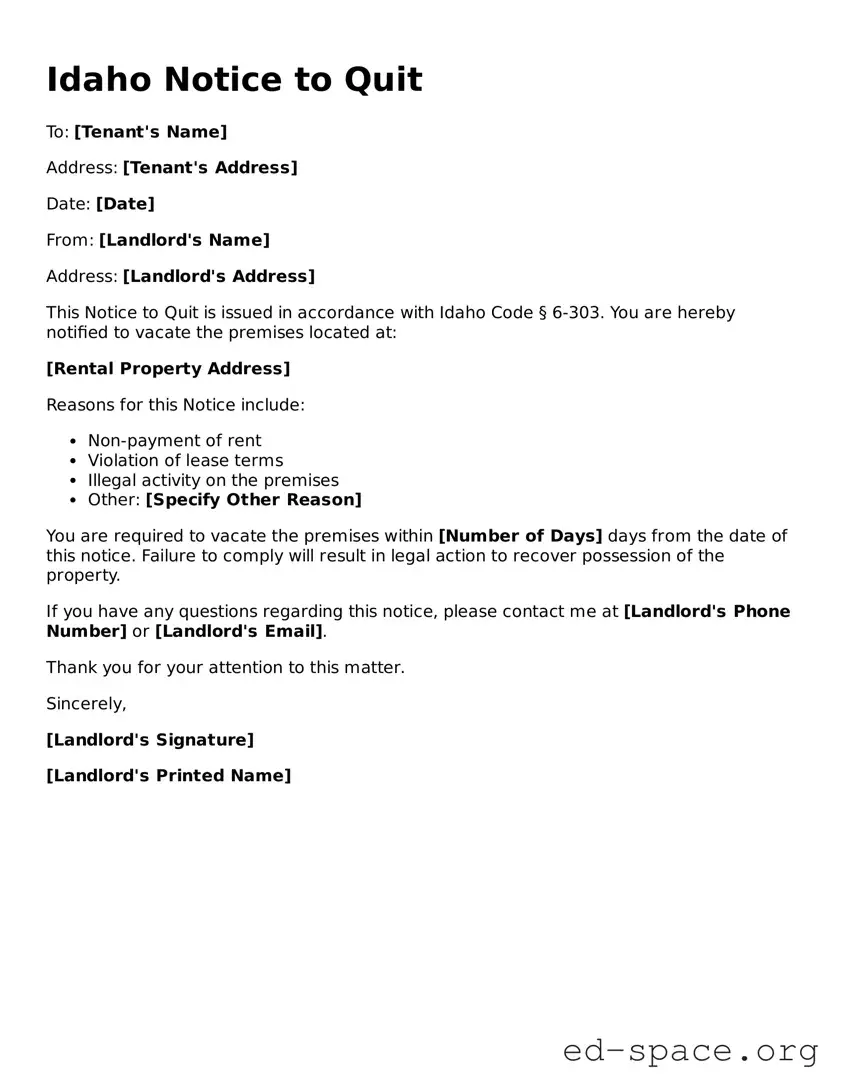
The Idaho Notice to Quit form serves as a crucial tool for landlords and property owners seeking to regain possession of their rental properties. This document outlines the necessary steps to inform tenants of their lease violations or the need to vacate the premises. Typically, the form includes key details such as the tenant's name, the property address, and the specific reasons for the eviction notice. It also specifies the time frame in which the tenant must respond or vacate, ensuring that both parties are aware of their rights and responsibilities. By following the proper procedures outlined in this form, landlords can minimize disputes and streamline the eviction process. Understanding the nuances of this document is essential for both landlords and tenants to navigate the complexities of rental agreements effectively.
Idaho Notice to Quit
To: [Tenant's Name]
Address: [Tenant's Address]
Date: [Date]
From: [Landlord's Name]
Address: [Landlord's Address]
This Notice to Quit is issued in accordance with Idaho Code § 6-303. You are hereby notified to vacate the premises located at:
[Rental Property Address]
Reasons for this Notice include:
You are required to vacate the premises within [Number of Days] days from the date of this notice. Failure to comply will result in legal action to recover possession of the property.
If you have any questions regarding this notice, please contact me at [Landlord's Phone Number] or [Landlord's Email].
Thank you for your attention to this matter.
Sincerely,
[Landlord's Signature]
[Landlord's Printed Name]
| Fact Name | Description |
|---|---|
| Purpose | The Idaho Notice to Quit form is used by landlords to formally notify tenants to vacate the rental property. |
| Governing Law | This form is governed by Idaho Code § 6-303, which outlines the eviction process and tenant rights. |
| Notice Period | Landlords must provide a minimum of 3 days' notice for non-payment of rent, while a 30-day notice is required for lease termination. |
| Delivery Methods | The notice can be delivered in person, by mail, or by posting it on the tenant's door. |
| Tenant Response | Tenants have the right to respond to the notice and may contest the eviction in court if they believe it is unjust. |
| Legal Consequences | Failure to comply with the notice may lead to legal eviction proceedings initiated by the landlord. |
Filling out the Idaho Notice to Quit form is a straightforward process that helps landlords formally notify tenants to vacate a rental property. After completing the form, it is essential to deliver it properly to ensure that it is legally effective.
Once the form is filled out and signed, the next step is to deliver it to the tenant. This can be done in person, by certified mail, or by posting it on the property, depending on the circumstances and legal requirements.
What is a Notice to Quit in Idaho?
A Notice to Quit is a legal document that a landlord uses to inform a tenant that they must vacate the rental property. This notice is typically issued when a tenant has violated the terms of the lease or rental agreement, such as failing to pay rent or causing damage to the property.
When should a landlord use a Notice to Quit?
A landlord should use a Notice to Quit when a tenant has not complied with the lease agreement. Common reasons include non-payment of rent, lease violations, or illegal activities on the premises. The notice serves as an official warning before further legal action, such as eviction, is pursued.
How much notice must a landlord give in Idaho?
The amount of notice required can vary based on the reason for the eviction. For non-payment of rent, a landlord must provide a 3-day notice. For lease violations, the notice period is typically 3 days as well. However, if the tenant is being evicted for other reasons, such as a month-to-month tenancy ending, a 30-day notice may be required.
What information must be included in a Notice to Quit?
A Notice to Quit should include specific information such as the tenant's name, the address of the rental property, the reason for the notice, and the date by which the tenant must vacate. It should also provide details about any actions the tenant can take to remedy the situation, if applicable.
Can a tenant contest a Notice to Quit?
Yes, a tenant can contest a Notice to Quit. If a tenant believes the notice is unjust or that they have rectified the issue, they may respond to the landlord. This could involve paying overdue rent or addressing lease violations. If the situation escalates, the tenant may choose to seek legal counsel to defend their rights.
What happens if a tenant does not comply with a Notice to Quit?
If a tenant does not comply with a Notice to Quit, the landlord may proceed with filing an eviction lawsuit in court. The court will then schedule a hearing to determine whether the eviction is warranted. If the court rules in favor of the landlord, the tenant may be ordered to vacate the property.
Is a Notice to Quit the same as an eviction notice?
No, a Notice to Quit is not the same as an eviction notice. The Notice to Quit is a preliminary step that informs the tenant of the need to vacate the property. An eviction notice follows if the tenant fails to leave by the specified date and legal proceedings are initiated to remove them from the property.
How should a Notice to Quit be delivered to the tenant?
A Notice to Quit can be delivered in several ways, including personal delivery, mailing it to the tenant's address, or posting it on the rental property. It is crucial for the landlord to keep a record of how and when the notice was delivered, as this may be needed for legal proceedings.
Can a landlord issue a Notice to Quit without a written lease?
Yes, a landlord can issue a Notice to Quit even if there is no written lease. In Idaho, verbal agreements are still considered valid. However, the terms of the rental agreement must be clear, and the landlord should be able to demonstrate the tenant's obligations and any violations.
What should tenants do upon receiving a Notice to Quit?
Upon receiving a Notice to Quit, tenants should carefully read the document to understand the reasons for the notice and the timeframe given. They should consider addressing any issues mentioned, such as paying overdue rent or correcting lease violations. Seeking legal advice may also be beneficial to understand their rights and options.
Failing to include the correct tenant's name. Ensure the name matches the lease agreement.
Not providing the property address. Include the full address to avoid confusion.
Missing the date of the notice. This is crucial for establishing timelines.
Using unclear or vague language. Be direct about the reason for the notice.
Not signing the form. A signature is necessary to validate the notice.
Omitting the landlord's contact information. Provide a phone number or email for follow-up.
Failing to specify the timeframe for compliance. Clearly state how long the tenant has to respond.
Not keeping a copy of the notice. Always retain a copy for your records.
Ignoring local laws. Check any specific requirements that may apply in your area.
When dealing with rental agreements and potential eviction processes in Idaho, understanding the various forms and documents that accompany the Notice to Quit is essential. Each document plays a crucial role in ensuring that both landlords and tenants are aware of their rights and obligations. Here’s a list of common forms that may be used alongside the Idaho Notice to Quit.
Being familiar with these documents not only helps in navigating the complexities of landlord-tenant relationships but also ensures that both parties are protected under the law. Always consider consulting a legal professional when dealing with eviction or rental issues to ensure compliance with local regulations.
The Notice to Quit form is a crucial document in landlord-tenant relationships, signaling the intent to terminate a lease. Several other documents share similarities with the Notice to Quit, primarily in their purpose and function. Here are four such documents:
When filling out the Idaho Notice to Quit form, it is important to approach the process with care. This document serves as a formal notice to a tenant regarding the termination of their rental agreement. Here are some essential do's and don'ts to keep in mind:
Understanding the Idaho Notice to Quit form is essential for both landlords and tenants. However, several misconceptions can lead to confusion. Here are nine common misconceptions, along with clarifications for each.
This is not true. A Notice to Quit is a formal request for a tenant to vacate the premises, while an eviction notice is a legal process that may follow if the tenant does not comply.
While there are standard forms available, landlords may customize their notices as long as they comply with Idaho law. It's important to ensure that the form meets legal requirements.
In Idaho, a written Notice to Quit is necessary. Verbal requests do not hold up legally and can lead to misunderstandings.
This misconception can be costly. Tenants must respond within the timeframe specified in the notice, typically three days for non-payment of rent.
Not exactly. Landlords can issue a Notice to Quit for specific reasons, such as non-payment of rent or lease violations, but not for arbitrary reasons.
Landlords can choose to withdraw the Notice to Quit before the tenant vacates, but this must be communicated clearly to the tenant.
In Idaho, the Notice to Quit must be delivered in person, by mail, or posted on the property. Email is not considered a valid method of delivery.
A Notice to Quit is a first step in the eviction process, but it does not guarantee eviction. Legal proceedings must still be followed if the tenant does not comply.
Tenants have the right to dispute a Notice to Quit. They can present their case in court if the landlord pursues eviction.
Being informed about these misconceptions can help both landlords and tenants navigate the rental process more effectively. Clear communication and understanding of the legal requirements are key to maintaining a positive rental relationship.