In the realm of legal documentation, the Idaho Notary Acknowledgment form plays a crucial role in ensuring the authenticity and integrity of signatures on important documents. This form serves as a formal declaration by a notary public, affirming that the individual signing a document has done so willingly and is who they claim to be. It typically includes essential details such as the signer's name, the date of the acknowledgment, and the notary's official seal. Additionally, the form may specify the type of document being acknowledged, providing clarity and context for its use. By utilizing this form, individuals can enhance the credibility of their documents, making them more acceptable in legal and business transactions. Understanding the nuances of the Idaho Notary Acknowledgment form is vital for anyone involved in signing or witnessing legal documents in the state, as it ensures compliance with Idaho law and helps prevent fraud.
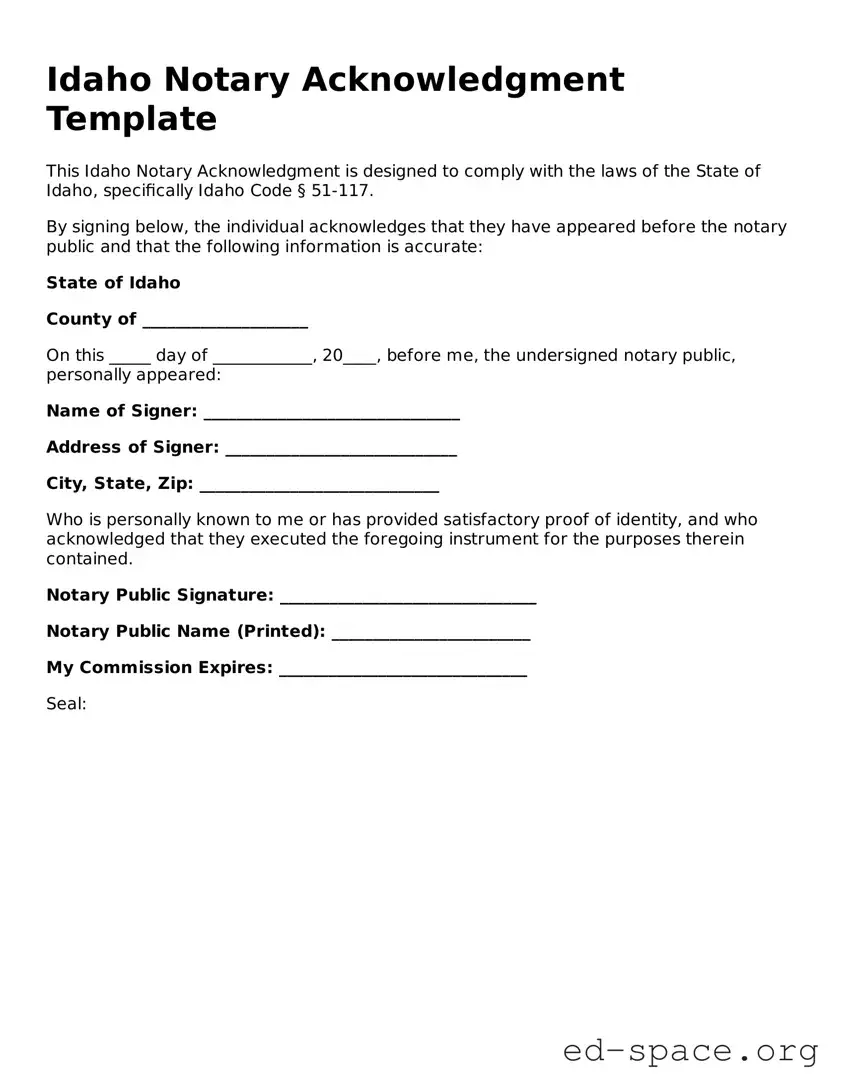
Idaho Notary Acknowledgment Template
This Idaho Notary Acknowledgment is designed to comply with the laws of the State of Idaho, specifically Idaho Code § 51-117.
By signing below, the individual acknowledges that they have appeared before the notary public and that the following information is accurate:
State of Idaho
County of ____________________
On this _____ day of ____________, 20____, before me, the undersigned notary public, personally appeared:
Name of Signer: _______________________________
Address of Signer: ____________________________
City, State, Zip: _____________________________
Who is personally known to me or has provided satisfactory proof of identity, and who acknowledged that they executed the foregoing instrument for the purposes therein contained.
Notary Public Signature: _______________________________
Notary Public Name (Printed): ________________________
My Commission Expires: ______________________________
Seal:
| Fact Name | Description |
|---|---|
| Purpose | The Idaho Notary Acknowledgment form is used to verify the identity of the signer and confirm that they willingly signed a document. |
| Governing Law | This form is governed by Idaho Code § 51-116, which outlines the requirements for notarial acts in the state. |
| Signature Requirement | The signer must be present when the notary public completes the acknowledgment. This ensures authenticity and compliance. |
| Notary Seal | A notary public must affix their official seal to the form, which adds an extra layer of verification and legitimacy. |
After obtaining the Idaho Notary Acknowledgement form, you will be ready to fill it out accurately. This form is essential for verifying signatures and ensuring that documents are executed properly. Follow the steps below to complete the form correctly.
Once you have filled out the form, ensure that all information is accurate and legible. The notary will review the completed form before proceeding with the notarization process.
What is an Idaho Notary Acknowledgement form?
The Idaho Notary Acknowledgement form is a legal document used to verify the identity of individuals signing a document. It confirms that the signer appeared before a notary public, who then witnesses the signing and affirms that the signer is who they claim to be. This form is commonly used for various legal documents, including contracts, deeds, and affidavits.
Why is a Notary Acknowledgement necessary?
A Notary Acknowledgement is essential because it helps prevent fraud. By requiring a notary to verify the identity of the signer, it adds an extra layer of security to important documents. This assurance is often required by courts and other institutions to ensure that the documents are legitimate and have been signed willingly.
How do I complete an Idaho Notary Acknowledgement form?
To complete the form, you must first sign the document in front of a notary public. The notary will then fill out the acknowledgment section, which includes details like the date, the location, and the notary’s signature and seal. Make sure to provide valid identification to the notary to confirm your identity.
Who can serve as a notary public in Idaho?
In Idaho, a notary public can be anyone who is at least 18 years old, a resident of Idaho or a non-resident who is employed in Idaho, and who has completed the required training and application process. Notaries are appointed by the Secretary of State and must adhere to specific guidelines and ethical standards.
What types of documents require a Notary Acknowledgement in Idaho?
Various documents may require a Notary Acknowledgement in Idaho. Common examples include real estate transactions, powers of attorney, legal affidavits, and certain court documents. Always check the specific requirements for the document you are dealing with, as different types may have different needs.
Is there a fee for notarization in Idaho?
Yes, notaries in Idaho are allowed to charge a fee for their services. The maximum fee a notary can charge is set by state law. Typically, fees range from $5 to $10 per signature, but it’s best to confirm the exact fee with the notary beforehand.
How long is a Notary Acknowledgement valid in Idaho?
A Notary Acknowledgement does not have a specific expiration date. However, the validity of the document itself may be subject to other laws or regulations. It’s important to ensure that the document remains relevant and legally binding, as the circumstances surrounding it may change over time.
Can a Notary Acknowledgement be done remotely in Idaho?
Yes, Idaho allows for remote notarization under certain conditions. This means that a notary can perform the acknowledgment using audio-visual technology. However, both the signer and the notary must comply with specific state regulations to ensure the process is secure and valid. Always check the latest guidelines to understand the requirements for remote notarization.
Incorrect Date Entry: One common mistake is failing to enter the correct date when the notary acknowledgment is signed. Ensure the date reflects when the notary performed the acknowledgment, not when the document was created.
Missing Signatures: Another frequent error is neglecting to obtain the necessary signatures. The signer must be present for the acknowledgment to be valid, and their signature must be included on the form.
Improper Identification: Not providing adequate identification can lead to issues. The notary must verify the identity of the signer, so it is essential to present valid identification at the time of signing.
Failure to Complete All Required Fields: Leaving fields blank or incomplete can invalidate the acknowledgment. All required information must be filled out completely to ensure the form is legally binding.
In Idaho, the Notary Acknowledgement form is often used in conjunction with various other documents. These documents serve different purposes, but they all play a crucial role in legal processes. Below is a list of commonly used forms and documents that accompany the Notary Acknowledgement.
Understanding these documents and their functions can help individuals navigate legal processes more effectively. Each form serves a unique purpose, and knowing when to use them can be essential for ensuring compliance and protecting one's rights.
The Notary Acknowledgment form serves a specific purpose in verifying signatures. However, several other documents share similar functions. Here’s a list of seven documents that are akin to the Notary Acknowledgment form:
Understanding these documents can help clarify their roles in legal processes. Each serves to verify identity or authority, reinforcing the integrity of the agreements made.
When filling out the Idaho Notary Acknowledgement form, it’s important to follow certain guidelines to ensure that the process goes smoothly. Here’s a list of things you should and shouldn’t do:
Understanding the Idaho Notary Acknowledgment form is essential for anyone needing to notarize documents. However, several misconceptions often arise regarding its use and requirements. Here are six common misunderstandings:
Many believe that notaries can notarize any type of document. In reality, notaries are limited to specific types of documents, and they must ensure that the document meets legal standards before proceeding with the acknowledgment.
Some think that the signer can be absent during the notarization process. However, the Idaho Notary Acknowledgment requires the signer to be present to verify their identity and willingness to sign the document.
People often assume that notarization makes a document legally binding. While notarization confirms the identity of the signer, it does not ensure that the document itself is valid or enforceable.
There is a misconception that notaries review the content of the document for accuracy. In fact, notaries do not evaluate the substance of the document; their role is to witness the signing and verify identities.
Some individuals believe that all notaries have the same powers. However, notaries may have different levels of authority based on their state laws, and some may have additional training or certifications.
Many think that a notarized document is final and cannot be altered. While notarization provides a level of authenticity, it does not prevent changes to the document afterward, provided all parties agree to the modifications.
Clarifying these misconceptions can help individuals navigate the notarization process more effectively and ensure that their documents are properly handled.
When using the Idaho Notary Acknowledgement form, it's important to understand a few key points to ensure proper completion and usage. Here are five essential takeaways:
By following these guidelines, you can effectively use the Idaho Notary Acknowledgement form and ensure that your documents are properly notarized.