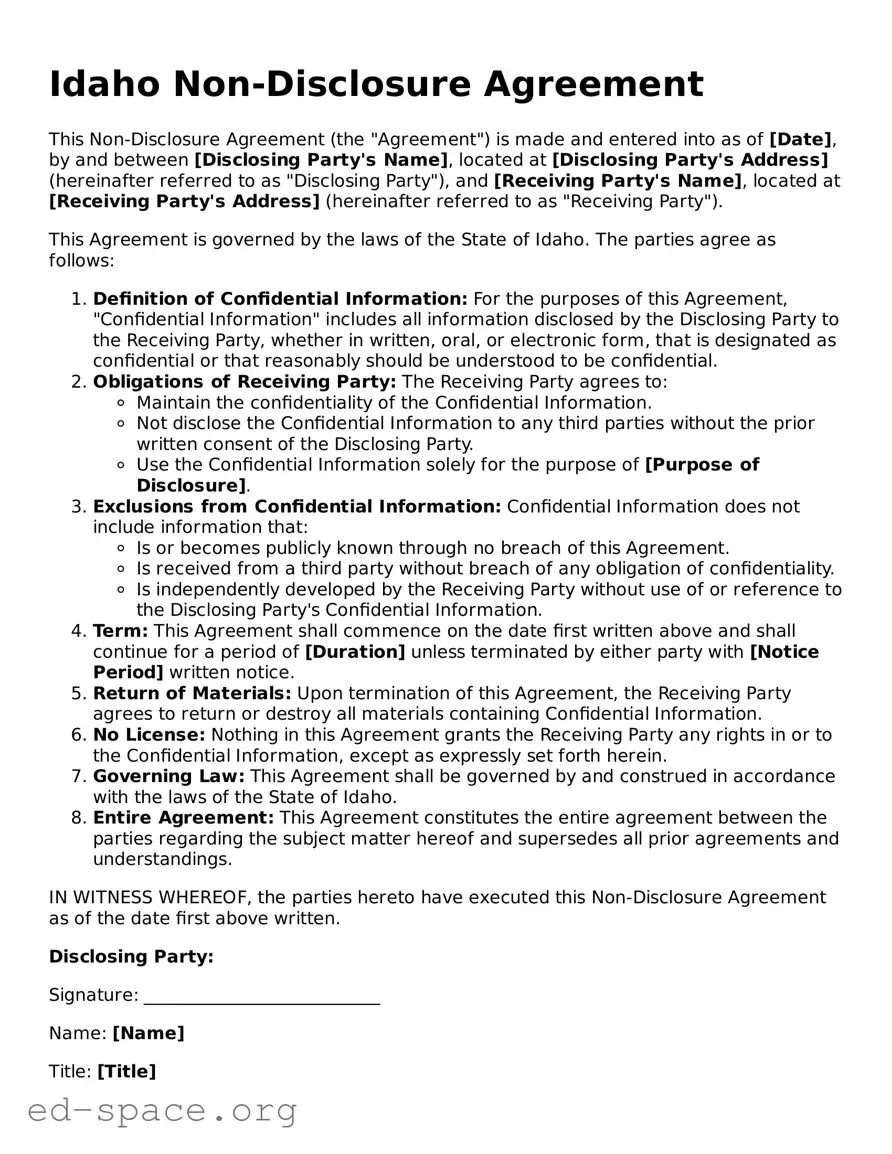
The Idaho Non-disclosure Agreement (NDA) form serves as a crucial legal tool for individuals and businesses seeking to protect sensitive information from unauthorized disclosure. This agreement establishes a confidential relationship between parties, ensuring that proprietary data, trade secrets, and other confidential materials remain secure. By outlining the obligations of the disclosing and receiving parties, the NDA delineates what information is considered confidential and the duration of the confidentiality obligation. It also specifies any exceptions to the confidentiality rule, such as information that becomes public knowledge through no fault of the receiving party. Additionally, the form may include provisions regarding the consequences of breaching the agreement, which can serve as a deterrent against potential violations. Understanding the key components of the Idaho NDA is essential for anyone looking to safeguard their intellectual property and maintain a competitive edge in their industry.
Idaho Non-Disclosure Agreement
This Non-Disclosure Agreement (the "Agreement") is made and entered into as of [Date], by and between [Disclosing Party's Name], located at [Disclosing Party's Address] (hereinafter referred to as "Disclosing Party"), and [Receiving Party's Name], located at [Receiving Party's Address] (hereinafter referred to as "Receiving Party").
This Agreement is governed by the laws of the State of Idaho. The parties agree as follows:
IN WITNESS WHEREOF, the parties hereto have executed this Non-Disclosure Agreement as of the date first above written.
Disclosing Party:
Signature: ___________________________
Name: [Name]
Title: [Title]
Receiving Party:
Signature: ___________________________
Name: [Name]
Title: [Title]
| Fact Name | Description |
|---|---|
| Purpose | The Idaho Non-disclosure Agreement (NDA) protects confidential information shared between parties. |
| Governing Law | Idaho state law governs the terms and enforcement of the NDA. |
| Parties Involved | The agreement typically involves a disclosing party and a receiving party. |
| Duration | The NDA can specify a duration for which the confidentiality obligation lasts. |
| Exclusions | Information that is publicly known or independently developed is usually excluded from confidentiality. |
| Legal Recourse | Parties may seek legal remedies if the NDA is breached. |
| Signature Requirement | Both parties must sign the NDA for it to be enforceable. |
| Modification | Any changes to the NDA should be made in writing and signed by both parties. |
| Use Cases | NDAs are commonly used in business partnerships, employment agreements, and joint ventures. |
After obtaining the Idaho Non-disclosure Agreement form, you will need to complete it accurately to ensure it serves its intended purpose. This process involves filling in specific details about the parties involved and the nature of the confidential information.
What is an Idaho Non-disclosure Agreement (NDA)?
An Idaho Non-disclosure Agreement (NDA) is a legally binding contract designed to protect confidential information shared between parties. It ensures that sensitive data, such as trade secrets or proprietary information, remains confidential and is not disclosed to unauthorized individuals or entities.
Who typically uses an NDA in Idaho?
NDAs are commonly utilized by businesses, entrepreneurs, and individuals who need to share confidential information with potential partners, employees, or contractors. They are particularly important in industries where intellectual property and trade secrets are crucial to maintaining a competitive edge.
What are the key components of an Idaho NDA?
An effective Idaho NDA generally includes several essential elements: a clear definition of what constitutes confidential information, the obligations of the receiving party, the duration of confidentiality, and the consequences of breach. Additionally, it may specify any exclusions from confidentiality, such as information already in the public domain.
How long does the confidentiality obligation last under an Idaho NDA?
The duration of the confidentiality obligation can vary depending on the agreement. Typically, NDAs specify a time frame during which the receiving party must keep the information confidential. This period can range from a few years to indefinitely, depending on the nature of the information and the agreement between the parties.
Are there any limitations to what can be protected by an NDA in Idaho?
Yes, there are limitations. An NDA cannot protect information that is already publicly available or that the receiving party can demonstrate was independently developed without reference to the confidential information. Additionally, information that is disclosed through legal proceedings or government requirements may not be protected under an NDA.
What happens if someone breaches an NDA in Idaho?
If a party breaches an NDA, the injured party may seek legal remedies. This can include monetary damages for any losses incurred due to the breach, as well as injunctive relief to prevent further disclosure of the confidential information. The specific consequences should be outlined in the NDA itself.
Can an NDA be enforced in Idaho?
Yes, NDAs can be enforced in Idaho, provided they meet legal requirements. The agreement must be clear, reasonable, and not contrary to public policy. Courts generally uphold NDAs as long as they are well-drafted and the terms are fair to both parties.
How can I create an Idaho Non-disclosure Agreement?
Creating an Idaho NDA can be done using templates available online or by consulting with a legal professional. It is crucial to ensure that the agreement is tailored to the specific needs of the parties involved and complies with Idaho law. Customizing the NDA helps to address unique circumstances and protect the interests of both parties effectively.
Incomplete Information: Many individuals fail to fill out all required fields. This can lead to delays or even the rejection of the agreement. Always double-check that every section is complete.
Incorrect Dates: Entering the wrong dates can create confusion about the timeline of the agreement. Ensure that the effective date and any expiration dates are accurate and clearly stated.
Not Defining Confidential Information: Some people neglect to clearly define what constitutes confidential information. This can result in misunderstandings later on. Be specific and comprehensive in outlining the information you want to protect.
Failure to Sign: It may seem obvious, but forgetting to sign the document is a common mistake. Both parties must sign for the agreement to be valid. Always verify that signatures are present before submitting the form.
A Non-disclosure Agreement (NDA) is a crucial document used to protect sensitive information shared between parties. In Idaho, as in many other jurisdictions, several additional forms and documents often accompany an NDA to ensure comprehensive protection and clarity in business dealings. Below are some of the common forms that may be used alongside an Idaho Non-disclosure Agreement.
Utilizing these documents in conjunction with an Idaho Non-disclosure Agreement can help create a robust framework for protecting sensitive information and ensuring that all parties understand their rights and responsibilities. Properly drafted agreements can prevent misunderstandings and foster trust in business relationships.
A Non-Disclosure Agreement (NDA) is a legal contract that protects sensitive information from being disclosed. Several other documents serve similar purposes in safeguarding information and ensuring confidentiality. Here’s a list of nine documents that share similarities with an NDA:
Each of these documents plays a vital role in protecting sensitive information in various contexts, ensuring that individuals and organizations can collaborate while safeguarding their interests.
When filling out the Idaho Non-disclosure Agreement form, it's important to follow specific guidelines to ensure accuracy and compliance. Here’s a helpful list of dos and don’ts:
Understanding the Idaho Non-disclosure Agreement (NDA) is crucial for anyone entering into a confidential relationship. However, several misconceptions can lead to confusion. Here are six common misconceptions:
By addressing these misconceptions, individuals and businesses can better navigate the complexities of NDAs in Idaho and protect their interests effectively.
Understand the purpose of the Idaho Non-disclosure Agreement (NDA). It protects confidential information shared between parties.
Clearly identify the parties involved. Include full legal names and addresses to avoid confusion.
Define what constitutes confidential information. Be specific about what information is protected under the agreement.
Specify the duration of the confidentiality obligation. Indicate how long the information must remain confidential.
Include any exceptions to confidentiality. For example, information that becomes public or is independently developed.
Ensure both parties sign the agreement. Signatures validate the NDA and demonstrate mutual consent.
Keep a copy of the signed NDA for your records. This serves as proof of the agreement and its terms.