In the competitive landscape of employment, non-compete agreements serve as crucial tools for both employers and employees, particularly in Idaho. These agreements outline the conditions under which an employee agrees not to engage in certain activities that could harm their employer's business interests after leaving the company. Typically, the Idaho Non-compete Agreement form includes essential elements such as the duration of the restriction, the geographic area it covers, and the specific activities that are prohibited. It is designed to protect trade secrets, client relationships, and proprietary information while also balancing the rights of employees to seek new opportunities. Understanding the nuances of this form is vital for both parties, as it can significantly impact future employment prospects and business operations. As Idaho continues to evolve its legal framework regarding employment practices, staying informed about the implications of non-compete agreements is essential for fostering fair competition and promoting a healthy job market.
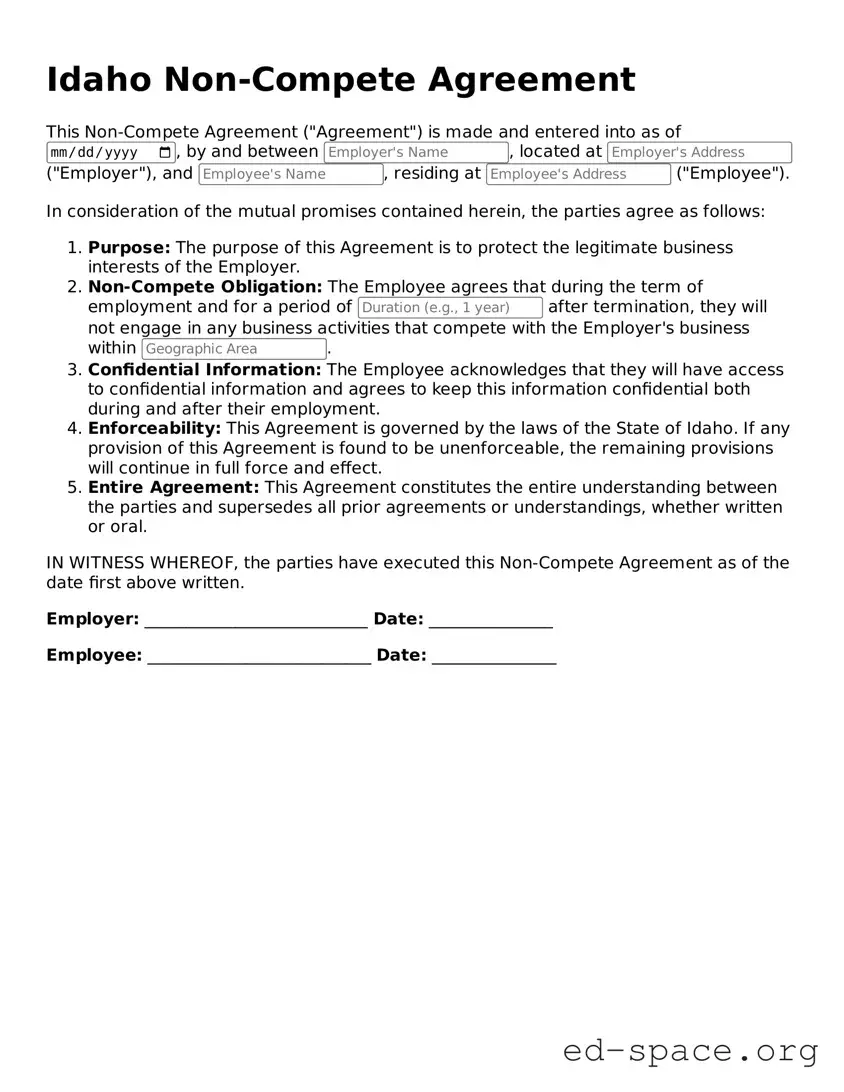
Idaho Non-Compete Agreement
This Non-Compete Agreement ("Agreement") is made and entered into as of , by and between , located at ("Employer"), and , residing at ("Employee").
In consideration of the mutual promises contained herein, the parties agree as follows:
IN WITNESS WHEREOF, the parties have executed this Non-Compete Agreement as of the date first above written.
Employer: ___________________________ Date: _______________
Employee: ___________________________ Date: _______________
| Fact Name | Description |
|---|---|
| Definition | A non-compete agreement is a contract that restricts an employee from competing with their employer for a specified time after leaving the company. |
| Governing Law | Idaho Code § 44-1801 et seq. governs non-compete agreements in Idaho. |
| Enforceability | In Idaho, a non-compete agreement is enforceable only if it is reasonable in time, geographic area, and scope of activity. |
| Duration | Typically, non-compete agreements in Idaho should not exceed two years in duration to be considered reasonable. |
| Geographic Limitations | The geographic area covered by a non-compete must be limited to where the employer operates or has legitimate business interests. |
| Consideration | For a non-compete agreement to be valid, there must be consideration, such as a job offer or access to confidential information. |
Completing the Idaho Non-compete Agreement form requires careful attention to detail. This document outlines the terms and conditions under which an employee agrees not to compete with their employer after leaving the company. Follow the steps below to ensure the form is filled out correctly.
After completing the form, it is advisable to keep a copy for personal records. This document may need to be referenced in the future, especially if any disputes arise regarding its terms.
What is a non-compete agreement in Idaho?
A non-compete agreement is a contract that restricts an employee from working for competitors or starting a competing business for a certain period after leaving their job. In Idaho, these agreements must be reasonable in scope, duration, and geographic area to be enforceable.
Are non-compete agreements enforceable in Idaho?
Yes, non-compete agreements can be enforceable in Idaho, but they must meet specific legal requirements. The agreement must protect legitimate business interests and not impose an undue hardship on the employee. Courts will evaluate the reasonableness of the terms.
What are the key elements of a valid non-compete agreement?
A valid non-compete agreement in Idaho should include clear terms regarding the duration of the restriction, the geographic area covered, and the specific activities that are restricted. It should also be signed by both parties to demonstrate mutual consent.
How long can a non-compete agreement last in Idaho?
The duration of a non-compete agreement in Idaho should be reasonable. Typically, agreements lasting six months to two years are more likely to be upheld. However, the specific circumstances of each case will influence what is considered reasonable.
Can an employer enforce a non-compete agreement if the employee is laid off?
Yes, an employer can enforce a non-compete agreement even if the employee was laid off. However, the enforceability may depend on the terms of the agreement and the circumstances surrounding the layoff. Courts may consider whether the layoff was voluntary or involuntary.
What happens if I violate a non-compete agreement?
If you violate a non-compete agreement, your former employer may take legal action against you. This could include seeking an injunction to prevent you from working for a competitor or pursuing damages for any losses incurred due to your violation.
Can I negotiate the terms of a non-compete agreement?
Yes, you can negotiate the terms of a non-compete agreement before signing it. It is advisable to discuss any concerns with your employer and seek modifications that make the agreement more reasonable. Always ensure you fully understand the implications of the agreement.
Are there any exceptions to non-compete agreements in Idaho?
Yes, there are exceptions. For instance, non-compete agreements may not be enforceable against certain professionals, such as physicians or those in specific trades, depending on Idaho law. Additionally, if the agreement is overly broad or unreasonable, it may be deemed unenforceable.
How can I determine if my non-compete agreement is enforceable?
To determine if your non-compete agreement is enforceable, consider consulting with a legal professional. They can help analyze the agreement's terms, the reasonableness of its restrictions, and how it applies to your specific situation.
What should I do if I believe my non-compete agreement is unfair?
If you believe your non-compete agreement is unfair, you should first review it carefully. Consider discussing your concerns with your employer. If necessary, seek legal advice to explore your options and understand your rights regarding the agreement.
Not Clearly Defining the Scope of Competition: Many individuals fail to specify what constitutes competition. Without clear definitions, it can lead to misunderstandings about what activities are restricted.
Ignoring Geographic Limitations: Some people overlook the geographic area where the non-compete will apply. It's crucial to limit the area to a reasonable size that reflects the business's actual market.
Setting an Unreasonable Duration: The duration of the non-compete agreement should be realistic. A common mistake is setting a time frame that is excessively long, which may not be enforceable.
Failing to Consider Industry Standards: Each industry has its norms regarding non-compete agreements. Not aligning the agreement with industry standards can render it ineffective or unenforceable.
Not Including Consideration: A non-compete agreement needs to have consideration, meaning something of value exchanged. People often forget to specify what they are receiving in return for agreeing to the restrictions.
Overlooking Legal Review: Skipping a legal review can be a critical mistake. Consulting with a legal professional can help ensure that the agreement complies with state laws and protects all parties involved.
When entering into a Non-compete Agreement in Idaho, several related documents may be necessary to ensure clarity and enforceability. These documents help outline the terms of employment, protect intellectual property, and clarify the expectations between employers and employees. Below is a list of common forms and documents often used in conjunction with a Non-compete Agreement.
These documents work together to create a comprehensive legal framework that protects both the employer's interests and the employee's rights. Understanding each of these forms can help individuals navigate their employment agreements more effectively.
A Non-compete Agreement is a legal document that restricts an individual from engaging in certain activities that could compete with their employer after leaving the company. Several other documents share similar purposes or concepts. Here’s a list of nine documents that are comparable to a Non-compete Agreement:
When filling out the Idaho Non-compete Agreement form, it is essential to approach the process thoughtfully. Here are some guidelines to consider:
When it comes to non-compete agreements in Idaho, several misconceptions often arise. Understanding these misunderstandings can help both employers and employees navigate their rights and responsibilities more effectively. Here are six common misconceptions:
Many people believe that if a non-compete agreement is signed, it must be upheld in court. However, Idaho law requires that these agreements be reasonable in scope, duration, and geographic area to be enforceable.
Not every employee is required to sign a non-compete agreement. These agreements are typically more common for higher-level positions or roles that involve sensitive information. Entry-level employees may not need to sign one at all.
While non-compete agreements can limit where and how an employee can work after leaving a job, they do not completely bar individuals from working in their field. Instead, they may restrict employment with specific competitors for a certain period.
Some believe that a verbal agreement is enough to enforce a non-compete clause. However, in Idaho, a written agreement is crucial for enforceability. Without a signed document, proving the terms of the agreement can be challenging.
These two types of agreements serve different purposes. A non-compete agreement restricts where and how an employee can work after leaving a job, while a non-disclosure agreement focuses on protecting confidential information during and after employment.
Employers must act within a reasonable time frame to enforce a non-compete agreement. Waiting too long to assert rights under the agreement can weaken their position and may lead to unenforceability.
By understanding these misconceptions, both employers and employees can make informed decisions regarding non-compete agreements in Idaho.
When considering the Idaho Non-compete Agreement form, several important aspects must be taken into account. Below are key takeaways that can guide individuals in effectively filling out and utilizing this legal document.
By keeping these key points in mind, individuals can better navigate the complexities of the Idaho Non-compete Agreement form.