Homepage Free Motor Vehicle Power of Attorney Form for Idaho
Content Overview

The Idaho Motor Vehicle Power of Attorney form is a vital document that enables individuals to designate someone else to handle specific motor vehicle-related tasks on their behalf. This form is particularly useful when the vehicle owner is unable to be present for transactions such as registration, title transfers, or other important dealings with the Idaho Department of Transportation. By granting this power, the vehicle owner can ensure that their interests are represented, even when they cannot be physically present. The form requires the vehicle owner's details, the designated agent's information, and the specific powers being granted. It's essential to complete the form accurately to avoid any complications in the future. Additionally, the form must be signed and dated by the vehicle owner, ensuring that the authority granted is both clear and legally binding. Understanding how to use this form effectively can save time and streamline processes related to vehicle management in Idaho.

Document Preview

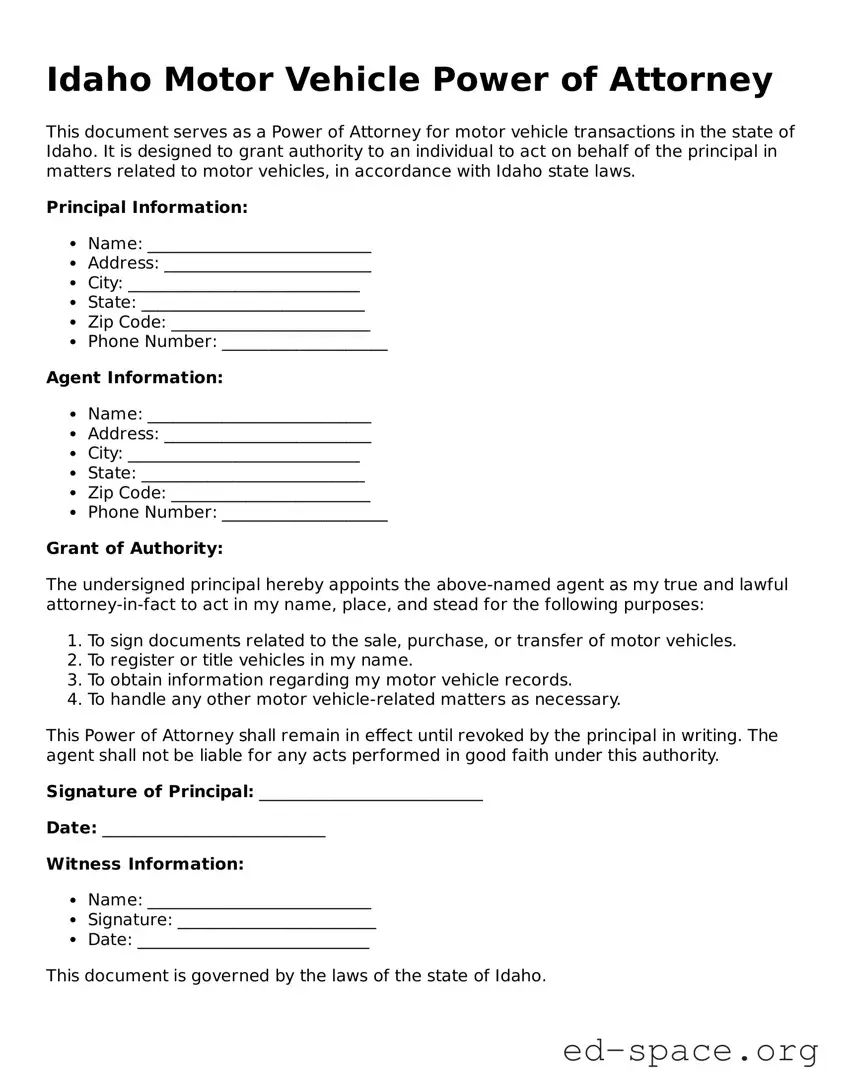
Idaho Motor Vehicle Power of Attorney

This document serves as a Power of Attorney for motor vehicle transactions in the state of Idaho. It is designed to grant authority to an individual to act on behalf of the principal in matters related to motor vehicles, in accordance with Idaho state laws.

Principal Information:

  • Name: ___________________________
  • Address: _________________________
  • City: ____________________________
  • State: ___________________________
  • Zip Code: ________________________
  • Phone Number: ____________________

Agent Information:

  • Name: ___________________________
  • Address: _________________________
  • City: ____________________________
  • State: ___________________________
  • Zip Code: ________________________
  • Phone Number: ____________________

Grant of Authority:

The undersigned principal hereby appoints the above-named agent as my true and lawful attorney-in-fact to act in my name, place, and stead for the following purposes:

  1. To sign documents related to the sale, purchase, or transfer of motor vehicles.
  2. To register or title vehicles in my name.
  3. To obtain information regarding my motor vehicle records.
  4. To handle any other motor vehicle-related matters as necessary.

This Power of Attorney shall remain in effect until revoked by the principal in writing. The agent shall not be liable for any acts performed in good faith under this authority.

Signature of Principal: ___________________________

Date: ___________________________

Witness Information:

  • Name: ___________________________
  • Signature: ________________________
  • Date: ____________________________

This document is governed by the laws of the state of Idaho.

PDF Form Details

Fact Name Details
Purpose The Idaho Motor Vehicle Power of Attorney form allows an individual to authorize another person to act on their behalf regarding motor vehicle transactions.
Governing Law This form is governed by Idaho Code § 49-1501, which outlines the powers granted to an attorney-in-fact for motor vehicle matters.
Signature Requirement The form must be signed by the principal, and it is recommended to have the signature notarized for added validity.
Usage Commonly used for selling, transferring, or registering a vehicle, this form streamlines the process for both parties involved.

Idaho Motor Vehicle Power of Attorney: Usage Guidelines

Completing the Idaho Motor Vehicle Power of Attorney form requires careful attention to detail. After filling out the form, it will need to be submitted according to the specific requirements set forth by the Idaho Department of Transportation or the appropriate authority.

  1. Obtain the Idaho Motor Vehicle Power of Attorney form. This can typically be found on the Idaho Department of Transportation website or at local DMV offices.
  2. Begin by entering the principal's name at the top of the form. This is the person granting the power of attorney.
  3. Provide the principal's address. Ensure that this information is accurate and up to date.
  4. Next, fill in the agent's name. This is the individual who will be acting on behalf of the principal.
  5. Include the agent's address to confirm their identity and location.
  6. Specify the vehicle information. This includes the make, model, year, and VIN (Vehicle Identification Number) of the vehicle in question.
  7. Indicate the duration of the power of attorney if applicable. You may choose to specify a start and end date or leave it open-ended.
  8. Both the principal and the agent must sign and date the form. Ensure that signatures are clear and legible.
  9. Finally, check if the form needs to be notarized. If so, take it to a notary public to complete the process.

Your Questions, Answered

What is the Idaho Motor Vehicle Power of Attorney form?

The Idaho Motor Vehicle Power of Attorney form is a legal document that allows one person to authorize another person to act on their behalf regarding motor vehicle-related matters. This can include tasks such as signing documents for the sale or transfer of a vehicle, registering a vehicle, or handling other transactions with the Idaho Department of Motor Vehicles (DMV).

Who can be designated as an agent in this form?

Any competent adult can be designated as an agent in the Idaho Motor Vehicle Power of Attorney form. This means that the person you choose should be someone you trust to handle your motor vehicle matters responsibly. It could be a family member, friend, or professional, such as an attorney.

How do I complete the Idaho Motor Vehicle Power of Attorney form?

To complete the form, you will need to provide specific information, such as your name, the name of the person you are appointing as your agent, and details about the vehicle involved. You will also need to sign and date the form in the presence of a notary public to make it legally binding.

Is the Idaho Motor Vehicle Power of Attorney form valid in other states?

The Idaho Motor Vehicle Power of Attorney form is primarily designed for use within Idaho. While some states may recognize it, it is advisable to check the laws of the specific state where you plan to use the form. If necessary, you may need to complete a similar form that complies with the laws of that state.

Can I revoke the Power of Attorney once it is granted?

Yes, you can revoke the Idaho Motor Vehicle Power of Attorney at any time, as long as you are competent to do so. To revoke the power, you should provide written notice to your agent and, if possible, to any institutions or entities that may have relied on the original document. It is also a good idea to complete a formal revocation form to ensure clarity.

What happens if the agent does not act in my best interest?

If an agent fails to act in your best interest or engages in misconduct, you may have legal options to address the situation. This could include revoking the Power of Attorney and potentially seeking legal advice to explore further actions. It is crucial to choose a trustworthy agent to minimize the risk of such issues.

Do I need to file the Idaho Motor Vehicle Power of Attorney form with any government agency?

Generally, you do not need to file the Idaho Motor Vehicle Power of Attorney form with any government agency. However, it is important to keep a copy of the signed and notarized form for your records. You may need to present it to the DMV or other entities when your agent is acting on your behalf.

Common mistakes

  1. Not Signing the Form: One of the most common mistakes is forgetting to sign the Power of Attorney form. Without a signature, the document is not valid.

  2. Missing Dates: People often forget to date the form. Including the date is crucial, as it indicates when the authority was granted.

  3. Incorrect Information: Filling in the wrong name or vehicle details can lead to complications. Always double-check the information provided.

  4. Not Notarizing the Form: In Idaho, some situations require notarization. Failing to get the document notarized when needed can invalidate it.

  5. Ignoring Revocation Procedures: After granting Power of Attorney, some forget to understand how to revoke it. Knowing the revocation process is important if circumstances change.

Documents used along the form

When dealing with motor vehicle transactions in Idaho, the Motor Vehicle Power of Attorney form is an essential document. However, it is often accompanied by other forms that facilitate various aspects of vehicle ownership and transfer. Below is a list of documents that may be used alongside the Power of Attorney form, each serving a unique purpose in the process.

  • Idaho Vehicle Registration Application: This form is required to register a vehicle in Idaho. It collects information about the vehicle and its owner, ensuring that the state has accurate records.
  • Bill of Sale: This document serves as proof of the transaction between the buyer and seller. It outlines the details of the sale, including the sale price and vehicle identification number (VIN).
  • Title Application: When transferring ownership of a vehicle, this application is necessary to obtain a new title. It ensures that the new owner is recognized legally by the state.
  • Odometer Disclosure Statement: This form is required to disclose the vehicle's mileage at the time of sale. It helps prevent odometer fraud and ensures transparency in the transaction.
  • Affidavit of Loss or Theft of Title: If the vehicle title is lost or stolen, this affidavit can be filed to request a duplicate title. It serves as a sworn statement regarding the circumstances of the loss.
  • Application for Duplicate Title: In cases where the original title is damaged or misplaced, this application is used to request a replacement title from the Idaho Department of Transportation.
  • Vehicle Transfer Notification: This document notifies the state of a vehicle transfer. It helps protect the seller from liability after the sale and ensures that the buyer is properly registered.
  • Release of Liability: This form releases the seller from any future liability associated with the vehicle after it has been sold. It is crucial for protecting the seller's interests.

Using the Idaho Motor Vehicle Power of Attorney form alongside these documents can streamline the process of vehicle transactions. Each form plays a vital role in ensuring compliance with state laws and protecting the rights of both buyers and sellers. Understanding these documents can lead to a smoother experience when navigating vehicle ownership in Idaho.

Similar forms

The Motor Vehicle Power of Attorney form allows individuals to designate someone else to handle specific tasks related to their vehicle. This document shares similarities with several other legal documents that also empower individuals to grant authority to others. Here are ten such documents:

  • General Power of Attorney: This document grants broad powers to an agent to act on behalf of the principal in various matters, including financial and legal affairs.
  • Durable Power of Attorney: Similar to a general power of attorney, but it remains effective even if the principal becomes incapacitated.
  • Limited Power of Attorney: This document restricts the agent's authority to specific tasks or situations, much like the focused scope of the motor vehicle power of attorney.
  • Healthcare Power of Attorney: It allows an individual to appoint someone to make medical decisions on their behalf, paralleling the delegation of vehicle-related decisions.
  • Financial Power of Attorney: This empowers an agent to manage financial transactions, akin to how a motor vehicle power of attorney facilitates vehicle transactions.
  • Real Estate Power of Attorney: Similar in function, this document allows an agent to handle real estate transactions, focusing on a specific type of asset.
  • Trustee Appointment Document: In a trust, this document designates a trustee to manage assets, similar to how a power of attorney allows someone to manage vehicle matters.
  • Business Power of Attorney: This allows an individual to delegate authority for business-related decisions, much like vehicle-related authority is delegated in a motor vehicle power of attorney.
  • Letter of Authorization: This informal document grants permission for someone to act on another's behalf in specific situations, resembling the formal delegation in a power of attorney.
  • Consent to Release Information: This document allows someone to access personal information, similar to how a motor vehicle power of attorney allows access to vehicle records and transactions.

Each of these documents serves the purpose of granting authority, whether for vehicle matters or other personal and financial affairs. Understanding their similarities can help individuals make informed decisions when choosing the right document for their needs.

Dos and Don'ts

When filling out the Idaho Motor Vehicle Power of Attorney form, it's important to follow certain guidelines to ensure the process goes smoothly. Here are some key dos and don'ts to keep in mind:

  • Do provide accurate and complete information about the vehicle and the parties involved.
  • Do ensure that the person you are granting power of attorney to is trustworthy and reliable.
  • Do sign the form in the presence of a notary public to validate it.
  • Do keep a copy of the completed form for your records.
  • Don't leave any sections of the form blank; incomplete forms may be rejected.
  • Don't use outdated versions of the form; always check for the latest version.
  • Don't rush through the process; take your time to ensure accuracy.
  • Don't forget to revoke the power of attorney if you no longer need it or if circumstances change.

Misconceptions

When it comes to the Idaho Motor Vehicle Power of Attorney form, several misconceptions can lead to confusion. Understanding these misconceptions is crucial for anyone looking to delegate authority regarding their vehicle. Here are five common misunderstandings:

  • It can only be used for vehicle sales. Many believe that this form is exclusively for selling a vehicle. In reality, it can also be used for tasks like registering a vehicle, obtaining title transfers, and handling other motor vehicle-related matters.
  • Only a lawyer can fill out the form. While legal advice can be helpful, it is not necessary to have a lawyer complete the Idaho Motor Vehicle Power of Attorney form. Individuals can fill it out themselves, as long as they understand the requirements and the information needed.
  • It must be notarized to be valid. Some people think that notarization is a requirement for the form to be effective. However, while notarization can add an extra layer of authenticity, it is not always mandatory for the form to be legally valid in Idaho.
  • It expires after a short period. There is a belief that the power of attorney is only valid for a limited time. In fact, the Idaho Motor Vehicle Power of Attorney remains in effect until the tasks are completed or until the principal revokes it, unless a specific expiration date is noted in the document.
  • It can only be used by individuals. Some think that only individuals can grant power of attorney for their vehicles. However, businesses and organizations can also use this form to designate someone to act on their behalf regarding motor vehicle matters.

By clarifying these misconceptions, individuals can better navigate the process of using the Idaho Motor Vehicle Power of Attorney form effectively.

Key takeaways

When filling out and using the Idaho Motor Vehicle Power of Attorney form, consider the following key takeaways:

  • Purpose of the Form: This form allows you to designate someone else to handle specific motor vehicle-related tasks on your behalf, such as registering a vehicle or transferring ownership.
  • Eligibility: Ensure that both the principal (the person granting authority) and the agent (the person receiving authority) meet the necessary requirements, including being of legal age and sound mind.
  • Specificity: Clearly outline the powers granted to the agent. Be specific about what actions they can take, as vague language may lead to confusion or misuse.
  • Signature Requirements: The form must be signed by the principal in the presence of a notary public. This step is crucial for the form’s validity.
  • Revocation: Remember that you can revoke the Power of Attorney at any time, as long as you provide proper notice to the agent and any relevant parties.