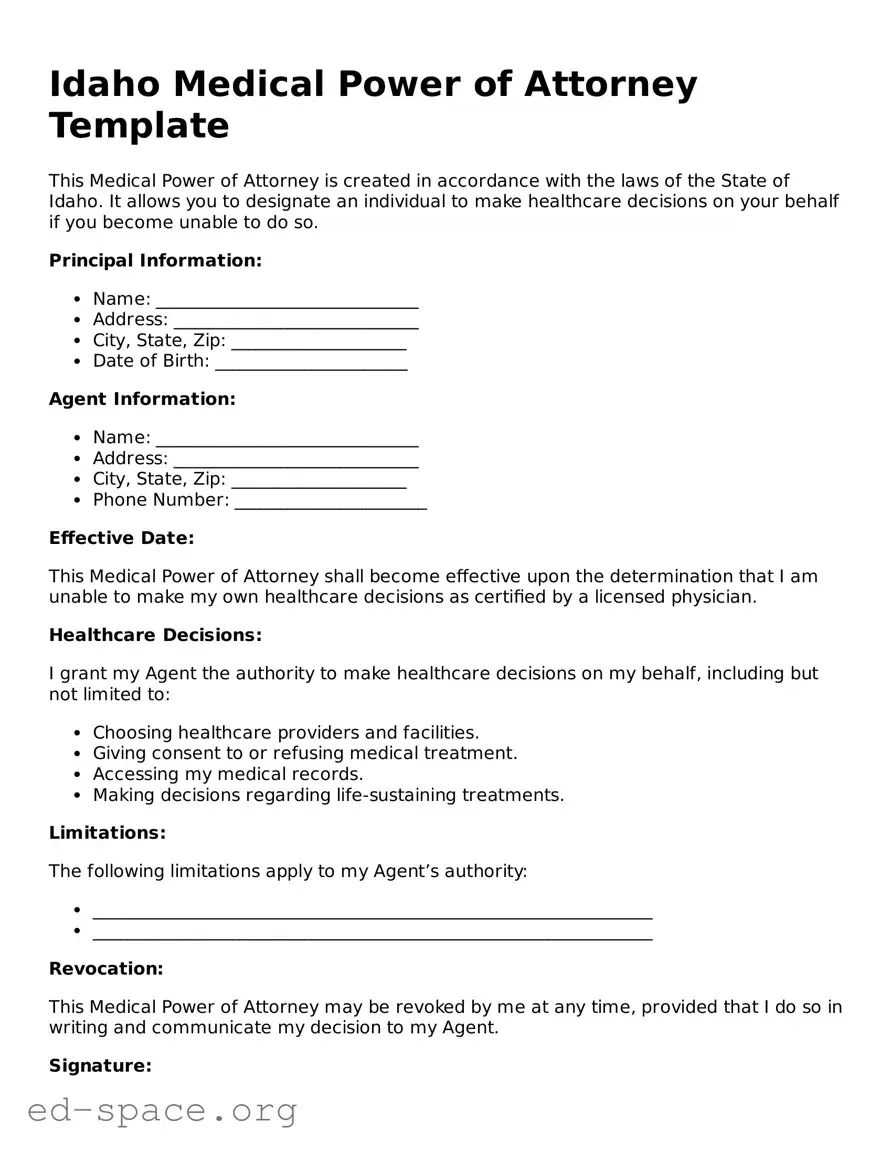
When it comes to making healthcare decisions, having a clear plan in place is essential, especially in unexpected situations. The Idaho Medical Power of Attorney form is a vital document that allows individuals to designate someone they trust to make medical decisions on their behalf if they become unable to do so. This form covers a range of important aspects, including the authority granted to the appointed agent, the specific medical decisions they can make, and any preferences regarding treatment options. It ensures that your healthcare wishes are respected and followed, even when you cannot communicate them. By completing this form, you empower a trusted person to act in your best interest, alleviating the burden on family members during difficult times. Understanding the key components of this form can help you make informed choices about your medical care and ensure that your voice is heard, even when you are unable to speak for yourself.
Idaho Medical Power of Attorney Template
This Medical Power of Attorney is created in accordance with the laws of the State of Idaho. It allows you to designate an individual to make healthcare decisions on your behalf if you become unable to do so.
Principal Information:
Agent Information:
Effective Date:
This Medical Power of Attorney shall become effective upon the determination that I am unable to make my own healthcare decisions as certified by a licensed physician.
Healthcare Decisions:
I grant my Agent the authority to make healthcare decisions on my behalf, including but not limited to:
Limitations:
The following limitations apply to my Agent’s authority:
Revocation:
This Medical Power of Attorney may be revoked by me at any time, provided that I do so in writing and communicate my decision to my Agent.
Signature:
By signing below, I confirm that I am of sound mind and that I understand the contents of this document.
______________________________
Signature of Principal
______________________________
Date
Witnesses:
This document must be signed in the presence of two witnesses or a notary public.
______________________________
Signature of Witness 1
______________________________
Date
______________________________
Signature of Witness 2
______________________________
Date
______________________________
Notary Public
______________________________
Date
| Fact Name | Details |
|---|---|
| Definition | An Idaho Medical Power of Attorney allows a person to designate another individual to make healthcare decisions on their behalf if they become unable to do so. |
| Governing Law | The Idaho Medical Power of Attorney is governed by Idaho Code § 39-4501 to § 39-4511. |
| Eligibility | Any competent adult can create a Medical Power of Attorney in Idaho. |
| Agent Selection | The individual creating the document can choose anyone as their agent, except for certain healthcare providers involved in their care. |
| Durability | This power of attorney remains effective even if the individual becomes incapacitated. |
| Witness Requirements | Two witnesses must sign the document, and they cannot be related to the individual or entitled to any part of their estate. |
| Revocation | The individual can revoke the Medical Power of Attorney at any time as long as they are competent to do so. |
Filling out the Idaho Medical Power of Attorney form is an important step in ensuring that your healthcare wishes are respected. This document allows you to designate someone to make medical decisions on your behalf if you are unable to do so. Follow these steps carefully to complete the form accurately.
After completing the form, it’s essential to discuss your choices with your appointed agent and any family members involved. This ensures that everyone understands your wishes and can act accordingly when the time comes.
What is a Medical Power of Attorney in Idaho?
A Medical Power of Attorney is a legal document that allows you to appoint someone to make healthcare decisions on your behalf if you become unable to do so. This person, known as your agent or proxy, will have the authority to make medical decisions based on your preferences and best interests.
Who can be appointed as my agent?
You can choose any competent adult as your agent. This can be a family member, friend, or someone you trust to make medical decisions for you. It is essential that the person you choose understands your values and wishes regarding healthcare.
Do I need to use a specific form for the Medical Power of Attorney in Idaho?
While Idaho does not require a specific form, it is advisable to use a form that meets state requirements. This ensures that the document is valid and recognized by healthcare providers. You can find templates online or consult with a legal professional for assistance.
Is my Medical Power of Attorney valid if I move to another state?
Generally, a Medical Power of Attorney created in Idaho will be recognized in other states, but laws vary. It is recommended to check the specific requirements of the new state or consider creating a new document that complies with local laws.
Can I revoke my Medical Power of Attorney?
Yes, you can revoke your Medical Power of Attorney at any time as long as you are competent. To revoke, you should notify your agent and any healthcare providers involved. It is also a good idea to destroy any copies of the old document to avoid confusion.
What happens if I do not have a Medical Power of Attorney?
If you do not have a Medical Power of Attorney and become unable to make your own medical decisions, a court may appoint a guardian to make decisions for you. This process can be lengthy and may not reflect your personal wishes.
Can I include specific medical wishes in my Medical Power of Attorney?
Yes, you can include specific instructions regarding your medical treatment and preferences. This can help guide your agent in making decisions that align with your values. It is important to discuss these wishes with your agent and document them clearly.
How do I ensure my Medical Power of Attorney is recognized by healthcare providers?
To ensure recognition, provide copies of your Medical Power of Attorney to your healthcare providers, family members, and your appointed agent. You may also want to discuss your wishes with your healthcare team to ensure they understand your preferences and the authority of your agent.
Not Designating an Agent: Failing to clearly name a trusted individual as your medical power of attorney can lead to confusion and disputes during critical moments.
Inadequate Communication: Not discussing your wishes with the designated agent can result in decisions that do not reflect your values and preferences.
Ignoring State Requirements: Each state has specific rules regarding medical powers of attorney. Overlooking Idaho’s requirements can invalidate the form.
Not Signing in Front of Witnesses: Idaho requires signatures to be witnessed. Failing to have the proper witnesses present may render the document ineffective.
Using Outdated Forms: Utilizing an old version of the form can lead to issues. Ensure you are using the most current Idaho Medical Power of Attorney form.
Leaving Sections Blank: Omitting important sections can create ambiguity. Complete all relevant parts of the form to ensure clarity in your wishes.
Not Reviewing the Document Regularly: Life circumstances change. Failing to review and update your medical power of attorney can lead to outdated decisions.
Overlooking Alternate Agents: Designating only one agent without an alternative can create complications if the primary agent is unavailable.
Neglecting to Keep Copies: Not making copies of the signed document can lead to situations where your agent cannot present the form when needed. Always keep copies accessible.
When considering a Medical Power of Attorney in Idaho, it is essential to understand that this document often works in conjunction with several other legal forms. Each of these documents serves a specific purpose, helping to ensure that an individual's healthcare preferences are respected and that their affairs are managed appropriately in case they become unable to communicate their wishes.
Understanding these documents and their roles can help individuals make informed decisions about their healthcare and financial management. By preparing these forms, individuals can ensure their preferences are honored and that their loved ones have the necessary tools to act on their behalf when needed.
When filling out the Idaho Medical Power of Attorney form, it’s important to follow certain guidelines to ensure the document is valid and effective. Here are four things you should and shouldn't do:
Understanding the Idaho Medical Power of Attorney form is crucial for anyone considering their healthcare decisions. However, several misconceptions can lead to confusion. Here are six common misconceptions:
Many people believe that a Medical Power of Attorney is only necessary for seniors. In reality, anyone over the age of 18 can benefit from having this document in place, as medical emergencies can happen at any age.
While consulting a lawyer can be helpful, it is not mandatory to have a lawyer complete the Idaho Medical Power of Attorney form. Individuals can fill out the form themselves, as long as they follow the state's guidelines.
A Medical Power of Attorney specifically pertains to healthcare decisions. Financial matters are handled by a different document, such as a Durable Power of Attorney. The two serve distinct purposes.
Many assume that the Medical Power of Attorney takes effect as soon as it is signed. However, in Idaho, this document typically becomes effective only when the principal is unable to make their own healthcare decisions.
Some people think that a Medical Power of Attorney created in Idaho is valid everywhere. While many states recognize out-of-state documents, it is essential to check the laws of the state where care is being provided.
People often believe that once a Medical Power of Attorney is created, it never needs to be updated. In fact, it is advisable to review and possibly revise the document periodically, especially after major life changes.
Clearing up these misconceptions can help individuals make informed decisions regarding their healthcare planning in Idaho.
When filling out and using the Idaho Medical Power of Attorney form, keep these key points in mind: