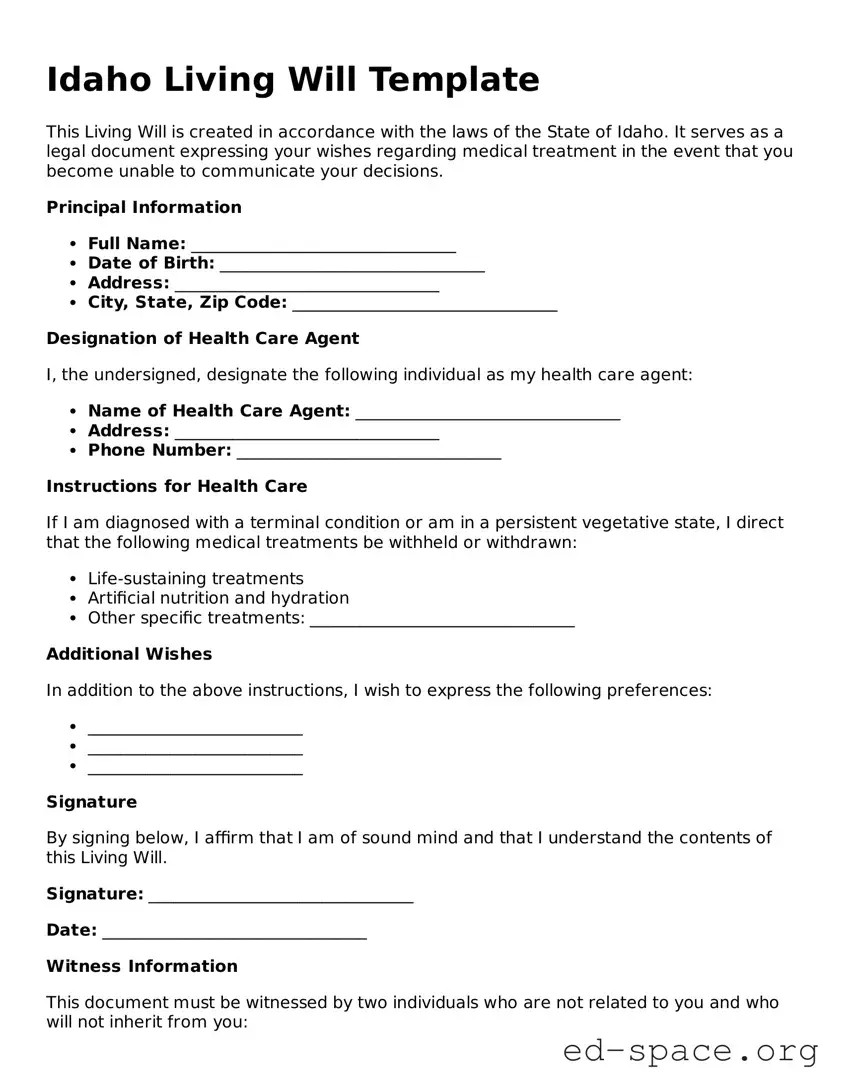
In the state of Idaho, the Living Will form serves as a crucial tool for individuals who wish to outline their preferences regarding medical treatment in the event they become unable to communicate their wishes. This document empowers individuals to make decisions about their healthcare in advance, ensuring that their values and desires are respected even when they cannot speak for themselves. The form typically addresses various medical scenarios, including end-of-life care and life-sustaining treatments, allowing individuals to specify their choices regarding interventions such as resuscitation and artificial nutrition. By completing a Living Will, individuals can relieve their loved ones of the burden of making difficult decisions during emotionally charged times. Furthermore, this form can be an essential part of a broader advance care planning process, which may also include appointing a healthcare proxy or agent to make decisions on one’s behalf. Understanding the significance of this document is vital, as it not only reflects personal beliefs but also fosters open communication among family members and healthcare providers, ultimately leading to care that aligns with the individual’s wishes.
Idaho Living Will Template
This Living Will is created in accordance with the laws of the State of Idaho. It serves as a legal document expressing your wishes regarding medical treatment in the event that you become unable to communicate your decisions.
Principal Information
Designation of Health Care Agent
I, the undersigned, designate the following individual as my health care agent:
Instructions for Health Care
If I am diagnosed with a terminal condition or am in a persistent vegetative state, I direct that the following medical treatments be withheld or withdrawn:
Additional Wishes
In addition to the above instructions, I wish to express the following preferences:
Signature
By signing below, I affirm that I am of sound mind and that I understand the contents of this Living Will.
Signature: ________________________________
Date: ________________________________
Witness Information
This document must be witnessed by two individuals who are not related to you and who will not inherit from you:
It is advisable to keep this document in a safe place and share copies with your health care agent and family members.
| Fact Name | Description |
|---|---|
| Definition | The Idaho Living Will is a legal document that allows individuals to outline their preferences for medical treatment in the event they become unable to communicate their wishes. |
| Governing Law | The Idaho Living Will is governed by Idaho Code § 39-4501 to § 39-4511. |
| Eligibility | Any adult who is at least 18 years old can create a Living Will in Idaho. |
| Witness Requirement | The document must be signed in the presence of two witnesses who are not related to the individual or entitled to any part of their estate. |
| Notarization | While notarization is not required, it is recommended to enhance the document's validity. |
| Revocation | A Living Will can be revoked at any time by the individual, provided they communicate their intent to do so. |
| Scope of Decisions | The document can specify preferences regarding life-sustaining treatment, resuscitation, and other medical interventions. |
| Durability | The Idaho Living Will remains in effect until it is revoked by the individual or until the individual passes away. |
| Healthcare Provider Compliance | Healthcare providers are required to comply with the wishes expressed in a Living Will, as long as they are aware of its existence. |
| Additional Documents | Individuals may also consider creating a Durable Power of Attorney for Health Care to complement their Living Will. |
Filling out the Idaho Living Will form is an important step in making your healthcare preferences known. After completing the form, you will need to ensure that it is signed and witnessed according to state requirements. This will help ensure that your wishes are respected in the event that you are unable to communicate them yourself.
What is a Living Will in Idaho?
A Living Will is a legal document that allows individuals to express their wishes regarding medical treatment in the event they become unable to communicate those wishes themselves. It specifically addresses end-of-life care and the types of medical interventions one may or may not want to receive.
Who can create a Living Will in Idaho?
Any adult who is at least 18 years old and of sound mind can create a Living Will in Idaho. This includes individuals who are capable of understanding the nature and consequences of the document they are signing.
What are the requirements for a valid Living Will in Idaho?
To be valid, a Living Will in Idaho must be signed by the individual creating it. It must also be witnessed by two individuals who are not related to the signer or beneficiaries of the estate. Alternatively, the document can be notarized.
Can I change or revoke my Living Will?
Yes, individuals can change or revoke their Living Will at any time. This can be done by creating a new document or by clearly stating the intention to revoke the previous Living Will in writing. It is important to inform healthcare providers and family members of any changes.
What should I include in my Living Will?
In a Living Will, individuals should specify their preferences regarding life-sustaining treatments, such as resuscitation, mechanical ventilation, and tube feeding. It is also helpful to include any specific conditions under which these treatments should or should not be administered.
How does a Living Will differ from a Durable Power of Attorney for Healthcare?
A Living Will focuses specifically on end-of-life decisions and medical treatment preferences, while a Durable Power of Attorney for Healthcare allows an individual to appoint someone to make healthcare decisions on their behalf if they are unable to do so. Both documents serve important but distinct purposes.
Is a Living Will recognized in other states?
Idaho's Living Will is generally recognized in other states, but laws can vary. It is advisable to check the specific requirements of the state in which you may be receiving medical care to ensure that your Living Will will be honored.
Where should I keep my Living Will?
It is important to keep your Living Will in a safe but accessible location. Inform family members and your healthcare provider about its location. Some individuals choose to carry a card in their wallet indicating that they have a Living Will and where it can be found.
Not Clearly Stating Medical Preferences: Many individuals fail to articulate their medical preferences clearly. Vague language can lead to confusion and misinterpretation by healthcare providers.
Neglecting to Update the Document: Life circumstances change. People often forget to revisit and update their Living Will after significant life events, such as marriage, divorce, or the diagnosis of a new medical condition.
Not Designating a Healthcare Proxy: Some individuals overlook the importance of appointing a healthcare proxy. This person will make decisions on their behalf if they are unable to communicate their wishes.
Failing to Discuss Wishes with Family: Open conversations about end-of-life wishes are crucial. Many people fill out the form without discussing their decisions with family members, which can lead to conflict or confusion later on.
Inadequate Signatures and Witnesses: The validity of a Living Will often hinges on proper signatures. Some individuals neglect to ensure that the document is signed by the required number of witnesses or fails to have it notarized when necessary.
Not Understanding State-Specific Requirements: Each state has its own rules regarding Living Wills. Failing to familiarize oneself with Idaho's specific requirements can render the document ineffective.
A Living Will is an important document that outlines your wishes regarding medical treatment in the event that you become unable to communicate those wishes yourself. In addition to the Living Will, there are several other forms and documents that can help ensure your healthcare preferences are honored and that your affairs are managed according to your wishes. Below is a list of commonly used documents that complement the Idaho Living Will form.
By preparing these documents alongside your Idaho Living Will, you can create a comprehensive plan that addresses both your medical and financial needs. This proactive approach helps ensure that your wishes are followed and that your loved ones are equipped to make decisions on your behalf when needed.
When filling out the Idaho Living Will form, it's important to approach the task thoughtfully. Here are some key dos and don'ts to keep in mind:
When it comes to Idaho's Living Will form, many people hold misconceptions that can lead to confusion. Understanding the facts can help ensure that your wishes are honored. Here are four common misconceptions:
While both documents deal with health care decisions, they serve different purposes. A Living Will outlines your wishes regarding end-of-life care, while a Durable Power of Attorney designates someone to make health care decisions on your behalf.
This is not true. You can create a Living Will at any time, regardless of your current health status. It's a proactive way to communicate your wishes about medical treatment.
Many believe that only older individuals need a Living Will. However, accidents and sudden illnesses can happen to anyone. It's wise for adults of all ages to consider having one.
This is false. You can update or revoke your Living Will at any time, as long as you are mentally competent. It’s important to review your wishes periodically, especially after major life changes.
Filling out and using the Idaho Living Will form is an important step in ensuring your healthcare wishes are respected. Here are some key takeaways to keep in mind:
Taking the time to create a Living Will can provide peace of mind for you and your loved ones. It ensures that your healthcare preferences are known and respected, even when you cannot voice them yourself.