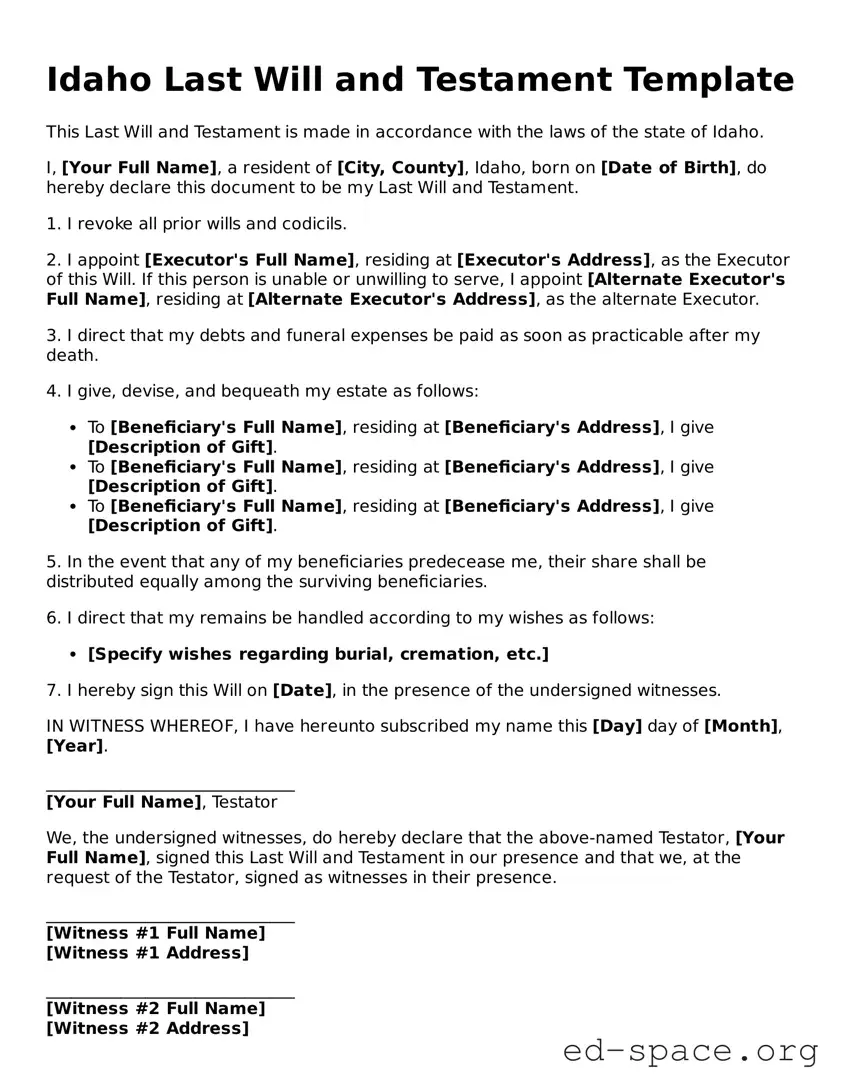
Creating a Last Will and Testament is an essential step in ensuring your wishes are honored after your passing. In Idaho, this legal document allows you to specify how your assets should be distributed, who will serve as your executor, and even appoint guardians for any minor children. The Idaho Last Will and Testament form is designed to be straightforward, enabling individuals to clearly outline their intentions. It typically includes sections for identifying the testator, detailing the distribution of property, and naming beneficiaries. Additionally, it requires signatures and witnesses to validate the document, ensuring that it meets the state's legal requirements. By taking the time to complete this form, you can provide peace of mind for yourself and your loved ones, knowing that your affairs will be handled according to your wishes.
Idaho Last Will and Testament Template
This Last Will and Testament is made in accordance with the laws of the state of Idaho.
I, [Your Full Name], a resident of [City, County], Idaho, born on [Date of Birth], do hereby declare this document to be my Last Will and Testament.
1. I revoke all prior wills and codicils.
2. I appoint [Executor's Full Name], residing at [Executor's Address], as the Executor of this Will. If this person is unable or unwilling to serve, I appoint [Alternate Executor's Full Name], residing at [Alternate Executor's Address], as the alternate Executor.
3. I direct that my debts and funeral expenses be paid as soon as practicable after my death.
4. I give, devise, and bequeath my estate as follows:
5. In the event that any of my beneficiaries predecease me, their share shall be distributed equally among the surviving beneficiaries.
6. I direct that my remains be handled according to my wishes as follows:
7. I hereby sign this Will on [Date], in the presence of the undersigned witnesses.
IN WITNESS WHEREOF, I have hereunto subscribed my name this [Day] day of [Month], [Year].
______________________________
[Your Full Name], Testator
We, the undersigned witnesses, do hereby declare that the above-named Testator, [Your Full Name], signed this Last Will and Testament in our presence and that we, at the request of the Testator, signed as witnesses in their presence.
______________________________
[Witness #1 Full Name]
[Witness #1 Address]
______________________________
[Witness #2 Full Name]
[Witness #2 Address]
| Fact Name | Description |
|---|---|
| Governing Law | The Idaho Last Will and Testament form is governed by Idaho Code § 15-2-501 to § 15-2-507. |
| Legal Age | In Idaho, individuals must be at least 18 years old to create a valid will. |
| Witness Requirement | Two witnesses are required to sign the will for it to be valid in Idaho. |
| Revocation | A will can be revoked by creating a new will or by physically destroying the original document. |
| Self-Proving Wills | Idaho allows for self-proving wills, which can simplify the probate process. |
| Holographic Wills | Handwritten wills, or holographic wills, are recognized in Idaho if they are signed and dated by the testator. |
| Executor Appointment | The testator can appoint an executor in the will to manage the estate after their passing. |
| Distribution of Assets | The will specifies how the testator's assets will be distributed among beneficiaries. |
Once you have the Idaho Last Will and Testament form in hand, you are ready to begin the process of designating how your assets will be distributed after your passing. This form allows you to express your wishes clearly and legally. Follow these steps to complete the form accurately.
What is a Last Will and Testament in Idaho?
A Last Will and Testament is a legal document that outlines how a person wishes to distribute their assets after their death. In Idaho, this document allows individuals to specify beneficiaries, appoint guardians for minor children, and designate an executor to manage the estate. It is an important tool for ensuring that a person's wishes are followed and can help prevent disputes among family members.
Who can create a Last Will and Testament in Idaho?
Any individual who is at least 18 years old and of sound mind can create a Last Will and Testament in Idaho. This means that the person must understand the nature of the document and the consequences of their decisions. There are no residency requirements, so individuals can create a will in Idaho even if they live in another state.
What are the requirements for a valid will in Idaho?
To be valid in Idaho, a Last Will and Testament must be in writing and signed by the testator (the person making the will). Additionally, the will must be witnessed by at least two individuals who are not beneficiaries. These witnesses must sign the document in the presence of the testator. If these requirements are met, the will is generally considered valid.
Can I make changes to my will after it is created?
Yes, you can make changes to your will at any time while you are still alive. This can be done by creating a new will or by drafting a codicil, which is an amendment to the existing will. It is important to follow the same formalities as the original will when making changes to ensure that they are legally enforceable.
What happens if I die without a will in Idaho?
If a person dies without a will, they are considered to have died intestate. In this case, Idaho law determines how the deceased's assets will be distributed. Typically, the estate will be divided among surviving relatives according to a specific hierarchy. This process can lead to outcomes that may not align with the deceased's wishes, making a will an important consideration.
How can I ensure my will is properly executed?
To ensure that your will is properly executed, follow the legal requirements for signing and witnessing as outlined by Idaho law. Additionally, store the will in a safe place and inform your executor and family members where it can be found. Consider consulting with a legal professional to review the document and confirm that it meets all necessary legal standards.
Can I revoke my will?
Yes, you can revoke your will at any time before your death. This can be done by creating a new will that explicitly states that it revokes all previous wills, or by physically destroying the existing will. It is advisable to inform your executor and family members about the revocation to prevent confusion or disputes in the future.
Not including all required personal information. Make sure to provide your full name, address, and date of birth.
Failing to name an executor. Choose someone you trust to carry out your wishes.
Omitting specific bequests. Clearly state what you want to leave to specific individuals.
Not signing the document. A will is not valid unless it is signed by you and witnessed.
Using outdated forms. Ensure you are using the most current version of the Idaho Last Will and Testament form.
Neglecting to have witnesses. Idaho law requires at least two witnesses to sign your will.
Not dating the will. A date helps clarify the most recent version of your will.
Making changes without proper procedures. If you need to amend your will, follow the correct process to avoid confusion.
Failing to store the will safely. Keep your will in a secure location and inform your executor where to find it.
Ignoring state laws. Familiarize yourself with Idaho's specific requirements for wills to ensure compliance.
When preparing a Last Will and Testament in Idaho, several other documents may be beneficial to ensure that your wishes are clearly articulated and legally binding. These documents can help address various aspects of estate planning and ensure a smoother transition for your loved ones. Below is a list of commonly used forms and documents that complement a Last Will and Testament.
Incorporating these documents alongside your Last Will and Testament can provide clarity and peace of mind. They serve to enhance your estate planning efforts, ensuring that your intentions are understood and respected by those you trust.
When filling out the Idaho Last Will and Testament form, it’s important to follow specific guidelines to ensure your wishes are clearly expressed and legally valid. Here are six things you should and shouldn’t do:
Understanding the Idaho Last Will and Testament form is crucial for effective estate planning. However, several misconceptions can lead to confusion. Here are nine common misconceptions:
In Idaho, a will does not need to be notarized to be valid. However, having it notarized can help streamline the probate process.
While consulting a lawyer is beneficial, individuals can create their own wills in Idaho as long as they meet state requirements.
Idaho does not recognize oral wills. A written document is necessary to ensure legal validity.
Updating a will can be straightforward. A new will can replace an old one, or a codicil can be added to modify specific provisions.
Not all assets need to be included in a will. Assets with designated beneficiaries, like life insurance or retirement accounts, pass outside the will.
Wills are important for everyone, regardless of wealth. They ensure that your wishes are honored and can simplify the process for your loved ones.
A will can be amended or revoked at any time, as long as the person creating it is of sound mind.
Even without minor children, a will is essential to dictate how your assets are distributed and who will handle your estate.
Not all wills require probate. Certain assets can pass outside of probate, depending on how they are structured.
Addressing these misconceptions can help individuals in Idaho make informed decisions about their estate planning needs.
When filling out and using the Idaho Last Will and Testament form, there are several important considerations to keep in mind. These key takeaways can help ensure that the will is valid and effectively communicates the testator's wishes.
By following these guidelines, individuals can create a valid Last Will and Testament that accurately reflects their intentions and complies with Idaho law.