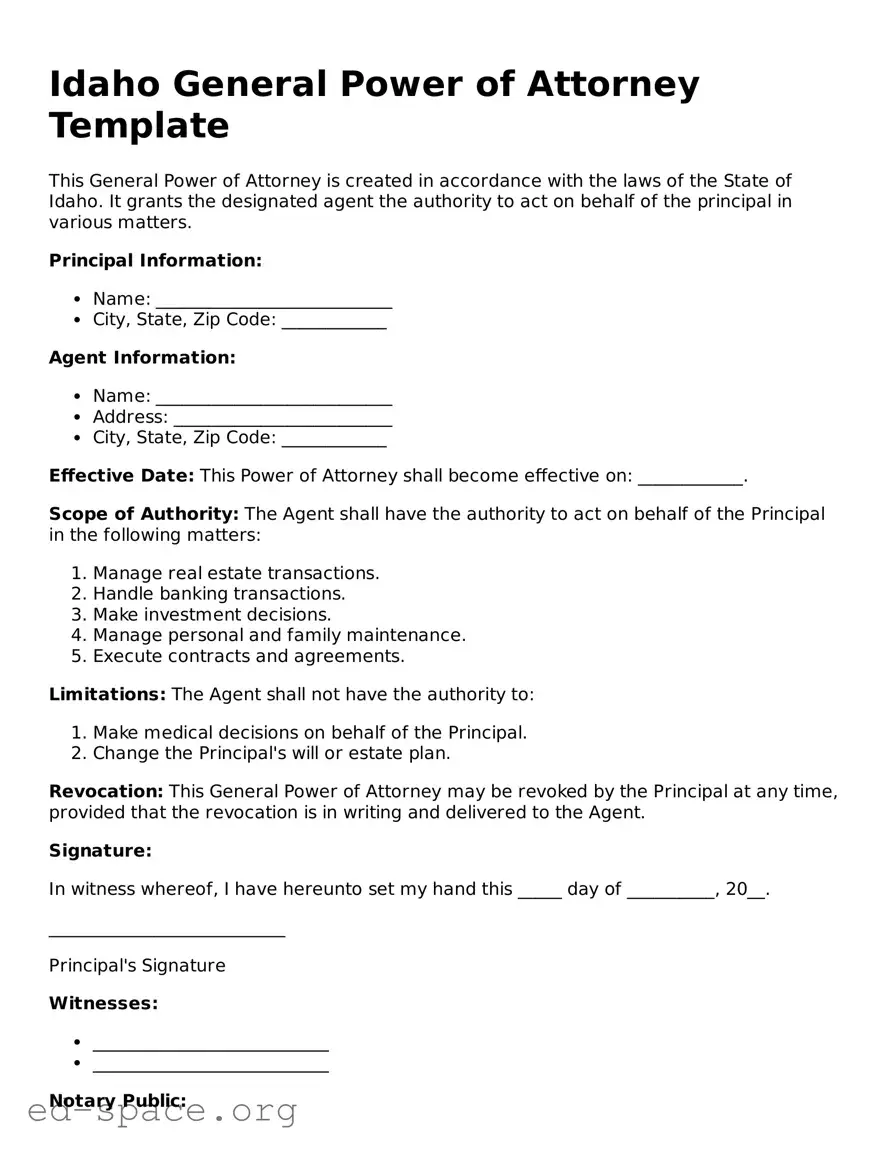
When it comes to managing your affairs, having a reliable plan in place is essential. The Idaho General Power of Attorney form is a valuable tool that allows you to appoint someone you trust to make decisions on your behalf. This can include handling financial matters, managing real estate, or making healthcare decisions if you're unable to do so. The form grants your agent broad authority, which can be tailored to your specific needs. It is important to choose someone who understands your wishes and can act in your best interest. Additionally, the Idaho General Power of Attorney can be effective immediately or only when you become incapacitated, depending on how you fill it out. Understanding how this form works and its implications can help ensure that your personal and financial matters are handled according to your preferences, even when you are not able to do so yourself.
Idaho General Power of Attorney Template
This General Power of Attorney is created in accordance with the laws of the State of Idaho. It grants the designated agent the authority to act on behalf of the principal in various matters.
Principal Information:
Agent Information:
Effective Date: This Power of Attorney shall become effective on: ____________.
Scope of Authority: The Agent shall have the authority to act on behalf of the Principal in the following matters:
Limitations: The Agent shall not have the authority to:
Revocation: This General Power of Attorney may be revoked by the Principal at any time, provided that the revocation is in writing and delivered to the Agent.
Signature:
In witness whereof, I have hereunto set my hand this _____ day of __________, 20__.
___________________________
Principal's Signature
Witnesses:
Notary Public:
State of Idaho, County of _______________
Subscribed and sworn to before me this _____ day of __________, 20__.
___________________________
Notary Public
My Commission Expires: _______________
| Fact Name | Details |
|---|---|
| Definition | The Idaho General Power of Attorney form allows a person (the principal) to grant another person (the agent) the authority to make decisions on their behalf. |
| Governing Law | This form is governed by Idaho Code § 15-12-101 through § 15-12-112. |
| Durability | The power of attorney can be durable, meaning it remains effective even if the principal becomes incapacitated. |
| Revocation | The principal can revoke the power of attorney at any time, as long as they are mentally competent. |
After obtaining the Idaho General Power of Attorney form, you'll need to fill it out carefully. Make sure to have all necessary information at hand to ensure a smooth process. Follow the steps below to complete the form correctly.
What is a General Power of Attorney in Idaho?
A General Power of Attorney in Idaho is a legal document that allows one person, known as the principal, to appoint another person, called the agent, to act on their behalf. This authority can cover a wide range of decisions, including financial and legal matters, allowing the agent to manage the principal’s affairs when they are unable to do so themselves.
Who can be appointed as an agent in a General Power of Attorney?
In Idaho, any competent adult can be appointed as an agent in a General Power of Attorney. This includes family members, friends, or professionals such as attorneys or financial advisors. It is essential to choose someone trustworthy, as they will have significant control over the principal's affairs.
Does the General Power of Attorney need to be notarized?
Yes, in Idaho, a General Power of Attorney must be notarized to be considered valid. This means that the principal must sign the document in the presence of a notary public, who will then acknowledge the signature. This step helps ensure that the document is legally binding and protects against potential fraud.
Can a General Power of Attorney be revoked?
Yes, a General Power of Attorney can be revoked at any time as long as the principal is competent. To revoke the document, the principal should create a written notice of revocation and inform the agent and any relevant third parties. It is advisable to destroy any copies of the original document to prevent confusion.
What happens if the principal becomes incapacitated?
If the principal becomes incapacitated, the General Power of Attorney remains in effect unless it is specified as a durable power of attorney. A durable power of attorney continues to be valid even if the principal loses the ability to make decisions. If the document is not durable, it will become void upon the principal's incapacitation.
Can the agent make medical decisions on behalf of the principal?
No, a General Power of Attorney typically does not grant authority for medical decisions unless it specifically includes medical powers. For healthcare decisions, a separate document known as a Health Care Power of Attorney or Advance Directive should be created. This document allows the agent to make medical decisions when the principal is unable to do so.
Is there a specific form required for a General Power of Attorney in Idaho?
Idaho does not require a specific form for a General Power of Attorney, but it is recommended to use a template that complies with state laws. Many templates are available online or through legal professionals, ensuring that all necessary elements are included to make the document valid.
How long does a General Power of Attorney remain in effect?
A General Power of Attorney remains in effect until it is revoked by the principal, the principal passes away, or the specified expiration date in the document is reached. If no expiration date is mentioned, it will generally remain valid until revoked or the principal becomes incapacitated, unless it is a durable power of attorney.
Not specifying the powers granted: One common mistake is failing to clearly outline the specific powers the agent will have. It's important to be precise. Without clear instructions, your agent may not know what decisions they can make on your behalf.
Forgetting to sign and date: A form that isn’t signed and dated is not valid. Ensure that you complete this step. Both the principal and the agent should sign to avoid any future disputes.
Neglecting to choose a successor agent: If your primary agent cannot serve, having a backup is crucial. Many people overlook this option. By naming a successor, you ensure that your affairs can still be managed seamlessly.
Not reviewing state-specific requirements: Each state has its own rules regarding power of attorney. Ignoring Idaho's specific regulations can lead to complications. Make sure you understand what is required in Idaho to ensure your document is legally binding.
When preparing a General Power of Attorney in Idaho, there are several other forms and documents that may be beneficial to have on hand. Each of these documents serves a unique purpose and can help ensure that your affairs are managed according to your wishes. Below is a list of commonly used documents alongside the General Power of Attorney form.
Having these documents prepared and organized can make a significant difference in managing your affairs effectively. It is advisable to consult with a legal professional to ensure that all documents are completed correctly and align with your specific needs and wishes.
Filling out the Idaho General Power of Attorney form is a significant step in managing your legal affairs. To ensure that the process goes smoothly, here are some essential dos and don'ts to keep in mind:
By following these guidelines, you can help ensure that your General Power of Attorney form is completed correctly and serves your intended purpose effectively.
Understanding the Idaho General Power of Attorney form is crucial for anyone considering its use. However, several misconceptions can lead to confusion. Here are ten common myths and the truths behind them.
This is not true. While it often covers financial decisions, it can also include health care and other personal matters, depending on how it is drafted.
Actually, the agent can be anyone you trust. It does not have to be a legal professional, but they should be responsible and reliable.
This is incorrect. The authority granted by a General Power of Attorney ends when the principal passes away.
In reality, you can revoke a General Power of Attorney at any time as long as you are mentally competent. This can be done through a written notice.
This misconception overlooks the fact that anyone can benefit from a General Power of Attorney, regardless of age. It’s particularly useful for those traveling or managing complex affairs.
This is misleading. The powers granted depend on what the principal specifies in the document. You can limit the authority to specific tasks or decisions.
This is not accurate. A Durable Power of Attorney remains effective even if the principal becomes incapacitated, while a General Power of Attorney may not.
While having a notary can help, it is not always required. The validity can depend on the specific requirements set by Idaho law.
This is false. After death, the agent has no authority. Estate matters are handled according to the will or state laws.
This is a misconception. Each General Power of Attorney can be tailored to meet individual needs and circumstances, ensuring it fits the principal's specific situation.
By clearing up these misconceptions, individuals can make informed decisions about using a General Power of Attorney in Idaho. Understanding the nuances can help ensure that your wishes are honored and your interests are protected.
When filling out and using the Idaho General Power of Attorney form, consider the following key takeaways: