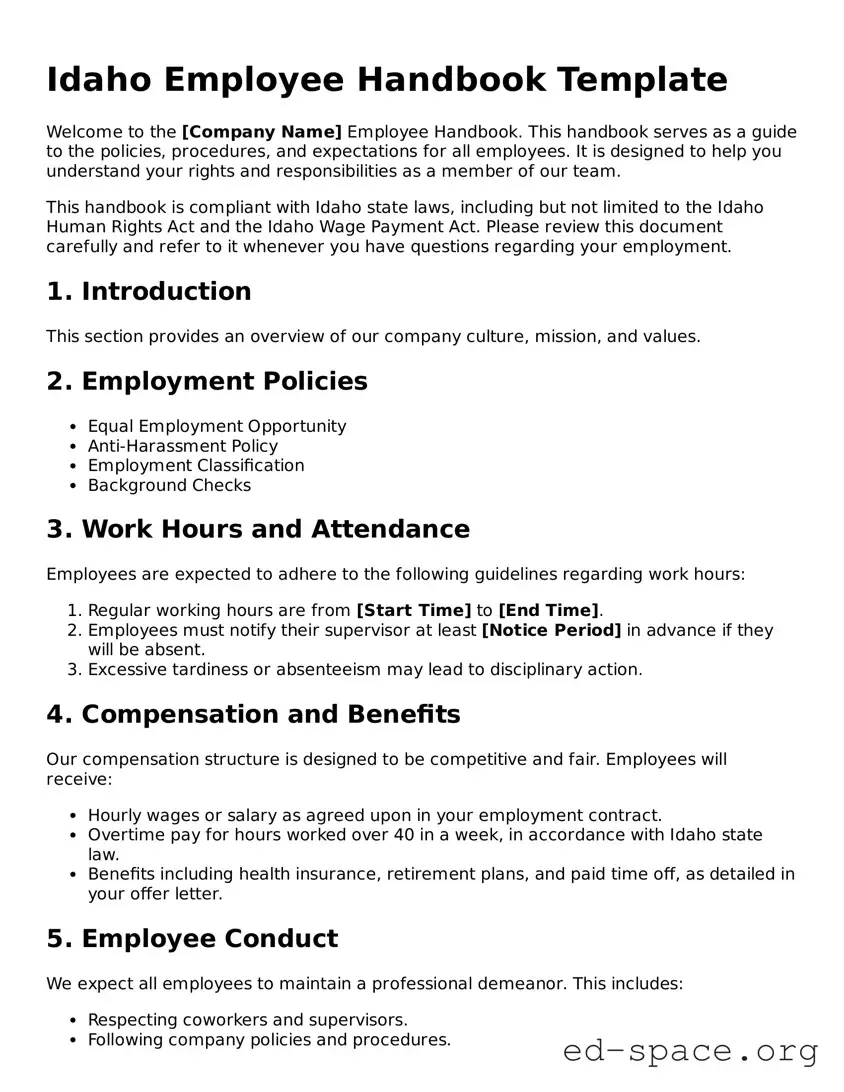
Creating a comprehensive employee handbook is essential for any business operating in Idaho. This document serves as a vital resource for both employers and employees, outlining workplace policies, expectations, and rights. Key aspects of the Idaho Employee Handbook include sections on company culture, employee conduct, anti-discrimination policies, and workplace safety protocols. Additionally, it typically addresses benefits, leave policies, and the procedures for addressing grievances. By clearly defining these elements, the handbook not only helps to foster a positive work environment but also ensures compliance with state and federal laws. A well-structured handbook can serve as a guide for employees, helping them understand their roles and responsibilities while providing a framework for the organization’s operations.
Idaho Employee Handbook Template
Welcome to the [Company Name] Employee Handbook. This handbook serves as a guide to the policies, procedures, and expectations for all employees. It is designed to help you understand your rights and responsibilities as a member of our team.
This handbook is compliant with Idaho state laws, including but not limited to the Idaho Human Rights Act and the Idaho Wage Payment Act. Please review this document carefully and refer to it whenever you have questions regarding your employment.
1. Introduction
This section provides an overview of our company culture, mission, and values.
2. Employment Policies
3. Work Hours and Attendance
Employees are expected to adhere to the following guidelines regarding work hours:
4. Compensation and Benefits
Our compensation structure is designed to be competitive and fair. Employees will receive:
5. Employee Conduct
We expect all employees to maintain a professional demeanor. This includes:
6. Safety and Health
Employee safety is a top priority. All employees must:
7. Acknowledgment of Receipt
By signing below, you acknowledge that you have received and read the [Company Name] Employee Handbook. You agree to abide by the policies and procedures outlined herein.
Employee Name: ____________________________
Employee Signature: ________________________
Date: ____________________________________
| Fact Name | Description |
|---|---|
| Purpose | The Idaho Employee Handbook serves as a guide for employees, outlining company policies, procedures, and expectations. |
| Compliance | This handbook helps ensure compliance with Idaho state laws and federal regulations, promoting a fair workplace environment. |
| Content Requirements | Essential topics include employee rights, workplace safety, and anti-discrimination policies, among others. |
| Governing Laws | The Idaho Employee Handbook is governed by the Idaho Code Title 44, which addresses labor laws and employee rights. |
| Updates | Regular updates to the handbook are necessary to reflect changes in laws and company policies, ensuring ongoing relevance. |
Filling out the Idaho Employee Handbook form is a straightforward process that requires attention to detail. Completing this form accurately is essential for ensuring that all necessary information is recorded properly. Follow the steps below to ensure a smooth completion of the form.
What is the Idaho Employee Handbook form?
The Idaho Employee Handbook form is a document that outlines the policies, procedures, and expectations for employees within a company in Idaho. It serves as a guide for employees to understand their rights and responsibilities, as well as the company’s standards of conduct.
Why is it important to have an Employee Handbook?
An Employee Handbook is essential for setting clear expectations. It helps prevent misunderstandings between employees and management. Additionally, it can protect the company from legal issues by demonstrating that policies are communicated effectively to all staff members.
Who should receive a copy of the Employee Handbook?
All employees should receive a copy of the Employee Handbook. This includes new hires during their onboarding process. Existing employees should also have access to the handbook, especially if there are updates or changes to policies.
How often should the Employee Handbook be updated?
The Employee Handbook should be reviewed and updated regularly, at least once a year. Changes in laws, company policies, or workplace practices may necessitate updates. Keeping the handbook current ensures that all employees have the most accurate information.
What should be included in the Employee Handbook?
The Employee Handbook should include sections on company policies, employee rights, workplace safety, benefits, and procedures for reporting issues. It should also cover topics such as anti-discrimination policies, disciplinary procedures, and leave policies.
What should I do if I have questions about the Employee Handbook?
If you have questions about the Employee Handbook, you should reach out to your HR department or supervisor. They can provide clarification on specific policies or direct you to the appropriate resources for further information.
Not Reading the Instructions: Many individuals overlook the instructions provided with the form. This can lead to misunderstandings about how to fill it out correctly.
Inaccurate Personal Information: Failing to provide correct personal details, such as name, address, or contact information, can cause issues later on.
Missing Signatures: Some people forget to sign the form. Without a signature, the document may be considered incomplete.
Overlooking Policy Acknowledgment: It’s crucial to acknowledge that you have read and understood the policies. Skipping this step can lead to confusion about expectations.
Neglecting to Update Information: If personal details change, such as a name change or a new address, failing to update the form can lead to outdated records.
Ignoring Deadlines: Submitting the form after the deadline can result in delays in processing or even penalties.
Not Asking Questions: If there’s confusion about any part of the form, many people hesitate to ask for clarification. This can lead to mistakes that could have been easily avoided.
Assuming All Policies Are Familiar: Some may think they know all the company policies, but not reviewing them can lead to misunderstandings.
Failing to Keep a Copy: After submission, not retaining a copy of the filled-out form can create problems if questions arise later.
When creating or updating an employee handbook in Idaho, several additional forms and documents may be necessary to ensure compliance and clarity in workplace policies. Below is a list of important documents that often accompany the Employee Handbook form.
Incorporating these documents alongside the Idaho Employee Handbook can help create a comprehensive framework for managing employees effectively. This ensures that both the employer and employees have a clear understanding of their rights, responsibilities, and the overall workplace environment.
When filling out the Idaho Employee Handbook form, it’s important to approach the task with care. Here are some guidelines to help you navigate the process effectively.
There are several misconceptions regarding the Idaho Employee Handbook form that can lead to confusion among employers and employees alike. Understanding these misconceptions can help ensure that the handbook serves its intended purpose effectively.
While it is true that not all businesses are legally required to have an employee handbook, having one is highly recommended. A handbook provides clarity on company policies and expectations, which can help prevent misunderstandings and disputes.
Many believe that an effective handbook must be comprehensive and lengthy. In reality, a concise and clear handbook that covers essential policies can be just as effective. The focus should be on clarity and accessibility, not on the number of pages.
Some employers think that once an employee handbook is drafted, it remains relevant indefinitely. However, it is crucial to regularly review and update the handbook to reflect changes in laws, company policies, and workplace practices.
Many employees assume that the handbook constitutes a contract between them and the employer. In most cases, the handbook is not legally binding. It serves as a guideline for policies and procedures, but it does not create enforceable rights unless explicitly stated.
Filling out and using the Idaho Employee Handbook form is an important step in establishing clear communication between employers and employees. Here are some key takeaways to keep in mind:
By following these guidelines, employers can create an effective and informative employee handbook that fosters a positive workplace environment.