In Idaho, the Do Not Resuscitate (DNR) Order form serves as a crucial document for individuals wishing to communicate their preferences regarding emergency medical treatment. This form is especially important for those with terminal illnesses or severe health conditions who may not want to receive life-sustaining interventions in the event of a cardiac arrest or respiratory failure. The DNR form must be completed by a qualified healthcare provider, ensuring that it accurately reflects the patient’s wishes. It is essential for patients to discuss their choices with family members and medical professionals to ensure everyone understands the implications. Once signed, the DNR order becomes part of the patient’s medical record, guiding emergency personnel in their response during critical situations. By clearly outlining a person's wishes, the DNR form helps to prevent unwanted resuscitation efforts, thereby respecting the individual's right to make informed decisions about their own healthcare. Understanding the details and processes involved in completing the DNR form is vital for both patients and their families, as it can significantly impact end-of-life care decisions.
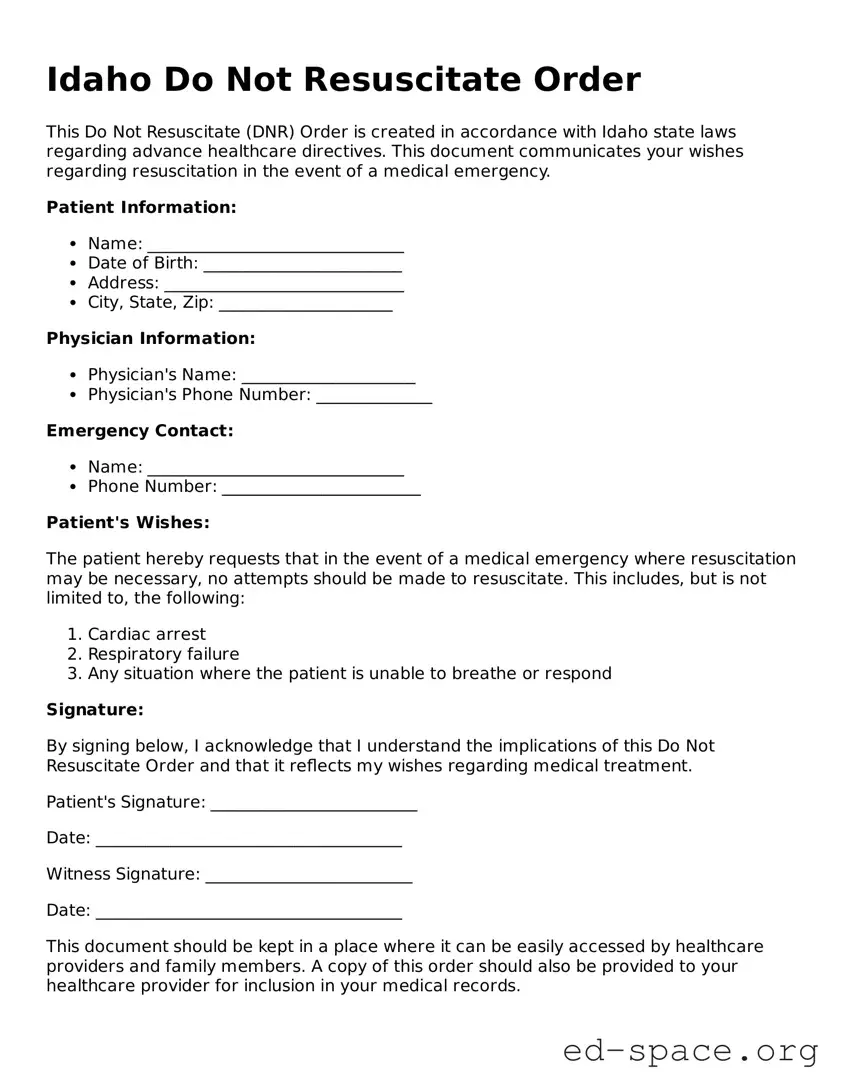
Idaho Do Not Resuscitate Order
This Do Not Resuscitate (DNR) Order is created in accordance with Idaho state laws regarding advance healthcare directives. This document communicates your wishes regarding resuscitation in the event of a medical emergency.
Patient Information:
Physician Information:
Emergency Contact:
Patient's Wishes:
The patient hereby requests that in the event of a medical emergency where resuscitation may be necessary, no attempts should be made to resuscitate. This includes, but is not limited to, the following:
Signature:
By signing below, I acknowledge that I understand the implications of this Do Not Resuscitate Order and that it reflects my wishes regarding medical treatment.
Patient's Signature: _________________________
Date: _____________________________________
Witness Signature: _________________________
Date: _____________________________________
This document should be kept in a place where it can be easily accessed by healthcare providers and family members. A copy of this order should also be provided to your healthcare provider for inclusion in your medical records.
| Fact Name | Details |
|---|---|
| Definition | An Idaho Do Not Resuscitate (DNR) Order is a legal document that tells medical personnel not to perform CPR if a person stops breathing or their heart stops beating. |
| Governing Law | The Idaho DNR Order is governed by Idaho Code § 39-4501 through § 39-4506. |
| Eligibility | Any adult can create a DNR Order if they are capable of making their own healthcare decisions. |
| Signature Requirement | The DNR Order must be signed by the patient or their legal representative. |
| Witness Requirement | The form must be witnessed by two individuals, who should not be related to the patient or entitled to any part of their estate. |
| Healthcare Provider | A physician must sign the DNR Order to validate it and ensure it complies with state laws. |
| Revocation | A patient can revoke the DNR Order at any time, verbally or in writing. |
| Placement | The DNR Order should be placed in a visible location, such as on the refrigerator or in a medical file, to ensure it is easily accessible during emergencies. |
| Emergency Medical Services | Emergency medical personnel are required to honor the DNR Order as long as it is valid and properly executed. |
| Additional Considerations | Patients may also want to discuss their DNR wishes with family members and healthcare providers to ensure everyone understands their preferences. |
Completing the Idaho Do Not Resuscitate Order form is an important step in ensuring your healthcare wishes are respected. Follow these steps carefully to fill out the form accurately.
After completing the form, ensure that it is readily accessible to your healthcare providers. This will help ensure that your wishes are honored in any medical situation.
What is a Do Not Resuscitate (DNR) Order in Idaho?
A Do Not Resuscitate Order is a legal document that allows individuals to refuse cardiopulmonary resuscitation (CPR) and other life-saving measures in the event of cardiac arrest. In Idaho, this order must be signed by a physician and is intended to honor the wishes of patients regarding their end-of-life care.
Who can request a DNR Order in Idaho?
Any adult who is capable of making their own healthcare decisions can request a DNR Order. Additionally, a legal guardian or a person holding a power of attorney for healthcare can also make this request on behalf of someone who is unable to do so.
How do I obtain a DNR Order form in Idaho?
You can obtain a DNR Order form from your healthcare provider, hospital, or online through the Idaho Department of Health and Welfare’s website. It is important to ensure that the form is completed correctly and signed by a physician.
What information is required on the DNR Order form?
The DNR Order form typically requires the patient’s name, date of birth, and a statement of their wishes regarding resuscitation. It must also include the signature of the attending physician and the date it was signed. Some forms may require additional information, such as the signature of a witness.
Is a DNR Order valid in all healthcare settings in Idaho?
Yes, once properly completed and signed, a DNR Order is valid across various healthcare settings in Idaho, including hospitals, nursing homes, and at home. However, it is advisable to inform all healthcare providers about the existence of the order to ensure it is honored.
Can a DNR Order be revoked?
Yes, a DNR Order can be revoked at any time by the patient or their authorized representative. To revoke the order, simply inform your healthcare provider, and it is recommended to destroy any copies of the original DNR form to avoid confusion.
What should I do if I change my mind about my DNR Order?
If you change your mind about your DNR Order, communicate your decision to your healthcare provider. It is essential to ensure that all copies of the previous order are destroyed and that a new order is created if you wish to have one in place.
Are there any costs associated with obtaining a DNR Order in Idaho?
There are generally no costs associated with obtaining a DNR Order itself. However, if you are receiving medical advice or services from a physician to complete the form, standard medical fees may apply. Always check with your healthcare provider for any potential charges.
Failing to consult a healthcare professional before completing the form. It is crucial to understand the implications of a Do Not Resuscitate (DNR) order.
Not providing clear and specific instructions. Ambiguities can lead to confusion among medical personnel during critical moments.
Neglecting to sign and date the form. Without a signature and date, the order may be considered invalid.
Forgetting to share the completed form with family members and healthcare providers. Communication is essential to ensure that everyone involved understands the individual's wishes.
Using outdated versions of the DNR form. Always verify that you are using the most current form to avoid potential legal issues.
Overlooking the need for witnesses or notarization, if required. Some jurisdictions may have specific requirements that must be met for the form to be legally binding.
Not discussing the decision with loved ones. Engaging in open conversations can help prevent misunderstandings and emotional distress later on.
Failing to review and update the DNR order regularly. As circumstances change, it is important to ensure that the document still reflects the individual's wishes.
When considering end-of-life care preferences, the Idaho Do Not Resuscitate (DNR) Order form is an important document. However, it is often accompanied by other forms and documents that can provide additional clarity and guidance for healthcare providers and family members. Below is a list of documents commonly used alongside the Idaho DNR Order form.
Having these documents in place can help ensure that healthcare providers and family members understand and respect an individual's wishes regarding medical treatment and end-of-life care. It is always advisable to discuss these preferences with loved ones and healthcare professionals to ensure clarity and alignment.
The Do Not Resuscitate (DNR) Order form is an important document in healthcare, specifically related to end-of-life decisions. Several other documents serve similar purposes in guiding medical treatment and ensuring patient wishes are honored. Here are ten documents that share similarities with the DNR Order form:
Understanding these documents can help individuals make informed decisions about their healthcare preferences and ensure their wishes are respected in critical situations.
When filling out the Idaho Do Not Resuscitate (DNR) Order form, it is essential to approach the task with care and attention. This document can significantly impact medical decisions, so understanding what to do and what to avoid is crucial. Here’s a list of important guidelines to consider:
Understanding the Idaho Do Not Resuscitate (DNR) Order form is important for making informed healthcare decisions. However, several misconceptions can lead to confusion. Here are seven common misunderstandings:
This is not true. A DNR order specifically addresses resuscitation efforts in the event of cardiac arrest. Other medical treatments and care can still be provided.
This misconception overlooks the fact that anyone can request a DNR order, regardless of their health status. It is a personal choice based on individual preferences.
In reality, a DNR order can be revoked or modified at any time by the patient or their authorized representative.
Healthcare providers are legally obligated to respect a valid DNR order. This ensures that a patient's wishes are honored during emergencies.
DNR orders can vary by state. It is essential to use the correct form for Idaho to ensure it is recognized and valid.
This is a common misunderstanding. A DNR order can be applicable in various settings, including at home or in long-term care facilities.
Creating a DNR order does not require legal assistance. Patients can fill out the form themselves or with the help of a healthcare provider.
Understanding the Idaho Do Not Resuscitate (DNR) Order form is essential for individuals and families making healthcare decisions. Here are key takeaways to consider:
Filling out and using the Idaho Do Not Resuscitate Order form is a significant step in making informed healthcare decisions. Understanding the key elements can help ensure that a patient's preferences are honored during critical moments.