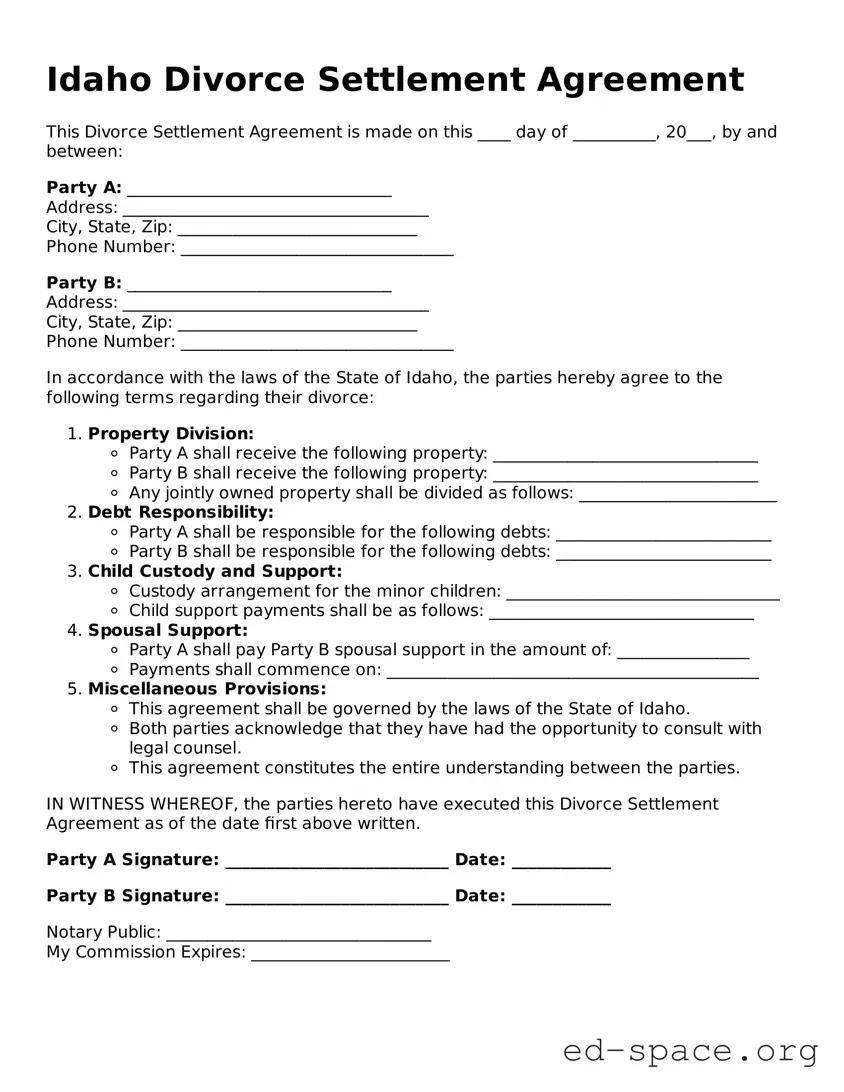
When navigating the complexities of divorce in Idaho, one crucial document stands out: the Divorce Settlement Agreement form. This form plays a vital role in outlining the terms of the divorce, ensuring that both parties have a clear understanding of their rights and responsibilities. It typically covers essential aspects such as the division of property, child custody arrangements, child support obligations, and spousal support, if applicable. By detailing these agreements, the form helps to minimize misunderstandings and disputes that may arise during the divorce process. Additionally, it may address other important issues like debt allocation and health insurance coverage. Completing this form accurately is key to reaching a fair settlement that reflects the needs and circumstances of both spouses and any children involved.
Idaho Divorce Settlement Agreement
This Divorce Settlement Agreement is made on this ____ day of __________, 20___, by and between:
Party A: ________________________________
Address: _____________________________________
City, State, Zip: _____________________________
Phone Number: _________________________________
Party B: ________________________________
Address: _____________________________________
City, State, Zip: _____________________________
Phone Number: _________________________________
In accordance with the laws of the State of Idaho, the parties hereby agree to the following terms regarding their divorce:
IN WITNESS WHEREOF, the parties hereto have executed this Divorce Settlement Agreement as of the date first above written.
Party A Signature: ___________________________ Date: ____________
Party B Signature: ___________________________ Date: ____________
Notary Public: ________________________________
My Commission Expires: ________________________
| Fact Name | Description |
|---|---|
| Purpose | The Idaho Divorce Settlement Agreement form outlines the terms of a divorce settlement between parties, including property division, child custody, and support obligations. |
| Governing Law | This form is governed by the Idaho Code, specifically Title 32, Chapter 7, which addresses divorce and family law matters. |
| Filing Requirement | Both parties must sign the agreement, and it must be filed with the court as part of the divorce proceedings. |
| Modification | Once approved by the court, the terms of the agreement can only be modified if both parties consent or if a significant change in circumstances occurs. |
| Child Support Guidelines | The agreement must comply with Idaho's child support guidelines to ensure fair and adequate support for children involved. |
| Legal Advice | While the form can be filled out without an attorney, it is highly recommended that individuals seek legal advice to ensure their rights are protected. |
Once you have the Idaho Divorce Settlement Agreement form in hand, you will need to complete it carefully. This document is essential for finalizing the terms of your divorce. Make sure to have all necessary information ready before you start filling it out.
After filling out the form, it will need to be filed with the appropriate court. Make sure to keep copies for your records. You may also want to consult with a legal professional to ensure everything is in order before submission.
What is a Divorce Settlement Agreement in Idaho?
A Divorce Settlement Agreement is a legal document that outlines the terms of a divorce between two parties. It covers various aspects such as the division of property, child custody, child support, and spousal support. This agreement is crucial for ensuring that both parties understand their rights and responsibilities following the divorce.
Why is a Divorce Settlement Agreement important?
This agreement is important because it helps to prevent future disputes between the parties. By clearly outlining the terms of the divorce, both individuals can avoid misunderstandings and conflicts. It serves as a binding contract that can be enforced in court if necessary.
How do I create a Divorce Settlement Agreement in Idaho?
To create a Divorce Settlement Agreement, both parties should discuss and negotiate the terms they wish to include. It is often advisable to consult with a lawyer to ensure that the agreement complies with Idaho law and adequately protects your interests. Once the terms are agreed upon, the document should be drafted and signed by both parties.
Can I modify a Divorce Settlement Agreement after it is signed?
Yes, a Divorce Settlement Agreement can be modified, but both parties must agree to the changes. If circumstances change significantly, such as a change in income or living situation, either party may request a modification through the court. It is essential to document any changes in writing.
What happens if one party does not comply with the Divorce Settlement Agreement?
If one party fails to comply with the terms of the agreement, the other party may seek enforcement through the court. The court can take various actions, including ordering compliance, modifying the agreement, or even imposing penalties on the non-compliant party.
Is a Divorce Settlement Agreement legally binding?
Yes, once both parties sign the Divorce Settlement Agreement and it is approved by the court, it becomes legally binding. This means that both parties are obligated to follow the terms set forth in the agreement. Failure to do so can result in legal consequences.
Do I need a lawyer to draft my Divorce Settlement Agreement?
While it is not legally required to have a lawyer draft your Divorce Settlement Agreement, it is highly recommended. A lawyer can provide valuable guidance, ensure that your rights are protected, and help you navigate the complexities of divorce law in Idaho.
How long does it take to finalize a Divorce Settlement Agreement?
The time it takes to finalize a Divorce Settlement Agreement can vary based on several factors, including the complexity of the issues involved and the willingness of both parties to negotiate. Generally, if both parties agree on the terms, the process can be completed in a few weeks. However, if there are disputes, it may take longer.
Where can I find the Divorce Settlement Agreement form in Idaho?
The Divorce Settlement Agreement form can typically be obtained from the Idaho state court website or through your local courthouse. It is important to ensure that you are using the most current version of the form and that it complies with Idaho laws.
Failing to provide complete information: Many individuals overlook the importance of filling out all required sections. Incomplete forms can lead to delays in the processing of the divorce.
Not being specific about assets and debts: When listing property, bank accounts, and debts, vague descriptions can cause confusion. It is essential to be clear and detailed to avoid misunderstandings.
Ignoring state guidelines: Each state has specific requirements for divorce settlements. Not adhering to Idaho's rules can result in the agreement being deemed invalid.
Overlooking the importance of notarization: Some individuals forget that certain sections of the agreement must be notarized. This step adds a layer of authenticity and can prevent future disputes.
Not considering future changes: Failing to address potential future changes, such as job loss or relocation, can lead to complications. It is wise to include provisions for modifications to the agreement.
When going through a divorce in Idaho, several forms and documents may accompany the Divorce Settlement Agreement. Each document serves a specific purpose in the process, ensuring that all aspects of the divorce are addressed properly. Below is a list of commonly used forms.
Each of these documents plays a crucial role in the divorce process, helping to ensure that everything is handled fairly and legally. Understanding each form can make the process smoother and less stressful for everyone involved.
Separation Agreement: Similar to a Divorce Settlement Agreement, a Separation Agreement outlines the terms under which spouses agree to live apart. It addresses issues like property division and support, often used when couples wish to separate without filing for divorce immediately.
Child Custody Agreement: This document specifies the arrangements for the care and custody of children following a divorce. Like a Divorce Settlement Agreement, it aims to ensure the best interests of the children are prioritized and provides clarity on parental responsibilities.
Property Settlement Agreement: This agreement focuses specifically on the division of marital property. It is similar to a Divorce Settlement Agreement as it delineates how assets and debts will be divided between spouses.
Spousal Support Agreement: This document details the terms of financial support one spouse will provide to the other after separation or divorce. It shares similarities with a Divorce Settlement Agreement in that it addresses financial obligations stemming from the marriage.
Prenuptial Agreement: Often established before marriage, this document outlines how assets will be divided in the event of a divorce. Its purpose aligns with that of a Divorce Settlement Agreement, as both aim to clarify financial arrangements between spouses.
Postnuptial Agreement: Similar to a prenuptial agreement, a postnuptial agreement is created after marriage. It serves to define the division of assets and financial responsibilities, akin to the objectives of a Divorce Settlement Agreement.
Child Support Agreement: This document specifies the financial support one parent will provide for their children following a divorce. It parallels the Divorce Settlement Agreement in its focus on the welfare of the children and financial obligations.
Mutual Consent Agreement: This agreement is used when both parties agree on the terms of their separation or divorce. It is similar to a Divorce Settlement Agreement, as it formalizes the mutual decisions made by the spouses.
Marital Settlement Agreement: This document outlines the terms of a couple’s divorce, including asset division, child custody, and support. It serves the same purpose as a Divorce Settlement Agreement, providing a comprehensive resolution to marital issues.
Divorce Decree: This is the final order issued by a court that officially ends a marriage. While it differs in function, it is similar to a Divorce Settlement Agreement in that it finalizes the terms agreed upon by both parties during the divorce process.
Filling out the Idaho Divorce Settlement Agreement form can feel overwhelming, but understanding what to do and what to avoid can make the process smoother. Here are some essential tips to consider:
By following these guidelines, you can navigate the Idaho Divorce Settlement Agreement form with greater confidence and clarity.
Understanding the Idaho Divorce Settlement Agreement form is essential for anyone going through a divorce. However, several misconceptions can lead to confusion. Here are six common misunderstandings:
Completing the Idaho Divorce Settlement Agreement form requires both parties to reach a mutual understanding on key issues such as property division, child custody, and support obligations.
It is essential to provide accurate and complete information. Inaccuracies can lead to delays or complications in the divorce process.
Both parties must sign the form. This signature indicates that both individuals agree to the terms outlined in the agreement.
After filling out the form, it should be filed with the appropriate court. This step formalizes the agreement and makes it legally binding.
Consideration of future changes is important. The agreement may need modifications if circumstances change, such as income adjustments or relocation.
Consulting with a legal professional can provide valuable guidance. A lawyer can help ensure that all aspects of the agreement comply with Idaho law and protect individual interests.