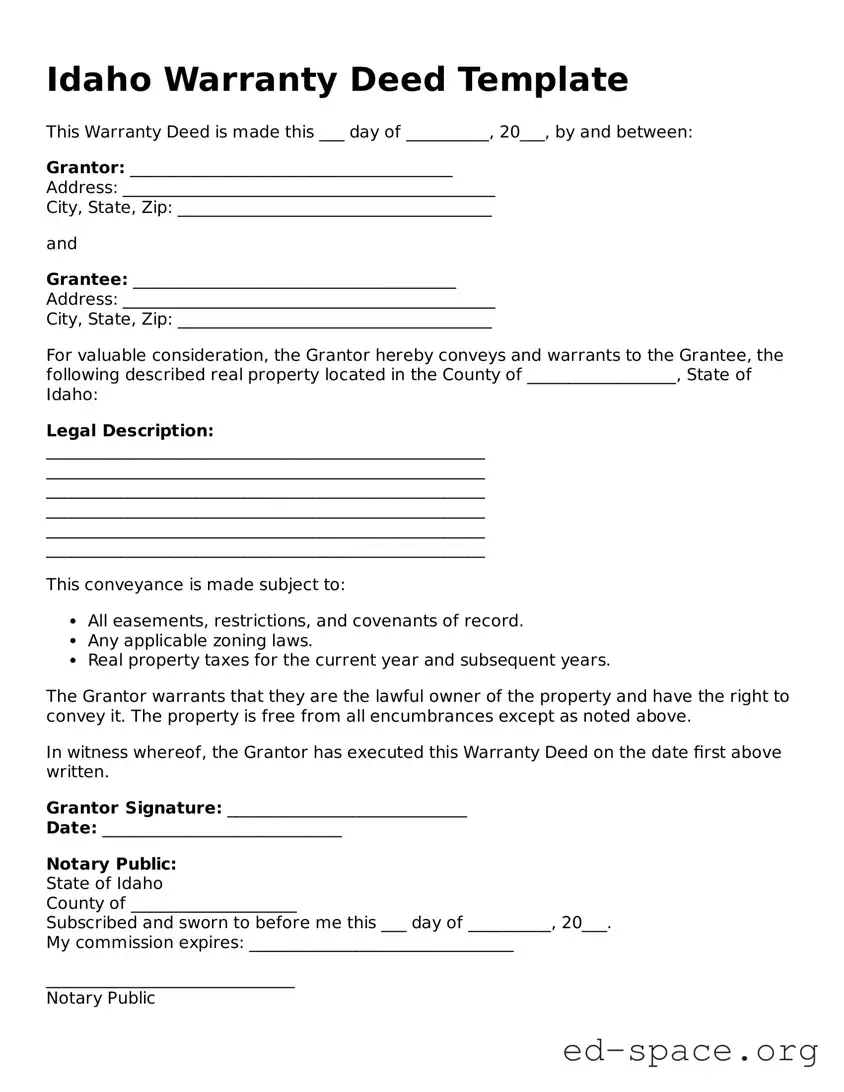
The Idaho Deed form is an essential legal document used in real estate transactions throughout the state. This form serves as the official record of property transfer, detailing the parties involved, the property description, and any conditions or restrictions related to the sale. It typically includes the grantor, who is the current property owner, and the grantee, who is the new owner. Additionally, the form may outline specific terms of the transfer, such as whether it is a warranty deed or a quitclaim deed, which can affect the rights and responsibilities of the parties. Proper execution of the Idaho Deed form ensures that the transfer is legally binding and protects the interests of both parties. Understanding how to complete this form accurately is crucial for anyone involved in buying or selling property in Idaho.
Idaho Warranty Deed Template
This Warranty Deed is made this ___ day of __________, 20___, by and between:
Grantor: _______________________________________
Address: _____________________________________________
City, State, Zip: ______________________________________
and
Grantee: _______________________________________
Address: _____________________________________________
City, State, Zip: ______________________________________
For valuable consideration, the Grantor hereby conveys and warrants to the Grantee, the following described real property located in the County of __________________, State of Idaho:
Legal Description:
_____________________________________________________
_____________________________________________________
_____________________________________________________
_____________________________________________________
_____________________________________________________
_____________________________________________________
This conveyance is made subject to:
The Grantor warrants that they are the lawful owner of the property and have the right to convey it. The property is free from all encumbrances except as noted above.
In witness whereof, the Grantor has executed this Warranty Deed on the date first above written.
Grantor Signature: _____________________________
Date: _____________________________
Notary Public:
State of Idaho
County of ____________________
Subscribed and sworn to before me this ___ day of __________, 20___.
My commission expires: ________________________________
______________________________
Notary Public
| Fact Name | Description |
|---|---|
| Purpose | The Idaho Deed form is used to transfer ownership of real property from one party to another. |
| Types of Deeds | Idaho recognizes several types of deeds, including warranty deeds and quitclaim deeds. |
| Governing Laws | The Idaho Deed form is governed by Idaho Code Title 55, Chapter 2. |
| Signatures Required | Both the grantor (seller) and grantee (buyer) must sign the deed for it to be valid. |
| Recording | To protect ownership rights, the deed should be recorded with the county recorder's office. |
Filling out the Idaho Deed form is an essential step in the property transfer process. Once completed, this document will need to be filed with the appropriate county recorder's office to ensure the change in ownership is legally recognized. The following steps will guide you through the process of accurately completing the form.
What is an Idaho Deed form?
An Idaho Deed form is a legal document used to transfer ownership of real estate from one party to another within the state of Idaho. It serves as proof of the transaction and outlines the details of the transfer, including the names of the parties involved, a description of the property, and any conditions related to the transfer. Understanding this document is crucial for anyone involved in buying or selling property in Idaho.
What types of Deeds are available in Idaho?
In Idaho, there are several types of Deeds, including Warranty Deeds, Quitclaim Deeds, and Special Warranty Deeds. A Warranty Deed provides a guarantee that the seller has clear title to the property and the right to sell it. A Quitclaim Deed, on the other hand, transfers whatever interest the seller has in the property without any guarantees. Special Warranty Deeds offer limited warranties, covering only the time the seller owned the property. Each type serves different purposes, so it's important to choose the right one based on your needs.
How do I fill out an Idaho Deed form?
Filling out an Idaho Deed form requires careful attention to detail. Start by entering the names of the grantor (the person transferring the property) and the grantee (the person receiving the property). Next, provide a legal description of the property, which can usually be found in the property’s current deed or tax records. Ensure that you include any necessary information, such as the date of the transfer and the consideration (the amount paid for the property). Once completed, the form must be signed by the grantor in the presence of a notary public.
Do I need to have the Idaho Deed form notarized?
Yes, in Idaho, the Deed form must be notarized. This means that the grantor must sign the document in front of a notary public, who will verify the identity of the signer and witness the signing. Notarization adds an extra layer of authenticity to the document, helping to prevent fraud and ensuring that the transfer of property is legitimate. Once notarized, the Deed must be recorded with the county recorder’s office to be legally effective.
Where do I file the Idaho Deed form after it’s completed?
After completing and notarizing the Idaho Deed form, you must file it with the county recorder’s office in the county where the property is located. This step is essential, as recording the Deed makes the transfer public and protects the rights of the new owner. There may be a small fee associated with the recording process, so it’s wise to check with the local recorder’s office for specific instructions and any applicable fees.
Can I use a generic Deed form for my property transfer in Idaho?
While you might find generic Deed forms online, it’s best to use a specific Idaho Deed form to ensure compliance with state laws. Each state has its own requirements regarding property transfers, and using a form tailored to Idaho can help avoid potential legal issues down the road. If you’re unsure, consulting with a real estate professional or an attorney can provide guidance tailored to your situation.
Failing to include all necessary parties in the deed. It is essential to list all grantors and grantees accurately to avoid legal disputes.
Not providing a complete legal description of the property. A vague or incomplete description can lead to confusion and issues with ownership.
Omitting the date of the transaction. The date is crucial for establishing the timeline of ownership and any related legal matters.
Forgetting to sign the deed. Without the proper signatures, the deed is not valid, and the transfer of property cannot be legally recognized.
Neglecting to have the deed notarized. In Idaho, notarization is often required to ensure the authenticity of the signatures and the document.
Not recording the deed with the county recorder's office. Failing to file the deed can result in challenges to ownership and may affect future transactions.
When engaging in property transactions in Idaho, several important documents accompany the deed form. Understanding these documents can help ensure a smooth transfer of ownership and protect your interests. Below are five commonly used forms and documents that are often associated with the Idaho Deed form.
Familiarizing yourself with these documents can significantly enhance your understanding of the property transfer process in Idaho. Each plays a vital role in ensuring that your rights are protected and that the transaction proceeds smoothly.
The Deed form is a crucial document in real estate and legal transactions, serving various purposes. Here are eight documents that share similarities with the Deed form, highlighting their functions and characteristics:
When filling out the Idaho Deed form, it’s important to be careful and thorough. Here are some key dos and don'ts to keep in mind:
Following these guidelines will help ensure that your deed is processed smoothly and without issues.
When it comes to the Idaho Deed form, several misconceptions can lead to confusion. Understanding these can help ensure proper use and compliance. Here are eight common misconceptions:
All deeds are the same. Many people believe that all deed forms are interchangeable. In reality, different types of deeds serve various purposes, such as warranty deeds, quitclaim deeds, and special purpose deeds.
A deed must be notarized to be valid. While notarization is often required for a deed to be recorded, it is not always necessary for the deed to be legally binding between the parties involved.
Only a lawyer can prepare a deed. Although hiring a lawyer can be beneficial, individuals can prepare their own deeds as long as they follow the correct format and legal requirements.
Once a deed is signed, it cannot be changed. A deed can be amended or revoked, but this requires a new legal document to be created and executed.
All property transfers require a deed. Some property transfers, such as those between spouses or through inheritance, may not require a formal deed.
Deeds are only for real estate. While most deeds pertain to real estate, they can also be used for transferring ownership of certain personal property.
The Idaho Deed form is the same for all counties. Some counties may have specific requirements or additional forms that must be included with the Idaho Deed form.
Filing a deed is the same as transferring ownership. Filing a deed with the county does not automatically transfer ownership; it must also be delivered to the grantee for the transfer to be effective.
Being aware of these misconceptions can help individuals navigate the process of using the Idaho Deed form more effectively.
When dealing with real estate transactions in Idaho, understanding how to properly fill out and use the Idaho Deed form is crucial. Here are some key takeaways to consider:
By keeping these key points in mind, individuals can navigate the process of filling out and using the Idaho Deed form with greater confidence and accuracy.