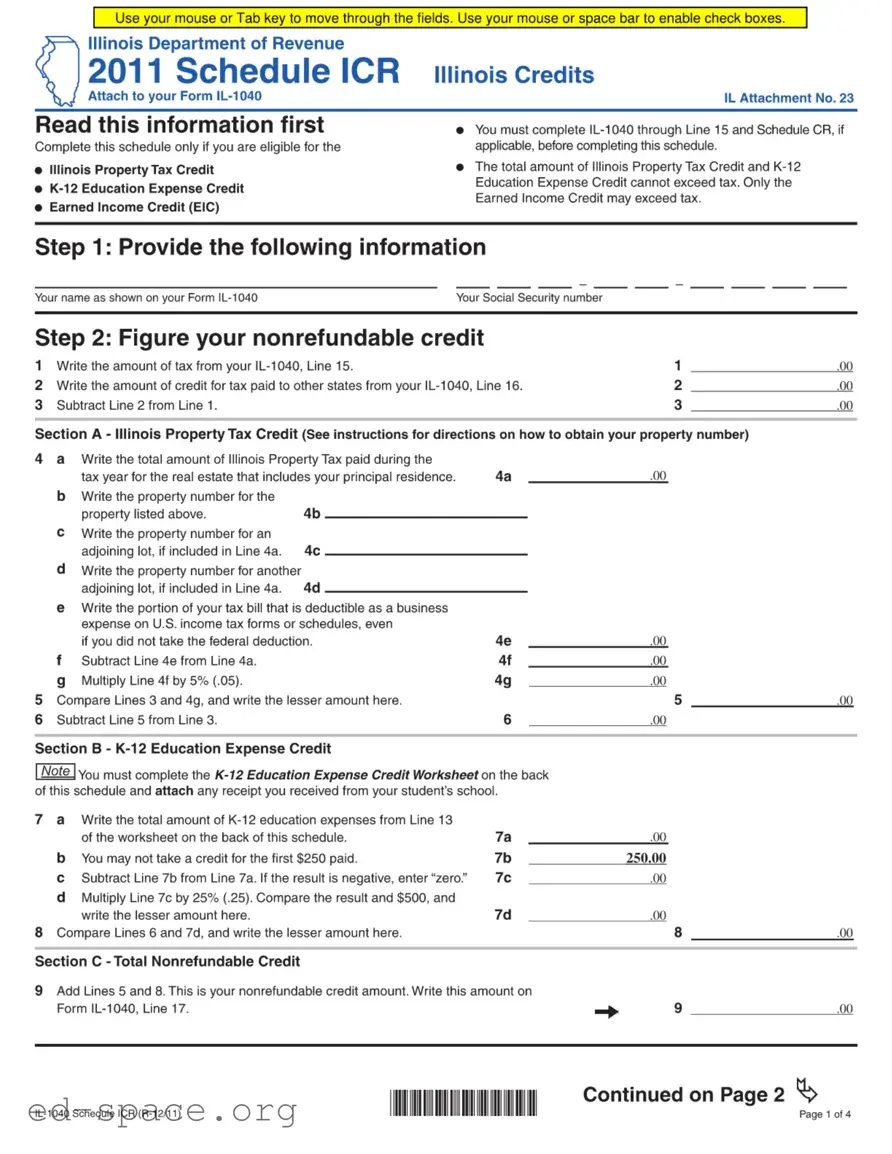
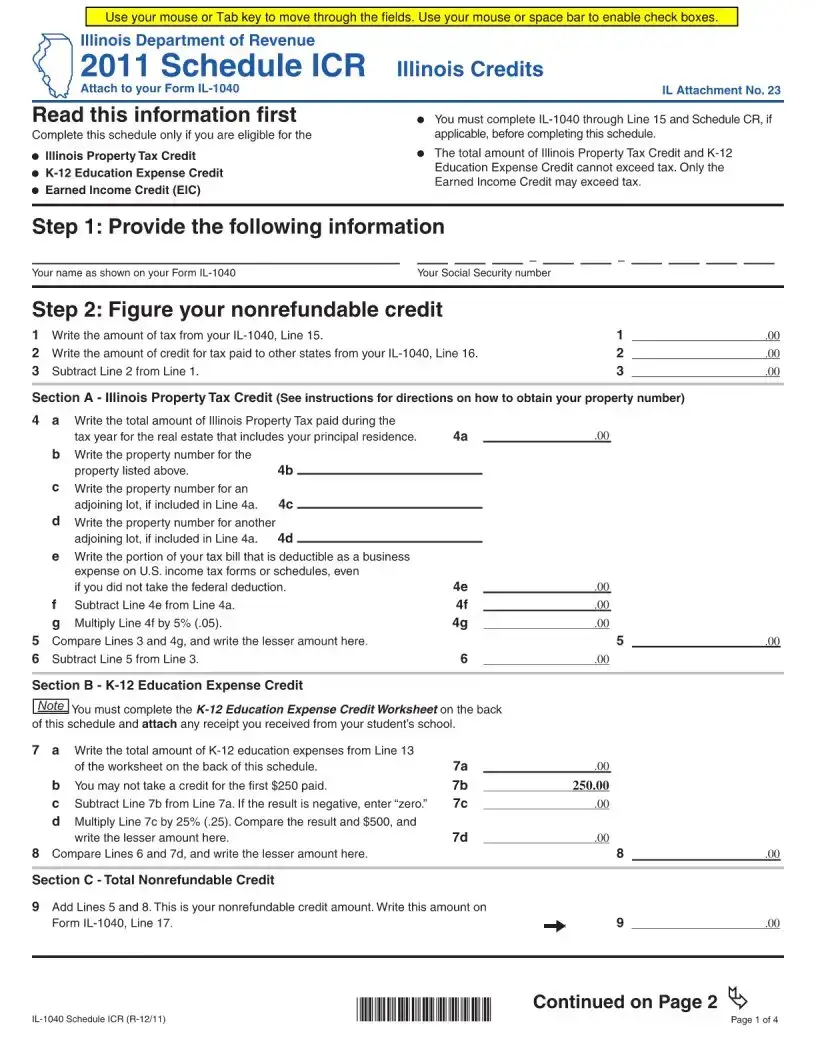
The Illinois Department of Revenue's Schedule ICR is an essential document for taxpayers seeking to claim specific credits on their state income tax returns. This form is primarily designed for individuals eligible for the Illinois Property Tax Credit, K-12 Education Expense Credit, and Earned Income Credit (EIC). Before filling out the Schedule ICR, taxpayers must complete their Form IL-1040 up to Line 15 and, if applicable, Schedule CR. The Schedule ICR requires detailed information about your tax situation, including your name, Social Security number, and the amounts of taxes paid. It guides you through calculating both nonrefundable and refundable credits, ensuring that you can accurately report your eligible credits. The nonrefundable credit section includes calculations for property taxes and educational expenses, while the refundable credit section focuses on the Earned Income Credit. By carefully following the instructions and providing the necessary information, taxpayers can maximize their credits and potentially reduce their overall tax liability.
| Fact Name | Description |
|---|---|
| Eligible Credits | This form allows taxpayers to claim the Illinois Property Tax Credit, K-12 Education Expense Credit, and Earned Income Credit (EIC). |
| Filing Requirements | Taxpayers must complete Form IL-1040 through Line 15 and Schedule CR, if applicable, before filling out this schedule. |
| Credit Limits | The combined total of the Illinois Property Tax Credit and K-12 Education Expense Credit cannot exceed the taxpayer's tax liability. Only the Earned Income Credit may exceed this limit. |
| Governing Law | This form is authorized under the Illinois Income Tax Act, which mandates disclosure of the information provided. |
Filling out the ICR form from the Illinois Department of Revenue is an essential step for individuals seeking to claim specific tax credits. Completing this form accurately ensures that you can benefit from available credits, such as the Illinois Property Tax Credit, K-12 Education Expense Credit, and Earned Income Credit. After filling out the form, it must be attached to your Form IL-1040 when you file your taxes.
What is the purpose of the ICR Illinois Department form?
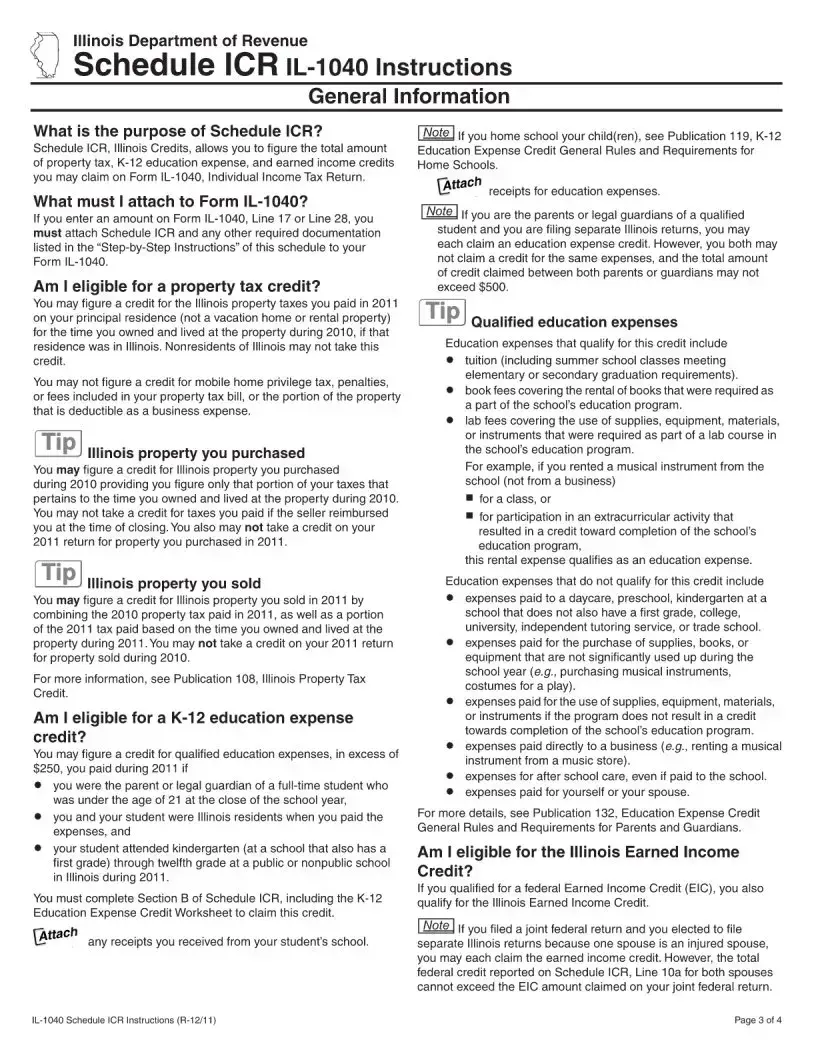
The ICR Illinois Department form, officially known as the Schedule ICR, is used to claim certain tax credits available to Illinois residents. These credits include the Illinois Property Tax Credit, K-12 Education Expense Credit, and the Earned Income Credit (EIC). To benefit from these credits, taxpayers must complete the form and attach it to their Form IL-1040.
Who should complete the ICR form?
Taxpayers who are eligible for the Illinois Property Tax Credit, K-12 Education Expense Credit, or Earned Income Credit should complete the ICR form. It is essential to first fill out Form IL-1040 through Line 15 and Schedule CR, if applicable, before starting the ICR form. This ensures that all necessary information is available for accurate credit calculations.
What information is required to complete the ICR form?
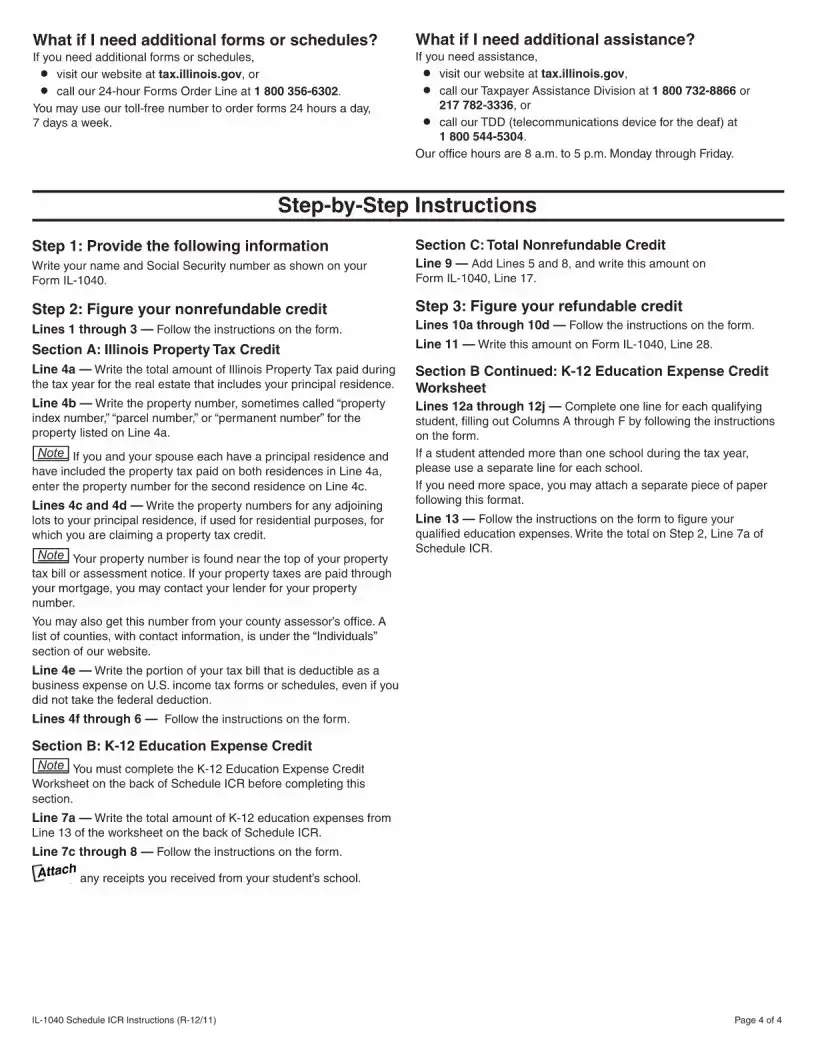
To complete the ICR form, individuals must provide their name as it appears on Form IL-1040 and their Social Security number. Additionally, they need to calculate their nonrefundable credits, which involves providing details about property taxes paid, K-12 education expenses, and any credits for taxes paid to other states. Specific property numbers and amounts related to education expenses must also be included.
How do I calculate the nonrefundable credit on the ICR form?
The nonrefundable credit is calculated in several steps. First, taxpayers must determine the amount of tax from their IL-1040, Line 15, and subtract any credits for taxes paid to other states from this amount. Next, they calculate the Illinois Property Tax Credit and K-12 Education Expense Credit, ensuring that the total does not exceed the tax owed, except for the Earned Income Credit, which may exceed the tax amount.
What is the K-12 Education Expense Credit and how is it calculated?
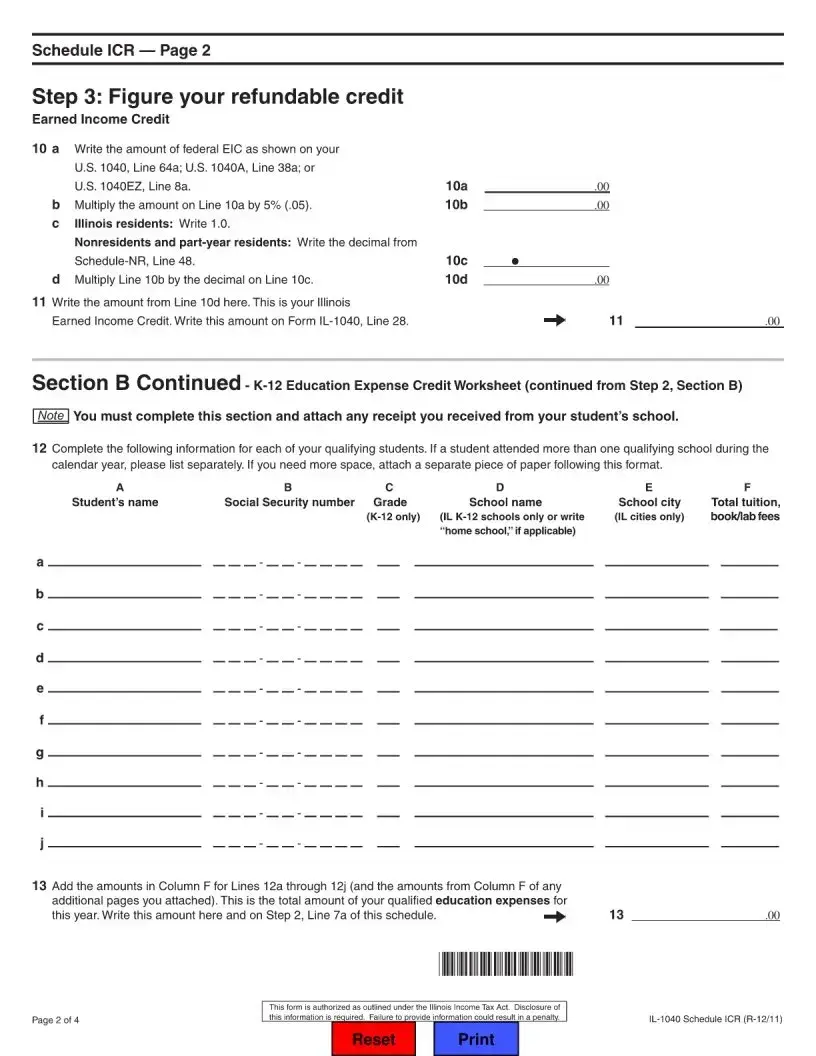
The K-12 Education Expense Credit allows taxpayers to claim a credit for qualifying education expenses incurred for their children attending K-12 schools. To calculate this credit, individuals must complete the K-12 Education Expense Credit Worksheet included with the ICR form. They should total their education expenses, subtract the first $250 paid, and then multiply the remaining amount by 25%. The resulting credit is compared to a maximum limit of $500, and the lesser amount is used for the overall credit calculation.
Can I claim the Earned Income Credit on the ICR form?
Yes, the Earned Income Credit can be claimed on the ICR form. Taxpayers must enter the amount of federal EIC as shown on their federal tax return and then calculate the Illinois Earned Income Credit by multiplying this amount by 5%. This credit is particularly beneficial for low to moderate-income earners and can exceed the total tax owed.
What should I do if I have more than one qualifying student for the K-12 Education Expense Credit?
If there are multiple qualifying students, taxpayers should complete the relevant section for each student on the ICR form. This includes providing details such as the student's name, Social Security number, grade, school name, and total tuition or fees. If additional space is needed, attaching a separate piece of paper in the same format is acceptable. The total expenses for all qualifying students will be summed and reported on the ICR form.
Failing to complete Form IL-1040 through Line 15 before starting the ICR form. It's essential to have this information ready.
Not including Schedule CR when applicable. This can lead to missing credits that you may be eligible for.
Incorrectly calculating the total amount of credits. Ensure that the total for the Illinois Property Tax Credit and K-12 Education Expense Credit does not exceed your tax amount.
Omitting your Social Security number. This information is critical for processing your credits accurately.
Writing the wrong property number on Line 4b, 4c, or 4d. Double-check these numbers to avoid errors.
Neglecting to subtract any deductible business expenses from your property tax bill on Line 4e. This can affect your total credit calculation.
Forgetting to complete the K-12 Education Expense Credit Worksheet. This is necessary for calculating your education expenses correctly.
Not attaching any receipts from your student’s school. Receipts are required for verification of expenses.
Misunderstanding the limits on the K-12 Education Expense Credit. Remember, you cannot claim a credit for the first $250 paid.
Failing to write the final amounts on the correct lines of Form IL-1040. Ensure that you transfer your nonrefundable and refundable credit amounts accurately.
The Illinois Department of Revenue Schedule ICR is an important document for taxpayers seeking to claim various credits, including the Illinois Property Tax Credit, K-12 Education Expense Credit, and Earned Income Credit. However, there are several other forms and documents that are often used in conjunction with this schedule. Each of these documents serves a specific purpose in the tax filing process, ensuring that taxpayers can accurately report their financial information and claim the credits they are entitled to.
Understanding these associated forms and documents can significantly streamline the tax filing process. Each plays a vital role in ensuring that taxpayers can accurately report their financial situation and claim the credits they deserve, ultimately leading to potential savings on their tax liabilities.
The Illinois Department of Revenue Schedule ICR form is similar to several other tax-related documents. Each of these forms serves to help taxpayers report credits, deductions, or other relevant information. Below is a list of seven documents that are similar to the Schedule ICR form, along with a brief explanation of how they are related:
When filling out the ICR Illinois Department form, there are important dos and don’ts to keep in mind. Follow these guidelines to ensure your application is accurate and complete.
By following these guidelines, you can help ensure that your form is processed smoothly and accurately.
Understanding the Illinois Department of Revenue's Schedule ICR can be challenging. Here are seven common misconceptions that people often have about this form:
By clarifying these misconceptions, individuals can better navigate the process of claiming their credits and ensure they receive the benefits they are entitled to.
When filling out the ICR Illinois Department form, consider these key points: