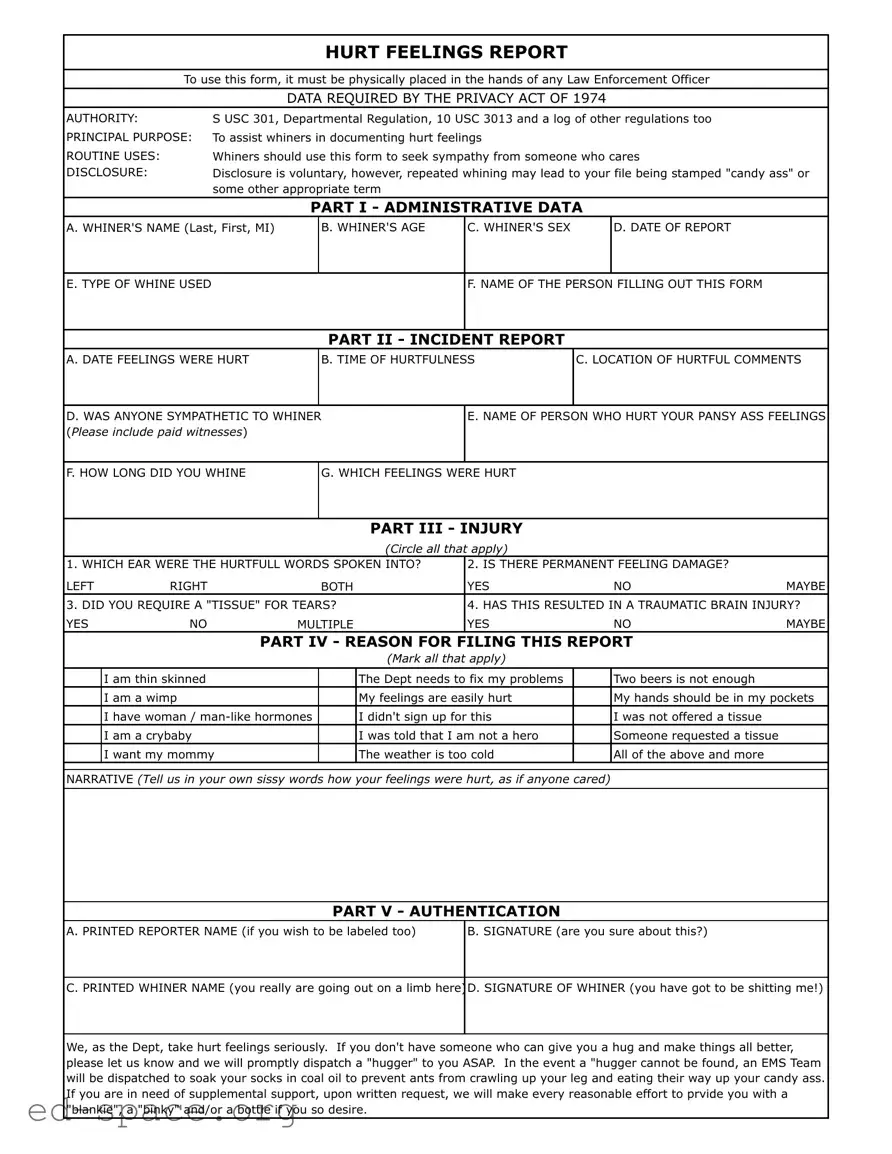
The Hurt Feelings Report form serves as a unique tool designed to help individuals document their emotional distress in a structured way. It requires the physical submission of the form to a law enforcement officer, ensuring that the complaint is formally recognized. This form is intended for those who feel their feelings have been hurt and wish to seek sympathy from others. It collects essential information such as the whiner’s name, age, and the specifics of the incident that caused the hurt feelings. The report includes sections for detailing the time, location, and nature of the hurtful comments, as well as any witnesses who may have been sympathetic. Additionally, it asks about the extent of the emotional injury, including whether a tissue was needed or if there was any lasting damage. The form also provides a space for individuals to express their reasons for filing, which can range from feeling overly sensitive to simply wanting attention. Finally, it concludes with an authentication section for the whiner to sign, affirming their claims. The underlying message is that while hurt feelings may seem trivial to some, they are taken seriously, and support will be offered to those in need.

HURT FEELINGS REPORT
To use this form, it must be physically placed in the hands of any Law Enforcement Officer
DATA REQUIRED BY THE PRIVACY ACT OF 1974
AUTHORITY: PRINCIPAL PURPOSE:
ROUTINE USES:
DISCLOSURE:
S USC 301, Departmental Regulation, 10 USC 3013 and a log of other regulations too To assist whiners in documenting hurt feelings
Whiners should use this form to seek sympathy from someone who cares
Disclosure is voluntary, however, repeated whining may lead to your file being stamped "candy ass" or some other appropriate term
PART I - ADMINISTRATIVE DATA
A. WHINER'S NAME (Last, First, MI)
B. WHINER'S AGE
C. WHINER'S SEX
D. DATE OF REPORT
E. TYPE OF WHINE USED
F. NAME OF THE PERSON FILLING OUT THIS FORM
PART II - INCIDENT REPORT
A. DATE FEELINGS WERE HURT
B. TIME OF HURTFULNESS
C. LOCATION OF HURTFUL COMMENTS
D. WAS ANYONE SYMPATHETIC TO WHINER (Please include paid witnesses)
E. NAME OF PERSON WHO HURT YOUR PANSY ASS FEELINGS
F. HOW LONG DID YOU WHINE
G. WHICH FEELINGS WERE HURT
PART III - INJURY
(Circle all that apply)
1. WHICH EAR WERE THE HURTFULL WORDS SPOKEN INTO? |
2. IS THERE PERMANENT FEELING DAMAGE? |
|
||||||
LEFT |
RIGHT |
|
BOTH |
|
YES |
NO |
MAYBE |
|
3. DID YOU REQUIRE A "TISSUE" FOR TEARS? |
|
4. HAS THIS RESULTED IN A TRAUMATIC BRAIN INJURY? |
||||||
YES |
NO |
MULTIPLE |
|
YES |
NO |
MAYBE |
||
|
|
PART IV - REASON FOR |
FILING THIS REPORT |
|
||||
|
|
|
|
(Mark all that apply) |
|
|
||
|
I am thin skinned |
|
|
The Dept needs to fix my problems |
|
Two beers is not enough |
|
|
|
I am a wimp |
|
|
My feelings are easily hurt |
|
My hands should be in my pockets |
||
|
I have woman / |
|
I didn't sign up for this |
|
I was not offered a tissue |
|
||
|
I am a crybaby |
|
|
I was told that I am not a hero |
|
Someone requested a tissue |
|
|
|
I want my mommy |
|
|
The weather is too cold |
|
All of the above and more |
|
|
NARRATIVE (Tell us in your own sissy words how your feelings were hurt, as if anyone cared)
PART V - AUTHENTICATION
A. PRINTED REPORTER NAME (if you wish to be labeled too)
B. SIGNATURE (are you sure about this?)
C. PRINTED WHINER NAME (you really are going out on a limb here) D. SIGNATURE OF WHINER (you have got to be shitting me!)
We, as the Dept, take hurt feelings seriously. If you don't have someone who can give you a hug and make things all better, please let us know and we will promptly dispatch a "hugger" to you ASAP. In the event a "hugger cannot be found, an EMS Team will be dispatched to soak your socks in coal oil to prevent ants from crawling up your leg and eating their way up your candy ass. If you are in need of supplemental support, upon written request, we will make every reasonable effort to prvide you with a "blankie", a "binky" and/or a bottle if you so desire.
| Fact Name | Description | Governing Law |
|---|---|---|
| Purpose of the Form | This form is designed to assist individuals in documenting their hurt feelings and seeking sympathy. | Privacy Act of 1974 |
| Submission Requirement | The form must be physically handed to a Law Enforcement Officer to be considered valid. | 10 USC 3013 |
| Voluntary Disclosure | While disclosure of information is voluntary, repeated submissions may result in a negative label. | USC 301 |
| Support Services | The department offers support services, including hugs and supplemental items, for those in need. | Departmental Regulation |
Filling out the Hurt Feelings Report form is a straightforward process. Follow these steps to ensure you provide all necessary information. Once completed, remember to give the form directly to a Law Enforcement Officer.
Once you have completed all sections, hand the form to a Law Enforcement Officer. They will take the necessary steps from there.
What is the purpose of the Hurt Feelings Report form?
The Hurt Feelings Report form is designed to help individuals document their feelings of hurt. It serves as a tool for those who believe they have been wronged or offended and wish to seek sympathy from others. While the form may seem humorous, it aims to provide a structured way for individuals to express their emotional distress.
Who can fill out the Hurt Feelings Report form?
Anyone who feels their feelings have been hurt can fill out the form. This includes individuals of all ages and backgrounds. However, it must be physically handed to a law enforcement officer for it to be processed. This requirement emphasizes the importance of taking emotional grievances seriously.
What information is required on the form?
The form requires basic information about the person filing the report, including their name, age, and sex. It also asks for details about the incident that caused the hurt feelings, such as the date, time, and location of the event, as well as the name of the person who allegedly caused the emotional distress.
Is it mandatory to disclose personal information on the form?
While the form asks for personal information, disclosure is voluntary. However, individuals should be aware that repeated submissions without sufficient justification may lead to a less than favorable assessment of their claims. It's important to approach the process with sincerity.
What happens after the form is submitted?
Once the form is submitted to a law enforcement officer, it will be reviewed. The department takes hurt feelings seriously and will attempt to provide support. If necessary, a "hugger" may be dispatched to offer comfort. In more extreme cases, emergency medical services may be called to assist.
Can I request additional support after filing the report?
Yes, individuals can request supplemental support after submitting the form. The department aims to provide additional comfort items such as a "blankie," a "binky," or even a bottle if needed. This is part of their commitment to addressing emotional needs.
What types of incidents are appropriate for this report?
The report is suitable for any incident where an individual feels their feelings have been hurt. This could range from personal interactions to more public situations. However, it’s essential to consider the context and seriousness of the grievance before proceeding.
Is there a limit to how many times I can submit this report?
While there is no official limit to submissions, individuals should be mindful of the potential for their reports to be viewed as excessive or frivolous. Continuous submissions without substantial reasons may lead to negative labels, so it’s advisable to use the form judiciously.
Neglecting to provide complete personal information: Failing to fill in your name, age, or sex can lead to delays in processing your report. Ensure all sections are completed to avoid unnecessary complications.
Inaccurate incident details: Providing vague or incorrect information about when and where your feelings were hurt can hinder the investigation. Be as specific as possible to help clarify your situation.
Omitting witnesses: If there were people present who can corroborate your experience, include them! Their statements can lend credibility to your report and provide additional context.
Failing to specify the type of whine: Clearly indicating the type of complaint helps the department understand the nature of your feelings. Don't skip this important detail!
Ignoring the narrative section: This is your chance to express your feelings in your own words. Skipping this part may leave your report feeling incomplete and lacking depth.
Not signing the report: A signature is essential for authentication. Without it, your report may not be taken seriously, and you could miss out on the support you need.
Using humor inappropriately: While some lightheartedness may be intended, it can be misinterpreted. Keep your tone respectful to ensure your concerns are taken seriously.
Submitting the form without a physical handoff: Remember, the report must be given directly to a law enforcement officer. Mailing or leaving it in an office will not suffice.
When dealing with sensitive situations, it's important to have the right forms and documents at your disposal. The Hurt Feelings Report form is just one of the tools available to help individuals express their emotions and seek support. Below are a few other forms and documents that often accompany the Hurt Feelings Report, each serving a unique purpose.
Having these documents on hand can streamline the process of addressing hurt feelings and ensure that individuals feel heard and supported. Each form plays a vital role in creating a comprehensive approach to emotional well-being. Remember, reaching out for help is a sign of strength, and utilizing these resources can make a significant difference.
When filling out the Hurt Feelings Report form, there are important guidelines to follow. Adhering to these can ensure that the process is smooth and effective.
Here are four common misconceptions about the Hurt Feelings Report form:
When using the Hurt Feelings Report form, keep the following key takeaways in mind:
Completing this form accurately can help ensure that your concerns are acknowledged, and appropriate support can be provided.