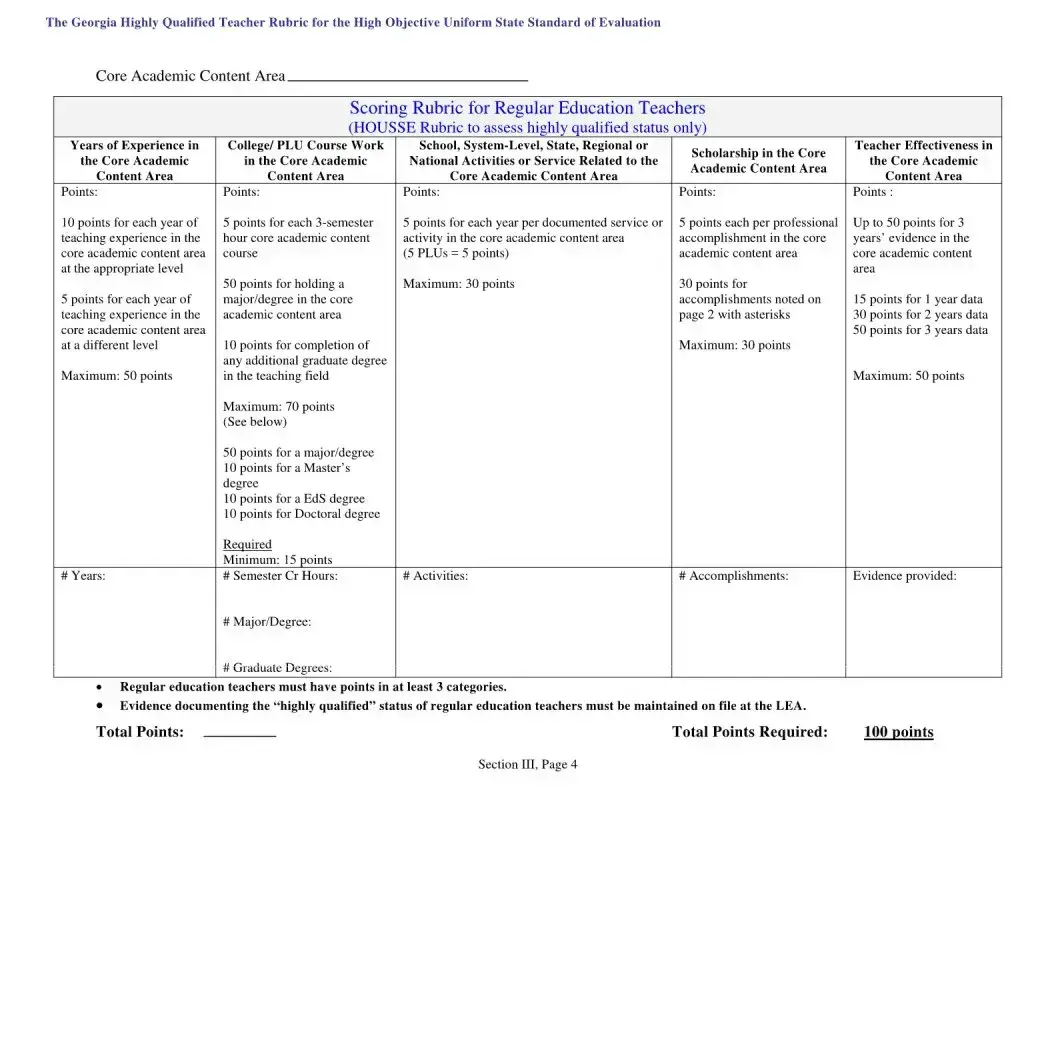
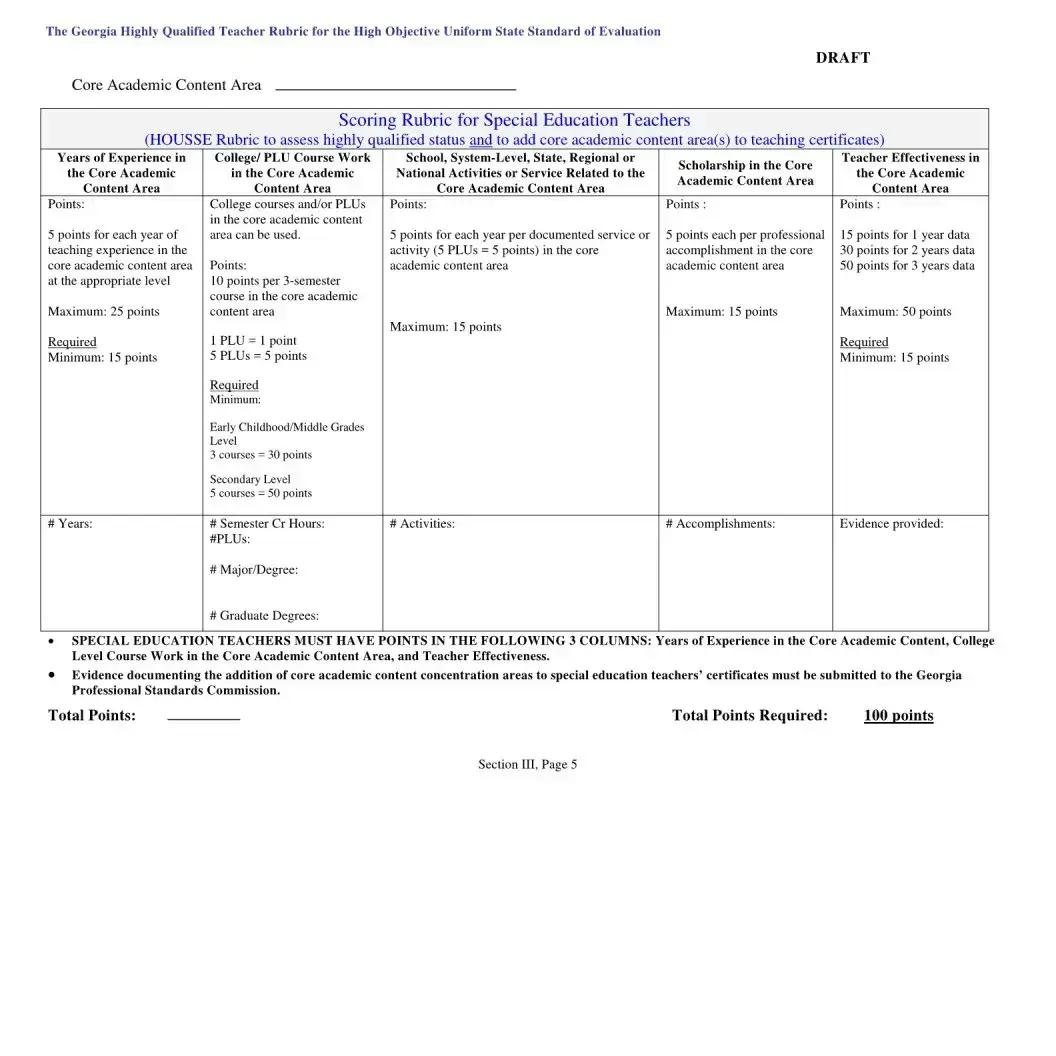
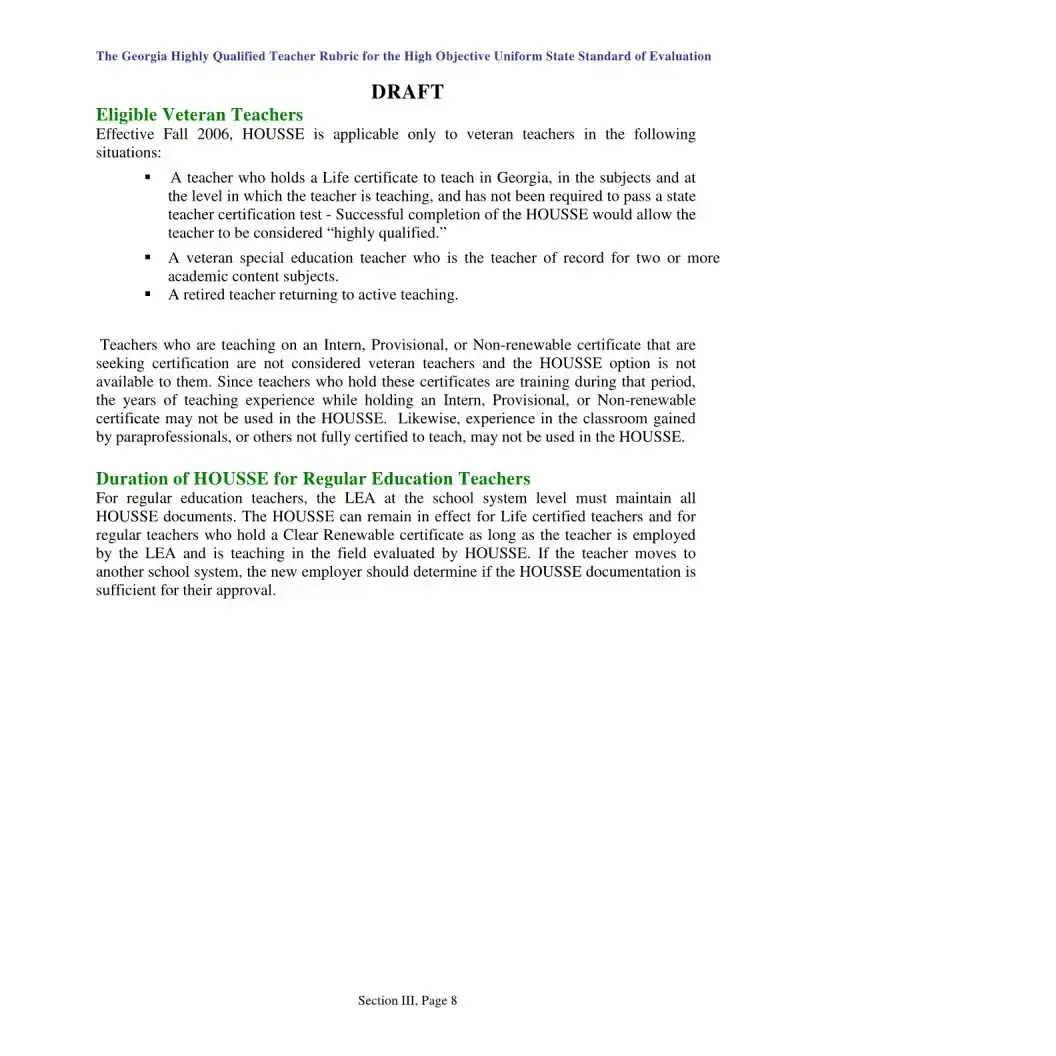
The Georgia HOUSSE Rubric serves as a crucial tool for evaluating the qualifications of veteran teachers in the state. It is part of the broader Title II-A Handbook, aimed at enhancing educator quality in Georgia schools. This form is designed specifically for teachers who have not met the standard content or testing requirements to be labeled as “highly qualified.” The HOUSSE Rubric is applicable to a select group of educators, including veteran special education teachers, retired teachers returning to the classroom, and those holding life certificates. To qualify, teachers must have at least three years of successful teaching experience in a core academic subject, which is assessed through their annual performance evaluations. The rubric evaluates various criteria, including years of experience, relevant college coursework, and professional activities related to the core academic content area. Additionally, it considers the teacher's effectiveness in impacting student achievement over time. This comprehensive assessment ensures that educators possess the necessary skills and knowledge to provide quality education to their students, thereby reinforcing the state’s commitment to educational excellence.
| Fact Name | Details |
|---|---|
| Title | Georgia HOUSSE Rubric: A guide for advancing educator quality in Georgia schools. |
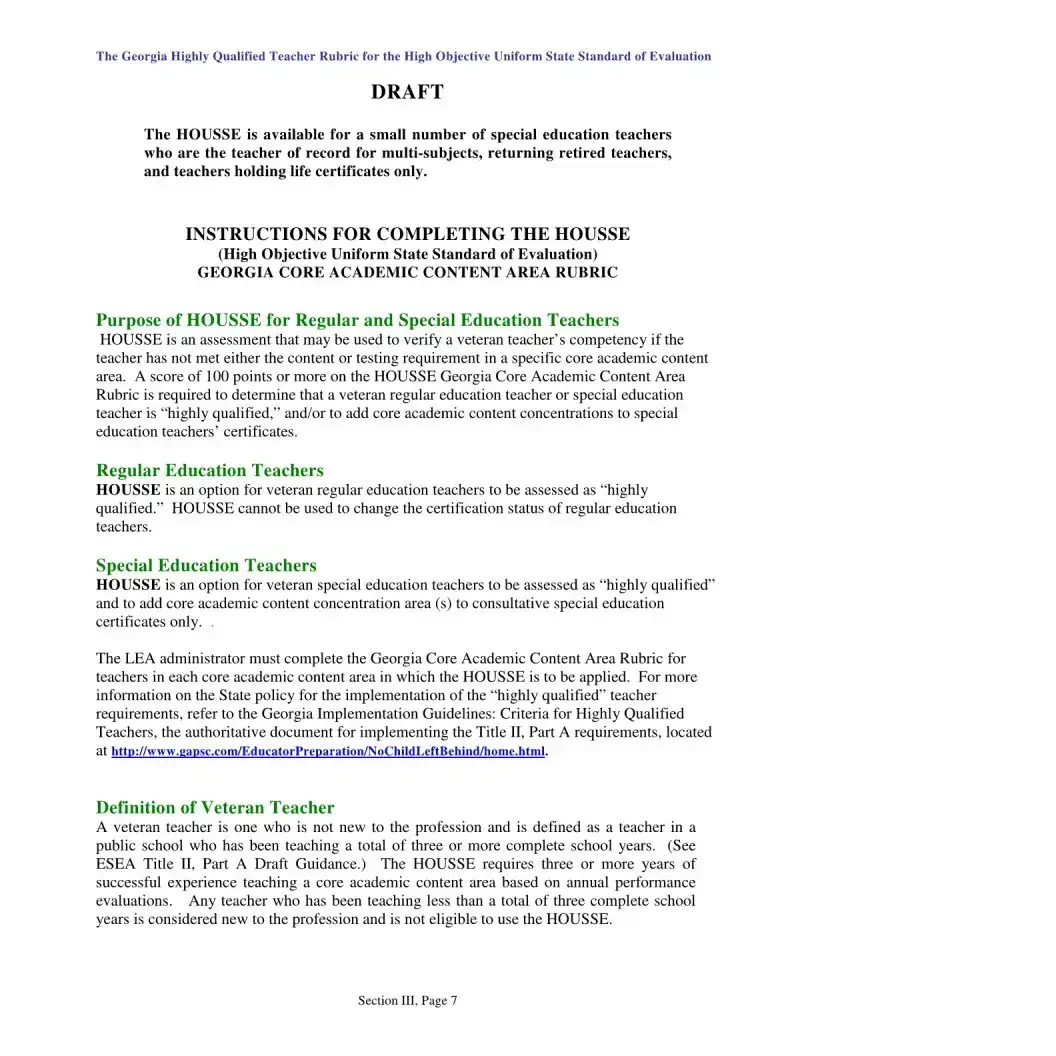
| Purpose | The HOUSSE is designed to assess veteran teachers' competency in core academic subjects. |
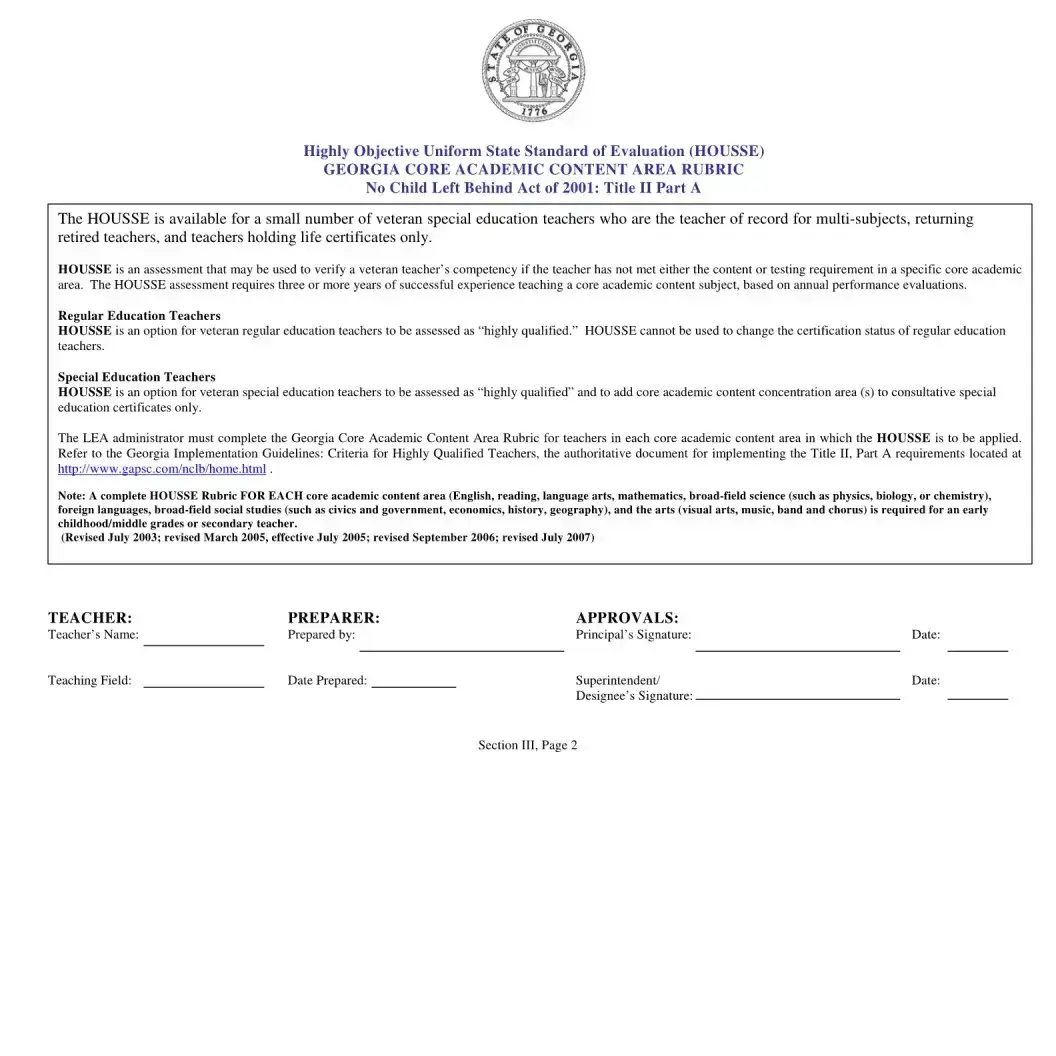
| Eligibility | Available to veteran special education teachers, returning retired teachers, and those holding life certificates. |
| Requirements | Teachers must have three or more years of successful teaching experience in the core academic area. |
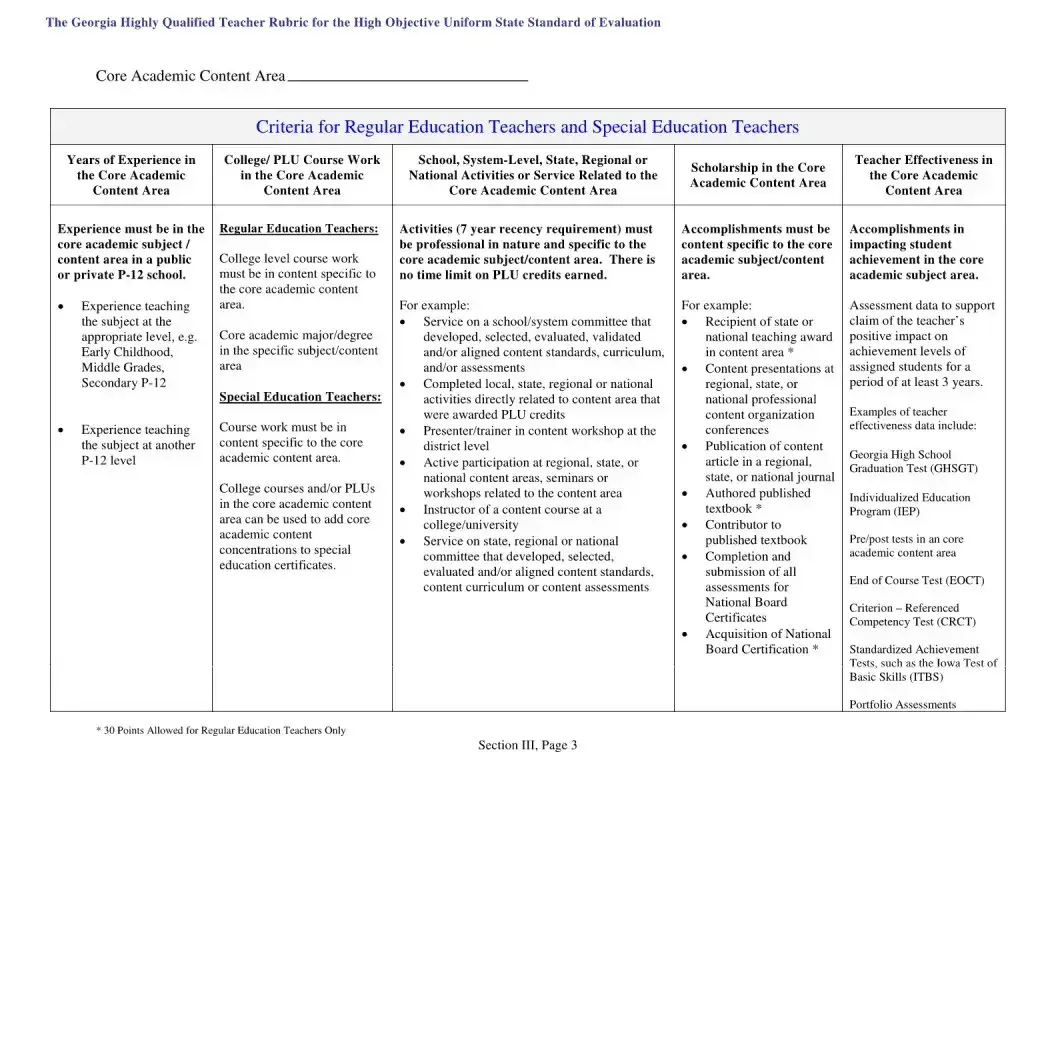
| Assessment Criteria | Evaluation is based on annual performance evaluations and specific criteria related to the content area. |
| Governing Law | No Child Left Behind Act of 2001: Title II Part A governs the HOUSSE process. |
| Regular Education Teachers | HOUSSE can help assess them as "highly qualified" but cannot change their certification status. |
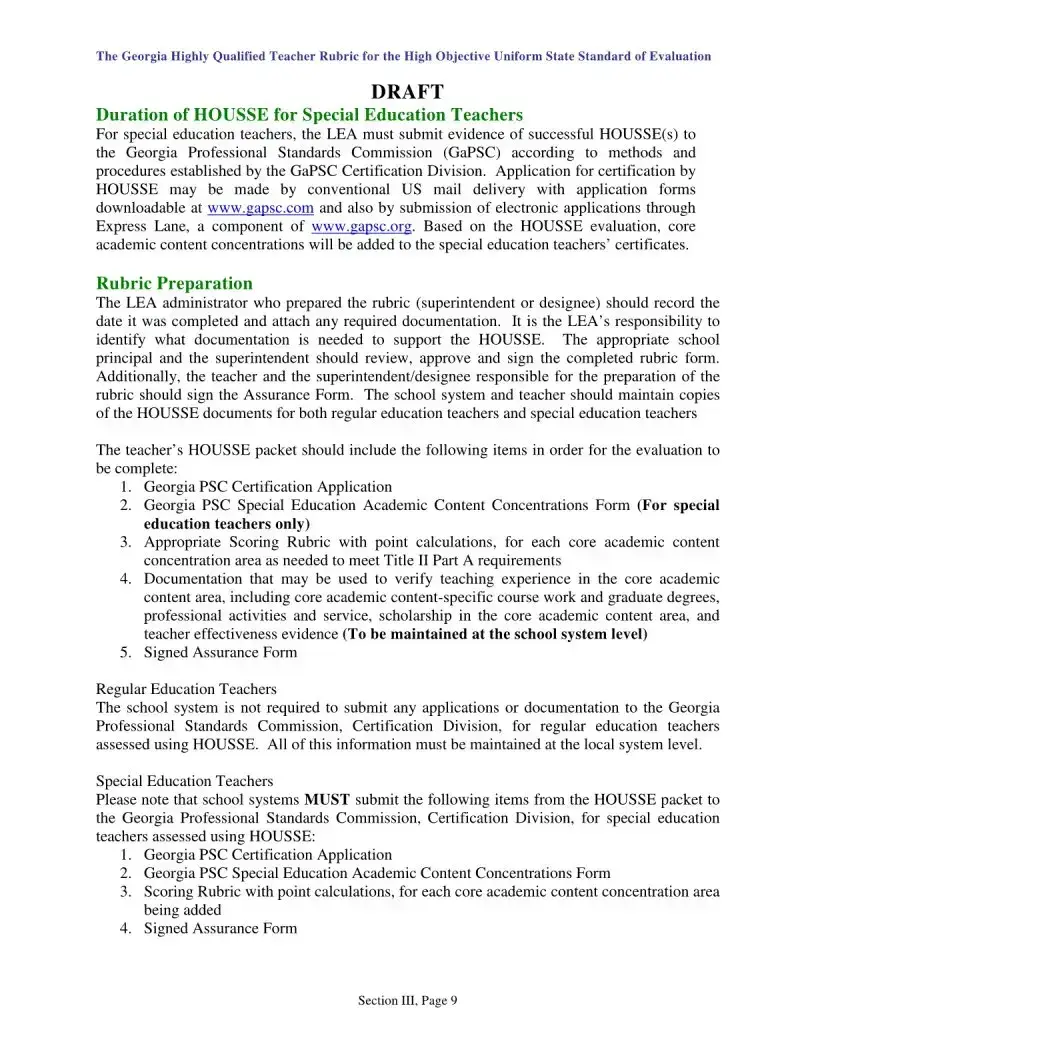
| Special Education Teachers | HOUSSE allows them to be assessed as "highly qualified" and add core academic content areas to their certificates. |
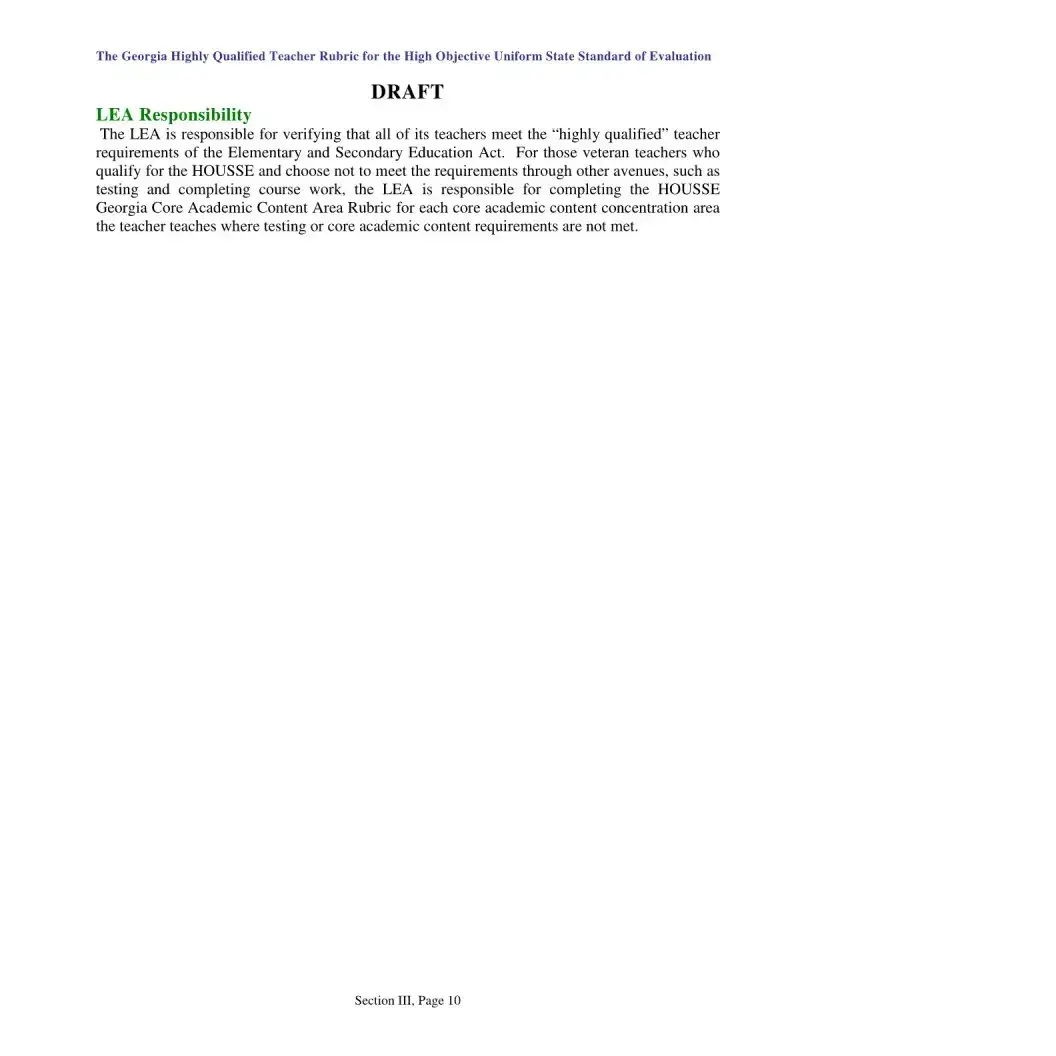
| Documentation | A complete HOUSSE Rubric is required for each core academic content area taught by the teacher. |
Completing the HOUSSE Rubric Georgia form requires careful attention to detail and accurate information about teaching experience and qualifications. This form is essential for veteran teachers seeking to demonstrate their competency in core academic subjects. Follow the steps below to ensure proper completion of the form.
What is the purpose of the HOUSSE Rubric in Georgia?
The HOUSSE Rubric serves as a standardized evaluation tool to assess the competency of veteran teachers in core academic subjects. It is particularly useful for teachers who meet certification requirements but do not fulfill the content or testing criteria to be deemed “highly qualified.” This rubric helps ensure that students receive instruction from qualified educators.
Who is eligible to use the HOUSSE Rubric?
The HOUSSE Rubric is available for a select group of educators, including veteran special education teachers who are the teacher of record for multiple subjects, returning retired teachers, and those holding life certificates. Regular education teachers may also use the rubric but cannot change their certification status through it.
How many years of experience are required for teachers using the HOUSSE Rubric?
Teachers must have at least three years of successful experience teaching in the core academic content area they wish to be evaluated on. This experience should be documented through annual performance evaluations in a public or private P-12 school setting.
What types of activities can count towards the HOUSSE evaluation?
Activities must be professional and relevant to the core academic subject. Examples include serving on committees that develop or align content standards, participating in workshops, or teaching college-level courses. These activities must have occurred within the last seven years, although there is no time limit on Professional Learning Units (PLUs) earned.
Can the HOUSSE Rubric be used to assess special education teachers?
Yes, special education teachers can use the HOUSSE Rubric to demonstrate their qualifications and to add core academic content concentrations to their consultative special education certificates. The evaluation must be conducted by the local education agency (LEA) administrator.
What documentation is required when completing the HOUSSE Rubric?
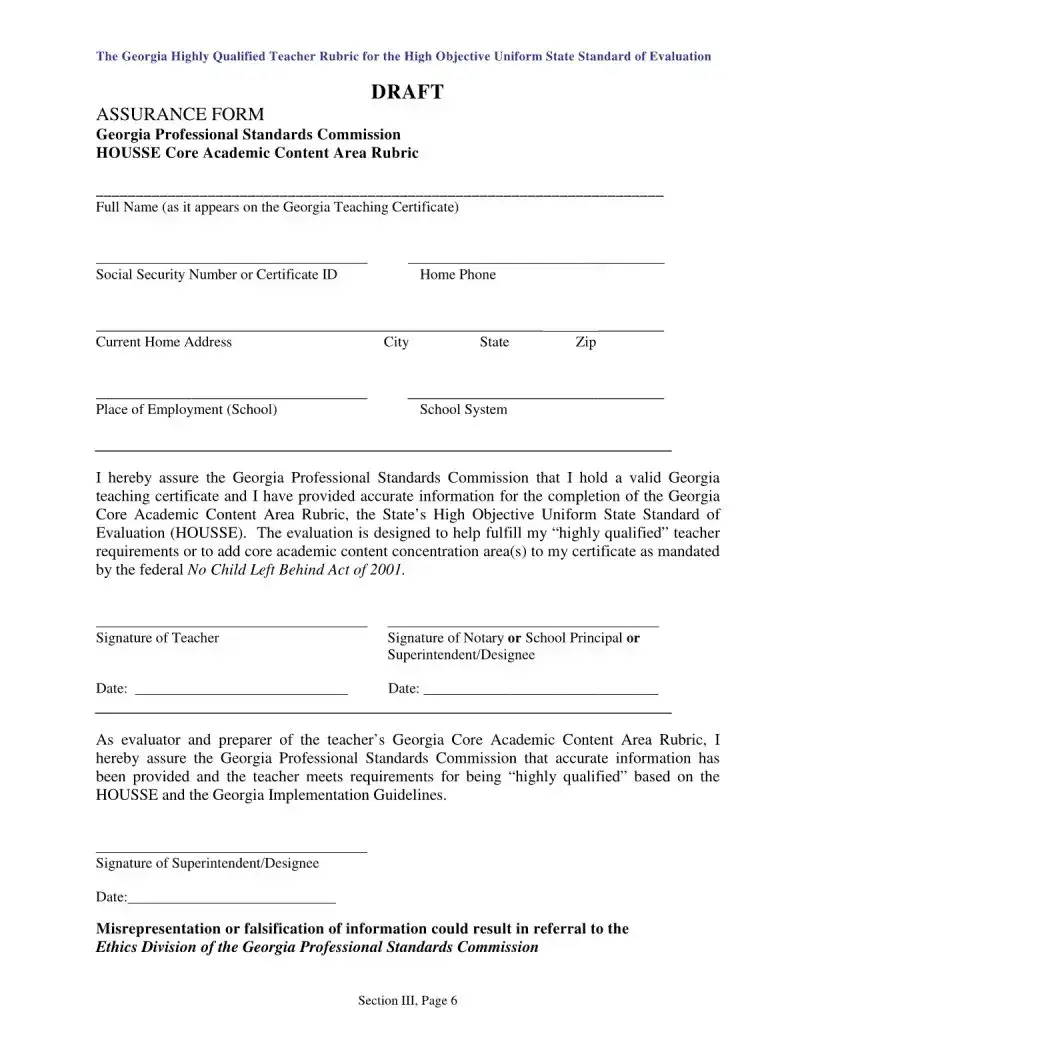
A complete HOUSSE Rubric must be filled out for each core academic content area, which includes subjects like English, mathematics, and science. Additionally, the rubric requires signatures from the teacher, the preparer, and the principal or superintendent, confirming that all information is accurate and complete.
How does the HOUSSE Rubric impact a teacher's certification status?
While the HOUSSE Rubric can help veteran teachers demonstrate their qualifications, it does not change the certification status of regular education teachers. Instead, it provides a pathway for them to be assessed as “highly qualified” based on their experience and contributions in their respective content areas.
Not reading the instructions carefully: Many people overlook the guidelines provided for filling out the HOUSSE Rubric Georgia form. Taking time to understand the requirements can prevent mistakes.
Incomplete information: Failing to provide all necessary details, such as the teacher's name or teaching field, can lead to delays in processing the application.
Incorrect course work documentation: Submitting unrelated college courses instead of those specific to the core academic content area can result in disqualification.
Neglecting to list relevant experiences: Not including all applicable teaching experiences may underestimate a teacher's qualifications.
Missing signatures: Forgetting to obtain the necessary approvals from principals or superintendents can halt the submission process.
Using outdated information: Submitting data that is not current, especially regarding professional development activities, can weaken the application.
Not providing evidence of effectiveness: Failing to include data demonstrating a teacher's impact on student achievement can lead to a lower assessment score.
Ignoring the recency requirement: Some activities have a seven-year recency requirement. Not adhering to this can lead to disqualification of experiences.
Misunderstanding the scoring criteria: Not being aware of how points are allocated can lead to an inaccurate representation of qualifications.
Submitting multiple rubrics: Filling out separate rubrics for each core academic area without following the guidelines can confuse the evaluation process.
The Georgia HOUSSE Rubric is a crucial document for evaluating veteran teachers' competencies in core academic subjects. Alongside this form, several other documents are often utilized to support the assessment and certification process. Below is a list of these important forms, each serving a specific purpose in ensuring that teachers meet the necessary qualifications.
Using these documents in conjunction with the HOUSSE Rubric helps ensure that teachers are evaluated comprehensively and fairly. This process ultimately supports the goal of maintaining high educational standards in Georgia schools.
The HOUSSE Rubric in Georgia is an important tool for assessing teacher competency. It shares similarities with several other documents that serve educational standards and evaluation purposes. Below is a list of documents that are similar to the HOUSSE Rubric, along with explanations of how they are alike:
Understanding these similarities can help educators navigate their professional requirements and ensure they meet the necessary standards for teaching effectively.
When filling out the HOUSSE Rubric Georgia form, there are several important guidelines to follow. Here is a list of things you should and shouldn't do:
Understanding the Georgia HOUSSE Rubric can be challenging, especially with the various misconceptions surrounding it. Here are ten common misunderstandings about the HOUSSE form, along with clarifications to help you navigate this important assessment tool.
By addressing these misconceptions, educators can better understand the HOUSSE Rubric and how it applies to their professional development and certification in Georgia.
When filling out and using the HOUSSE Rubric Georgia form, keep these key takeaways in mind: