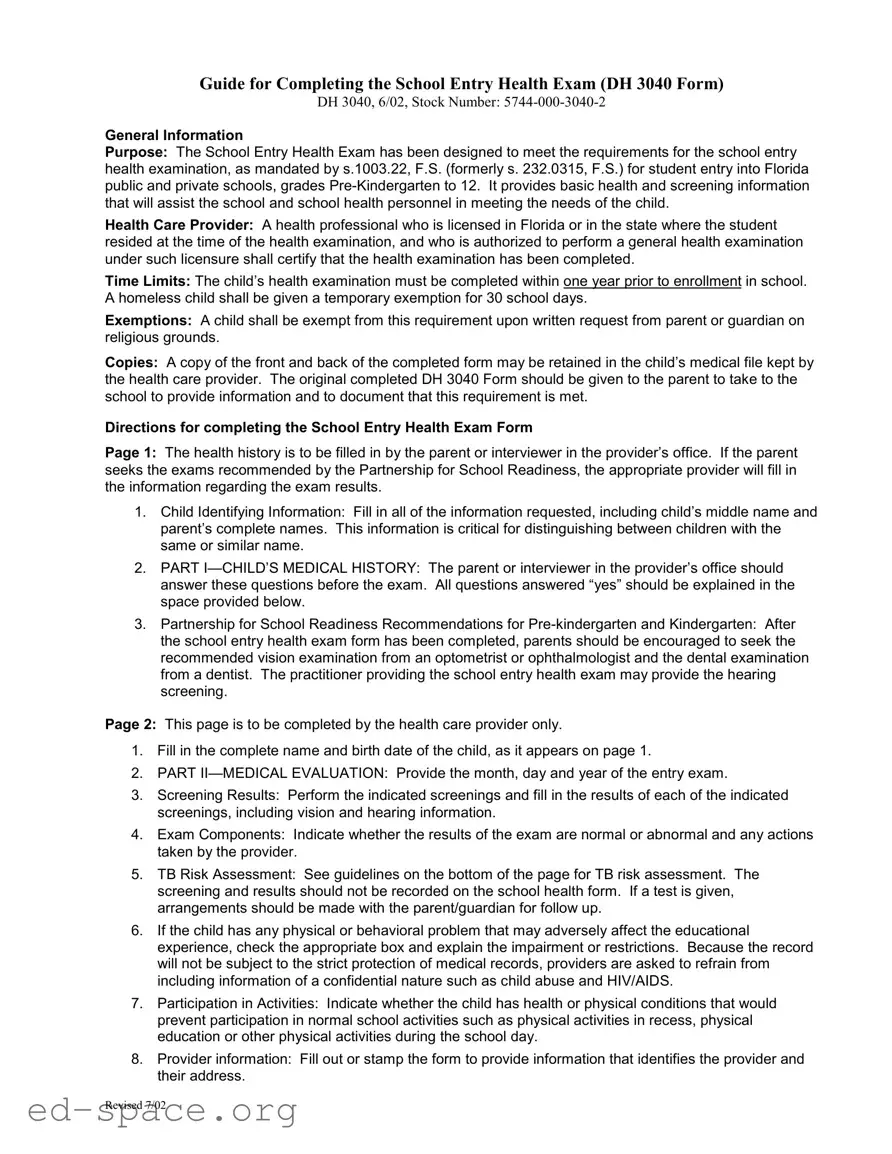
The Health For Florida form, specifically the DH 3040, plays a crucial role in ensuring that children meet health requirements for school entry in Florida. This form is essential for students entering public and private schools from Pre-Kindergarten to 12th grade. It serves as a comprehensive tool for health care providers to document the results of a child's health examination, which must be completed within one year prior to enrollment. A licensed health professional, either from Florida or the state where the child resided, is responsible for certifying that the examination has been conducted. The form includes sections for both parents and health care providers, ensuring that vital health history is accurately recorded. Parents are required to fill out the child’s identifying information and medical history, while providers complete the medical evaluation and screening results. Exemptions exist for certain situations, such as religious grounds or for homeless children, who receive a temporary exemption. Ultimately, the completed DH 3040 form not only documents compliance with state regulations but also assists schools in understanding the health needs of their students.
Guide for Completing the School Entry Health Exam (DH 3040 Form)
DH 3040, 6/02, Stock Number:
General Information
Purpose: The School Entry Health Exam has been designed to meet the requirements for the school entry health examination, as mandated by s.1003.22, F.S. (formerly s. 232.0315, F.S.) for student entry into Florida public and private schools, grades
Health Care Provider: A health professional who is licensed in Florida or in the state where the student resided at the time of the health examination, and who is authorized to perform a general health examination under such licensure shall certify that the health examination has been completed.
Time Limits: The child’s health examination must be completed within one year prior to enrollment in school. A homeless child shall be given a temporary exemption for 30 school days.
Exemptions: A child shall be exempt from this requirement upon written request from parent or guardian on religious grounds.
Copies: A copy of the front and back of the completed form may be retained in the child’s medical file kept by the health care provider. The original completed DH 3040 Form should be given to the parent to take to the school to provide information and to document that this requirement is met.
Directions for completing the School Entry Health Exam Form
Page 1: The health history is to be filled in by the parent or interviewer in the provider’s office. If the parent seeks the exams recommended by the Partnership for School Readiness, the appropriate provider will fill in the information regarding the exam results.
1.Child Identifying Information: Fill in all of the information requested, including child’s middle name and parent’s complete names. This information is critical for distinguishing between children with the same or similar name.
2.PART
3.Partnership for School Readiness Recommendations for
Page 2: This page is to be completed by the health care provider only.
1.Fill in the complete name and birth date of the child, as it appears on page 1.
2.PART
3.Screening Results: Perform the indicated screenings and fill in the results of each of the indicated screenings, including vision and hearing information.
4.Exam Components: Indicate whether the results of the exam are normal or abnormal and any actions taken by the provider.
5.TB Risk Assessment: See guidelines on the bottom of the page for TB risk assessment. The screening and results should not be recorded on the school health form. If a test is given, arrangements should be made with the parent/guardian for follow up.
6.If the child has any physical or behavioral problem that may adversely affect the educational experience, check the appropriate box and explain the impairment or restrictions. Because the record will not be subject to the strict protection of medical records, providers are asked to refrain from including information of a confidential nature such as child abuse and HIV/AIDS.
7.Participation in Activities: Indicate whether the child has health or physical conditions that would prevent participation in normal school activities such as physical activities in recess, physical education or other physical activities during the school day.
8.Provider information: Fill out or stamp the form to provide information that identifies the provider and their address.
Revised 7/02
| Fact Name | Details |
|---|---|
| Purpose | The School Entry Health Exam is required for student entry into Florida public and private schools from Pre-Kindergarten to 12th grade, as mandated by s.1003.22, F.S. |
| Health Care Provider | A licensed health professional must certify the completion of the health examination. This can be a provider from Florida or the state where the student resided at the time of the exam. |
| Time Limits | The health examination must be completed within one year prior to school enrollment. Homeless children receive a temporary exemption for 30 school days. |
| Exemptions | Parents or guardians can request an exemption from the health examination requirement on religious grounds. |
| Form Copies | A copy of the completed DH 3040 Form should be retained in the child's medical file by the health care provider. The original form goes to the parent for school submission. |
| Medical History | The child's medical history must be filled out by a parent or interviewer before the exam. All "yes" responses need explanations. |
Filling out the Health For Florida form is an important step in ensuring your child meets the health requirements for school entry. After completing this form, you will be able to provide necessary health information to the school, which will help them support your child's needs effectively.
After completing the form, ensure that the original DH 3040 Form is given to you, the parent or guardian, to present at your child's school. Keeping a copy for your records is also a good practice.
What is the purpose of the Health For Florida form?
The Health For Florida form, also known as the School Entry Health Exam (DH 3040 Form), is required for students entering Florida public and private schools from Pre-Kindergarten to 12th grade. It provides essential health and screening information to help school health personnel support the child's needs.
Who can complete the health examination?
A licensed health professional in Florida, or in the state where the student lived at the time of the examination, must complete the health examination. This professional must be authorized to perform general health exams under their licensure.
What are the time limits for completing the health examination?
The health examination must be completed within one year before the child enrolls in school. If the child is homeless, they can receive a temporary exemption for 30 school days.
Can a child be exempt from the health examination?
Yes, a child can be exempt from this requirement if a parent or guardian submits a written request based on religious grounds.
What should be done with the completed form?
The original completed DH 3040 Form should be given to the parent. They will then take it to the school to show that the health examination requirement has been met. A copy of the front and back of the form can be kept in the child's medical file by the health care provider.
Who fills out the first page of the form?
The first page of the form is to be filled out by the parent or an interviewer in the provider’s office. This includes providing the child's identifying information and answering questions about the child's medical history.
What should be included in the medical history section?
Parents or interviewers must answer all questions in the medical history section. If any questions are answered "yes," further explanations should be provided in the space given. This information is important for the health provider to understand the child's health needs.
What screenings are recommended after the health exam?
After completing the health exam, parents should seek additional screenings such as a vision examination from an optometrist or ophthalmologist and a dental examination from a dentist. The health care provider may also conduct a hearing screening.
What information does the health care provider need to complete on the second page?
The health care provider must fill in the child's name and birth date, provide the date of the health examination, and record the results of various screenings, including vision and hearing. They should also indicate whether the exam results are normal or abnormal and note any actions taken.
What should the provider avoid including in the health form?
Providers should refrain from including sensitive information such as child abuse or HIV/AIDS details, as the record will not be protected as strictly as confidential medical records.
Incomplete Child Identifying Information: Failing to provide the child's middle name or the complete names of the parents can lead to confusion. This information is essential to distinguish between children with similar names.
Neglecting Medical History Questions: Parents or interviewers often overlook the importance of answering all medical history questions. If any questions are answered “yes,” they must be explained in the designated space to ensure clarity.
Skipping Recommended Examinations: Some parents forget to seek the recommended vision and dental examinations after completing the health exam. These screenings are crucial for a child’s overall health and readiness for school.
Page 2 Errors: The health care provider must fill out Page 2 accurately. Mistakes in the child’s name or birth date, as it appears on Page 1, can create complications in the record-keeping process.
Improper Screening Results Documentation: Failing to perform all indicated screenings or neglecting to document the results can lead to gaps in the child’s health records. Every screening, especially vision and hearing, is vital.
Ignoring TB Risk Assessment Guidelines: Providers sometimes overlook the TB risk assessment guidelines. It is essential to follow these guidelines carefully and not record sensitive information on the health form.
Provider Information Missing: Lastly, not filling out or stamping the provider information can cause delays. This section is necessary to identify the health care provider and their address, ensuring proper communication and follow-up.
When preparing for a child's entry into school, the Health For Florida form is just one piece of the puzzle. Several other documents complement this form, ensuring that students meet health requirements and receive necessary screenings. Below is a list of key forms that often accompany the Health For Florida form, each serving a unique purpose in the process.
Each of these documents plays a critical role in supporting a child’s health and educational journey. By understanding their purposes and ensuring they are completed accurately, parents and guardians can facilitate a smoother transition into the school environment, ultimately benefiting the child's overall experience.
Things to Do:
Things Not to Do:
Misconceptions about the Health For Florida form can lead to confusion for parents and guardians. Here are nine common misconceptions, along with clarifications to help you better understand the requirements and process.
Understanding these misconceptions can ease the process of completing the Health For Florida form and ensure that your child’s health needs are met appropriately.
When filling out and using the Health For Florida form, it is essential to follow specific guidelines to ensure compliance and provide accurate health information for school entry. Here are ten key takeaways: