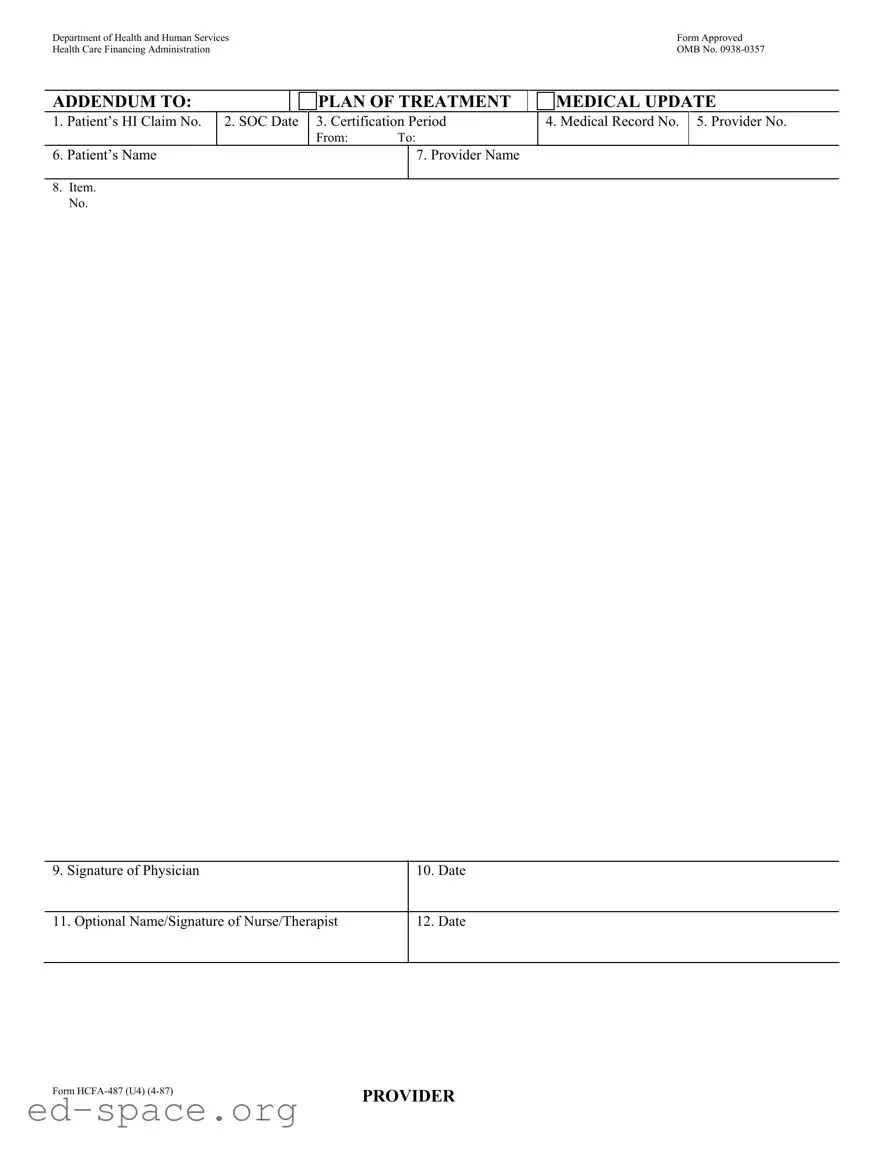
The HCFA 487 form serves as a crucial addendum to the plan of treatment for patients under the care of healthcare providers. This document is essential for updating medical information and ensuring that patient care remains aligned with the latest medical evaluations. It includes key details such as the patient’s Health Insurance claim number, the date of service, and the certification period, which are vital for tracking the patient's treatment history. Additionally, the form captures the provider's information, including their name and identification number, ensuring that all updates are accurately attributed. The signature of the physician is required to validate the medical update, while there is also an optional section for the name and signature of a nurse or therapist, further enhancing the form's credibility. By filling out the HCFA 487, healthcare providers can maintain comprehensive and up-to-date records, which are essential for effective patient management and compliance with healthcare regulations.

Department of Health and Human Services |
Form Approved |
Health Care Financing Administration |
OMB No. |
ADDENDUM TO: |
|
|
PLAN OF TREATMENT |
|
MEDICAL UPDATE |
||||
|
|
|
|
|
|
|
|
|
|
1. |
Patient’s HI Claim No. |
2. SOC Date |
3. Certification Period |
|
4. Medical Record No. |
5. Provider No. |
|||
|
|
|
|
From: |
To: |
|
|
|
|
6. |
Patient’s Name |
|
|
|
|
7. Provider Name |
|
|
|
|
|
|
|
|
|
|
|
|
|
8.Item.
No.
9. Signature of Physician
10. Date
11. Optional Name/Signature of Nurse/Therapist
12. Date
Form
PROVIDER
| Fact Name | Description |
|---|---|
| Purpose | The HCFA 487 form serves as an addendum to the plan of treatment, specifically for medical updates related to patient care. |
| Governing Law | This form is governed by regulations under the Social Security Act, particularly those pertaining to Medicare and Medicaid services. |
| Key Information | It requires essential patient information, including the patient’s HI Claim number, certification period, and medical record number. |
| Provider Requirements | Healthcare providers must sign the form, certifying the accuracy of the information provided and the necessity of the treatment updates. |
| Use in States | While the HCFA 487 is a federal form, states may have specific requirements for its submission, often outlined in state Medicaid guidelines. |
Completing the HCFA 487 form is an essential step in the medical billing process. It is crucial to ensure that all information is accurate and complete to facilitate proper processing. Follow the steps below to fill out the form correctly.
Once all fields are completed, review the form for accuracy before submission. This attention to detail will help ensure that the necessary information is conveyed effectively, allowing for a smoother process in the next steps of care or billing.
What is the HCFA 487 form used for?
The HCFA 487 form, also known as the Addendum to Plan of Treatment Medical Update, is used to provide updates regarding a patient's treatment plan. It is typically completed by healthcare providers to document changes in a patient’s medical condition or treatment needs. This form is essential for ensuring that all parties involved in a patient’s care are informed of any modifications, thereby facilitating better coordination and continuity of care.
Who is required to fill out the HCFA 487 form?
Healthcare providers, such as physicians, nurses, or therapists, are responsible for completing the HCFA 487 form. The form is generally filled out when there is a need to update the treatment plan due to changes in the patient’s health status or treatment requirements. In some cases, a nurse or therapist may also sign the form to provide additional insights into the patient’s care.
What information is needed to complete the HCFA 487 form?
To complete the HCFA 487 form, several key pieces of information are required. This includes the patient’s Health Insurance (HI) Claim Number, the Start of Care (SOC) date, the certification period, and the medical record number. Additionally, the form requires the patient's name, the provider's name, and the signature of the physician, along with the date of completion. Optional signatures from nurses or therapists may also be included to enhance the documentation.
How does the HCFA 487 form impact patient care?
The HCFA 487 form plays a crucial role in patient care by ensuring that all healthcare providers involved in a patient’s treatment are on the same page. By documenting updates to the treatment plan, the form helps to prevent miscommunication and ensures that the care provided aligns with the patient's current needs. This can lead to improved health outcomes and a more efficient healthcare process overall.
Where can I obtain a copy of the HCFA 487 form?
A copy of the HCFA 487 form can typically be obtained from healthcare facilities that accept Medicare or Medicaid, as they often use this form for billing and documentation purposes. Additionally, it may be available on the official website of the Centers for Medicare & Medicaid Services (CMS) or through healthcare software systems used by providers. If you are unsure where to find it, contacting your healthcare provider's office is a good first step.
Failing to include the Patient’s HI Claim Number. This number is crucial for identifying the patient’s insurance claim and ensuring proper processing.
Incorrectly entering the SOC Date. The Start of Care date must accurately reflect when treatment began, as it affects coverage and reimbursement.
Neglecting to specify the Certification Period. This period outlines the duration for which services are authorized and must be clearly indicated.
Omitting the Medical Record Number. This number links the form to the patient’s medical history and is essential for verification.
Using an incorrect Provider Number. Ensure that the provider number is accurate and matches the one registered with the health care financing administration.
Not clearly stating the Patient’s Name. The name must match the one on the insurance policy to avoid confusion and delays.
Failing to include the Provider Name. This information is necessary for identifying who is responsible for the patient’s care.
Overlooking the Signature of Physician. A signature is required to validate the information provided and confirm that the physician agrees with the treatment plan.
Not dating the form. Both the physician's and optional nurse/therapist's signatures must be accompanied by a date to establish a timeline for the treatment plan.
The HCFA 487 form, also known as the Addendum to Plan of Treatment Medical Update, is an important document used in the healthcare system, particularly for Medicare claims. Alongside this form, several other documents may be required to ensure a comprehensive submission for healthcare services. Below is a list of additional forms and documents often used in conjunction with the HCFA 487.
Each of these documents plays a vital role in the healthcare billing process and helps ensure that patients receive the appropriate care while maintaining compliance with regulatory requirements. Properly completing and submitting these forms can facilitate timely reimbursement and improve patient outcomes.
The HCFA 487 form serves as an important document in the healthcare industry, particularly for documenting patient treatment plans and updates. Here are ten documents that share similarities with the HCFA 487 form:
When filling out the HCFA 487 form, it is important to follow specific guidelines to ensure accuracy and compliance. Below is a list of recommended actions and common mistakes to avoid.
The HCFA 487 form, also known as the Addendum to Plan of Treatment Medical Update, is often misunderstood. Here are ten common misconceptions about this form:
Understanding these misconceptions can help clarify the purpose and use of the HCFA 487 form, ensuring that patients and providers can navigate the healthcare system more effectively.
When filling out the HCFA 487 form, it is essential to ensure that all required information is accurately provided. This form serves as an important addendum to a patient's plan of treatment and medical update.