In Hawaii, managing the affairs of a loved one who has passed away can be a challenging experience, especially when it comes to settling their estate. For smaller estates, the process can be simplified through the use of the Hawaii Small Estate Affidavit form. This form serves as a valuable tool for individuals seeking to transfer assets without the need for formal probate proceedings. It is designed for estates with a total value that does not exceed a specified limit, making it accessible for many families. By completing the affidavit, heirs can claim personal property, such as bank accounts, vehicles, and other assets, directly from institutions or entities holding the deceased’s belongings. The form requires specific information, including details about the deceased, the heirs, and the assets involved. Additionally, it must be signed under oath, affirming that the information provided is accurate and that the estate qualifies under Hawaii's small estate laws. Understanding this form can ease the burden during a difficult time, allowing families to focus on what truly matters—honoring their loved one's memory.
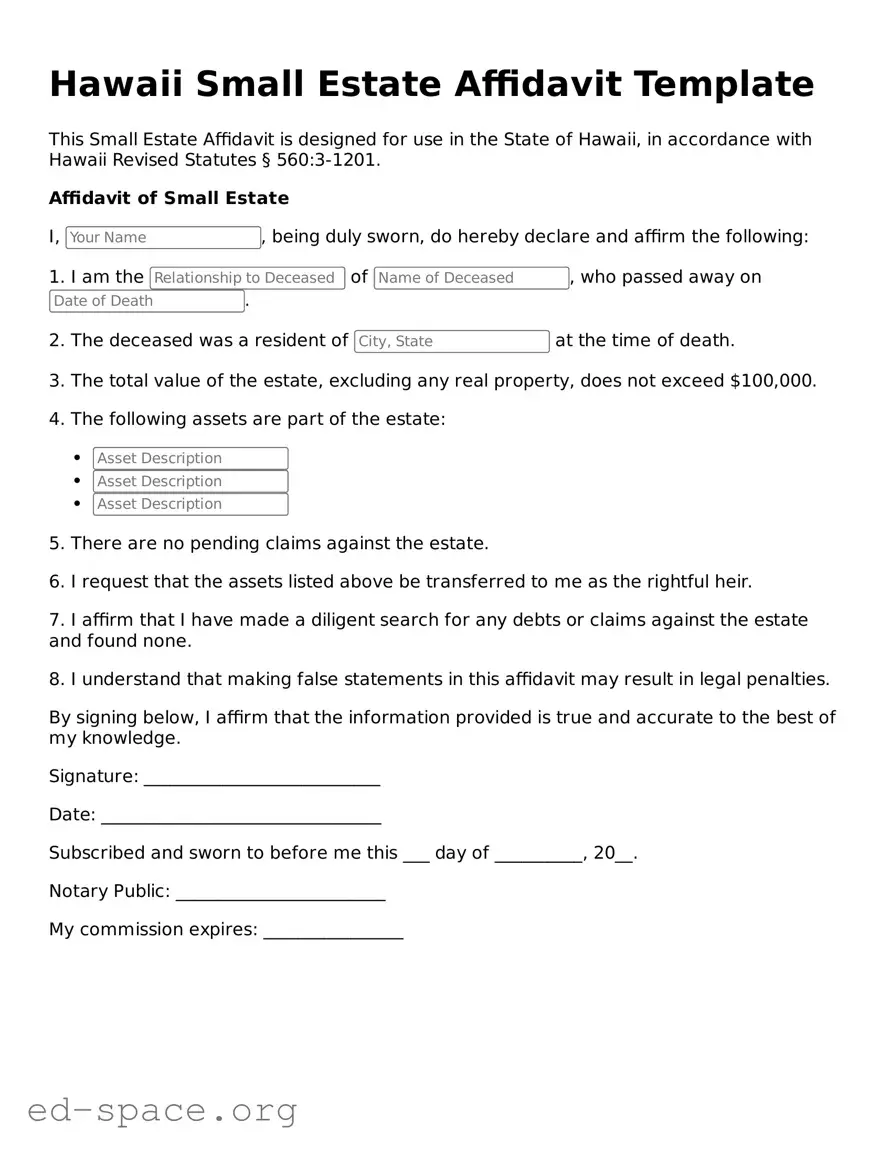
Hawaii Small Estate Affidavit Template
This Small Estate Affidavit is designed for use in the State of Hawaii, in accordance with Hawaii Revised Statutes § 560:3-1201.
Affidavit of Small Estate
I, , being duly sworn, do hereby declare and affirm the following:
1. I am the of , who passed away on .
2. The deceased was a resident of at the time of death.
3. The total value of the estate, excluding any real property, does not exceed $100,000.
4. The following assets are part of the estate:
5. There are no pending claims against the estate.
6. I request that the assets listed above be transferred to me as the rightful heir.
7. I affirm that I have made a diligent search for any debts or claims against the estate and found none.
8. I understand that making false statements in this affidavit may result in legal penalties.
By signing below, I affirm that the information provided is true and accurate to the best of my knowledge.
Signature: ___________________________
Date: ________________________________
Subscribed and sworn to before me this ___ day of __________, 20__.
Notary Public: ________________________
My commission expires: ________________
| Fact Name | Description |
|---|---|
| Eligibility | The Hawaii Small Estate Affidavit can be used when the total value of the estate is $100,000 or less, excluding real property. |
| Governing Law | This form is governed by Hawaii Revised Statutes, Section 560:3-1201. |
| Use of the Affidavit | The affidavit allows heirs to claim assets without going through the formal probate process, simplifying estate administration. |
| Filing Requirements | It must be filed with the appropriate court and signed by all heirs to the estate. |
After gathering all necessary information, you are ready to fill out the Hawaii Small Estate Affidavit form. This form is essential for settling a small estate without going through the probate process. Completing it accurately will help ensure that the estate can be administered smoothly.
Once the form is completed and notarized, it can be submitted to the appropriate court or authority. Following submission, the next steps will involve distributing the assets according to the information provided in the affidavit.
What is a Hawaii Small Estate Affidavit?
The Hawaii Small Estate Affidavit is a legal document that allows individuals to claim assets of a deceased person without going through the formal probate process. This form is typically used when the total value of the deceased's estate is below a certain threshold, which, as of 2023, is $100,000 for personal property and $25,000 for real property.
Who can use the Small Estate Affidavit?
Any individual who is an heir or beneficiary of the deceased can use the Small Estate Affidavit. This includes spouses, children, and other relatives. It is important that the person filing the affidavit has a legitimate claim to the deceased's assets and is willing to assume responsibility for the estate's debts.
How do I complete the Small Estate Affidavit?
To complete the Small Estate Affidavit, you must provide information about the deceased, including their name, date of death, and details about their assets. You will also need to declare that the total value of the estate falls below the specified threshold. It is advisable to gather any supporting documents, such as a death certificate and asset valuations, to accompany your affidavit.
Where do I file the Small Estate Affidavit?
The completed Small Estate Affidavit should be filed with the appropriate court in the county where the deceased lived at the time of death. Some counties may allow for electronic filing, while others may require you to submit the document in person. Check with your local court for specific filing procedures.
What happens after I file the Small Estate Affidavit?
Once you file the Small Estate Affidavit, the court will review the document. If everything is in order, the court will issue an order allowing you to collect the deceased's assets. You can then present this order to banks, financial institutions, or other entities holding the deceased's property to claim the assets.
Are there any risks associated with using a Small Estate Affidavit?
While the Small Estate Affidavit can simplify the process of settling an estate, it is not without risks. If the affidavit is filed incorrectly or if there are disputes among heirs, it could lead to legal challenges. Additionally, if the deceased had significant debts, creditors may still pursue claims against the estate. It is wise to consult with a legal professional if you have any concerns about the process.
Incomplete Information: One of the most common mistakes is failing to provide all required information. Every section of the form needs to be filled out completely. Missing details can lead to delays or rejection of the affidavit.
Incorrect Value Assessment: Applicants often miscalculate the total value of the estate. It's crucial to accurately assess the value of all assets to determine if they qualify under Hawaii's small estate limits.
Not Including All Assets: Some individuals overlook certain assets, such as personal property or bank accounts. Every asset owned by the deceased should be included to ensure a comprehensive affidavit.
Improper Signatures: The affidavit must be signed by the appropriate parties. Failing to have all necessary signatures can invalidate the document. Ensure that all required individuals sign where indicated.
Neglecting to Notarize: Many people forget that the affidavit must be notarized. A notary public’s signature is essential for the affidavit to be considered valid.
Missing Supporting Documents: Applicants sometimes fail to attach necessary documents, such as a death certificate or proof of relationship to the deceased. These documents are vital for verifying claims made in the affidavit.
Ignoring State-Specific Requirements: Each state has its own rules regarding small estate affidavits. Failing to adhere to Hawaii’s specific guidelines can lead to complications. It is important to familiarize oneself with these requirements before submission.
The Hawaii Small Estate Affidavit is a useful document for individuals looking to settle the estate of a deceased person with minimal assets. However, several other forms and documents often accompany this affidavit to ensure a smooth process. Below is a list of these related documents, each serving a specific purpose in the estate settlement process.
Each of these documents plays a crucial role in the estate settlement process in Hawaii. Properly preparing and submitting them can help ensure that the estate is resolved efficiently and in accordance with the law.
The Small Estate Affidavit form is similar to several other legal documents that help manage the affairs of a deceased person's estate. Here are seven documents that share similarities with the Small Estate Affidavit:
When filling out the Hawaii Small Estate Affidavit form, it’s important to follow certain guidelines to ensure accuracy and compliance. Here are nine things you should and shouldn't do:
By following these guidelines, you can help ensure that your Small Estate Affidavit is processed smoothly and efficiently.
Understanding the Hawaii Small Estate Affidavit form is crucial for anyone dealing with the estate of a deceased person. Unfortunately, several misconceptions can lead to confusion and potential legal issues. Here are five common misconceptions:
Clearing up these misconceptions is essential for anyone navigating the estate process in Hawaii. Proper understanding can save time, reduce stress, and ensure that assets are distributed fairly and legally.
Filling out and using the Hawaii Small Estate Affidavit can simplify the process of settling a small estate. Here are some key takeaways to keep in mind:
Understanding these points can help navigate the process more effectively and ensure a smoother transition during a difficult time.