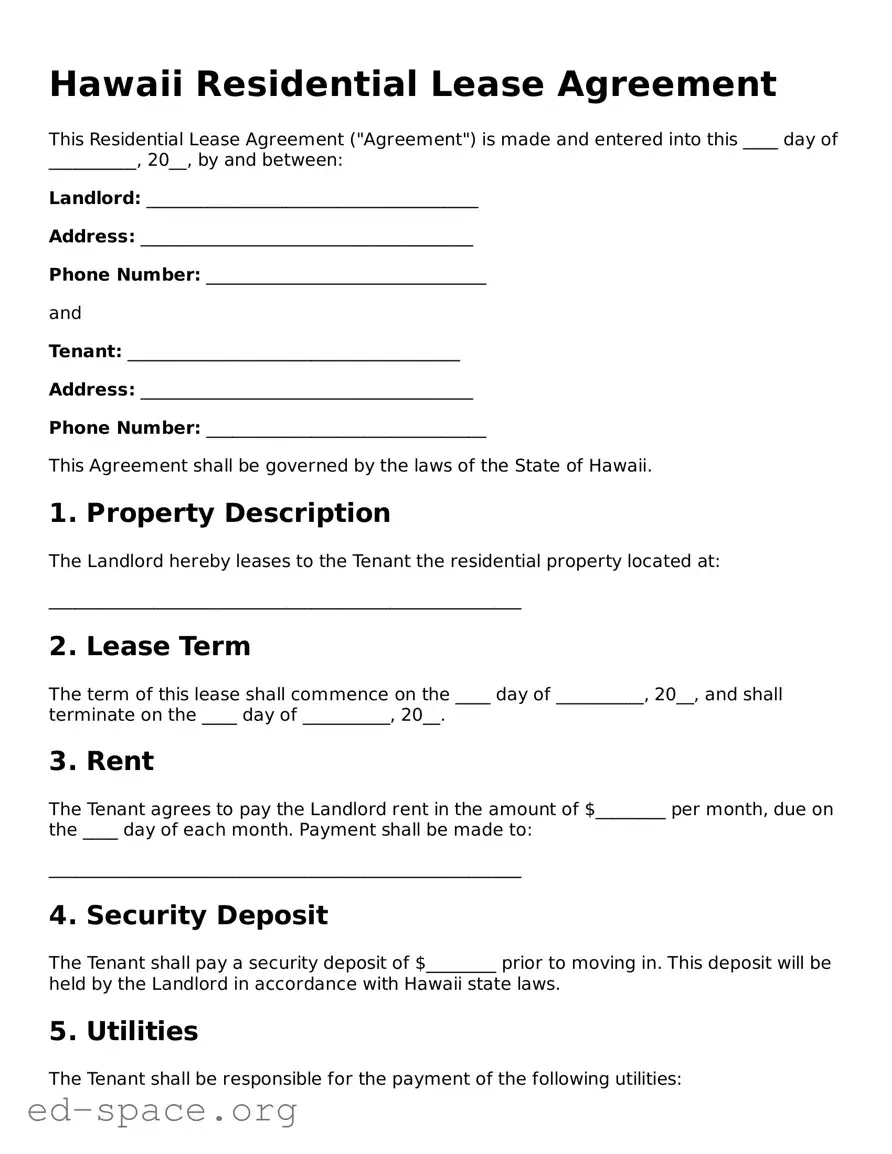
The Hawaii Residential Lease Agreement is a crucial document for both landlords and tenants, serving as the foundation for a clear and mutually beneficial rental relationship. This form outlines essential details such as the duration of the lease, rental payment terms, and the responsibilities of both parties. It specifies the property address, the names of the involved parties, and the amount of rent due, ensuring that all parties have a shared understanding of their commitments. Additionally, the agreement addresses security deposits, maintenance responsibilities, and rules regarding pets, providing clarity and reducing potential disputes. By detailing procedures for lease termination and renewal, the document helps to protect the rights of both landlords and tenants. Understanding these key elements is vital for anyone entering into a rental agreement in Hawaii, as it promotes a harmonious living arrangement and safeguards against misunderstandings.
Hawaii Residential Lease Agreement
This Residential Lease Agreement ("Agreement") is made and entered into this ____ day of __________, 20__, by and between:
Landlord: ______________________________________
Address: ______________________________________
Phone Number: ________________________________
and
Tenant: ______________________________________
Address: ______________________________________
Phone Number: ________________________________
This Agreement shall be governed by the laws of the State of Hawaii.
1. Property Description
The Landlord hereby leases to the Tenant the residential property located at:
______________________________________________________
2. Lease Term
The term of this lease shall commence on the ____ day of __________, 20__, and shall terminate on the ____ day of __________, 20__.
3. Rent
The Tenant agrees to pay the Landlord rent in the amount of $________ per month, due on the ____ day of each month. Payment shall be made to:
______________________________________________________
4. Security Deposit
The Tenant shall pay a security deposit of $________ prior to moving in. This deposit will be held by the Landlord in accordance with Hawaii state laws.
5. Utilities
The Tenant shall be responsible for the payment of the following utilities:
6. Maintenance and Repairs
The Tenant agrees to maintain the property in good condition and promptly report any necessary repairs to the Landlord.
7. Use of Property
The property shall be used exclusively for residential purposes. The Tenant shall not engage in any unlawful activities on the premises.
8. Termination
Upon termination of this Agreement, the Tenant agrees to vacate the premises and return all keys to the Landlord.
9. Governing Law
This Agreement shall be construed in accordance with the laws of the State of Hawaii.
IN WITNESS WHEREOF, the parties hereto have executed this Residential Lease Agreement as of the day and year first above written.
Landlord Signature: ____________________________
Date: ________________________________________
Tenant Signature: _____________________________
Date: ________________________________________
| Fact Name | Description |
|---|---|
| Governing Law | The Hawaii Residential Lease Agreement is governed by the Hawaii Revised Statutes, particularly Chapter 521. |
| Parties Involved | The agreement typically involves two parties: the landlord (lessor) and the tenant (lessee). |
| Property Description | The lease must clearly describe the rental property, including the address and any specific details. |
| Lease Term | The document specifies the duration of the lease, which can be month-to-month or for a fixed term. |
| Rent Payment | It outlines the amount of rent due, the due date, and acceptable payment methods. |
| Security Deposit | The agreement details the amount of the security deposit and conditions for its return. |
| Maintenance Responsibilities | Both parties' responsibilities for property maintenance and repairs are defined in the lease. |
| Utilities | The lease specifies which utilities are included in the rent and which are the tenant's responsibility. |
| Termination Conditions | It outlines the conditions under which either party can terminate the lease, including notice requirements. |
| Dispute Resolution | The agreement may include provisions for resolving disputes, such as mediation or arbitration. |
Filling out the Hawaii Residential Lease Agreement form is an important step in securing a rental property. This form outlines the terms of the lease and protects the rights of both the landlord and tenant. Follow the steps below to ensure you complete the form accurately and efficiently.
After completing the form, it is advisable to keep a copy for your records. Ensure both the landlord and tenant have signed copies to avoid any misunderstandings in the future.
What is a Hawaii Residential Lease Agreement?
A Hawaii Residential Lease Agreement is a legal document that outlines the terms and conditions under which a landlord rents a residential property to a tenant. This agreement typically includes details such as the rental amount, lease duration, security deposit, and responsibilities of both parties.
What are the key components of the agreement?
The key components of a Hawaii Residential Lease Agreement include the names of the landlord and tenant, the property address, the lease term (fixed-term or month-to-month), rent amount and payment due date, security deposit details, maintenance responsibilities, and rules regarding pets and subletting.
How long is a typical lease term?
Lease terms can vary widely. In Hawaii, residential leases often range from six months to one year. However, month-to-month agreements are also common, allowing for more flexibility for both landlords and tenants.
What should I consider before signing a lease?
Before signing a lease, carefully review all terms and conditions. Consider the rent amount, lease duration, and any additional fees. It's also important to understand the maintenance responsibilities and any rules about pets or guests. Make sure you feel comfortable with the agreement and ask questions if anything is unclear.
Can a landlord increase the rent during the lease term?
Generally, landlords cannot increase the rent during a fixed-term lease unless the agreement specifically allows for it. For month-to-month leases, landlords can typically raise the rent, but they must provide proper notice, usually 30 days in Hawaii.
What happens if I need to break the lease early?
If you need to break a lease early, you may face penalties, including losing your security deposit or having to pay rent until a new tenant is found. It's best to communicate with your landlord and review the lease terms regarding early termination.
Are there any specific tenant rights in Hawaii?
Yes, tenants in Hawaii have specific rights, including the right to a habitable living environment, protection against discrimination, and the right to privacy. Landlords must provide proper notice before entering the property and cannot retaliate against tenants for asserting their rights.
What is a security deposit, and how is it handled?
A security deposit is a sum of money paid by the tenant to cover potential damages or unpaid rent. In Hawaii, the maximum security deposit is usually one month's rent for unfurnished properties and two months' rent for furnished ones. Landlords must return the deposit within 14 days after the lease ends, minus any deductions for damages.
Is it necessary to have the lease agreement notarized?
No, it is not necessary to have a Hawaii Residential Lease Agreement notarized for it to be legally binding. However, both parties should sign the agreement to confirm their acceptance of the terms. Keeping a copy of the signed lease for your records is also recommended.
Failing to provide accurate personal information. Make sure to include your full name, current address, and contact details. Inaccuracies can lead to misunderstandings.
Not specifying the lease term clearly. Indicate whether it is a month-to-month lease or a fixed-term lease. Ambiguity can create confusion down the line.
Overlooking the security deposit details. Clearly state the amount of the security deposit and the conditions for its return. This protects both parties.
Ignoring the maintenance responsibilities. Clearly outline who is responsible for repairs and maintenance. This avoids disputes later on.
Neglecting to read the entire agreement. Every section is important. Take the time to understand all terms and conditions before signing.
Not including pet policies. If pets are allowed or prohibited, specify this in the agreement. This can prevent issues for both tenants and landlords.
The Hawaii Residential Lease Agreement is a crucial document for both landlords and tenants, outlining the terms and conditions of renting a residential property. However, several other forms and documents often accompany this agreement to ensure clarity and legal compliance. Below are five important documents frequently used in conjunction with the Hawaii Residential Lease Agreement.
In summary, while the Hawaii Residential Lease Agreement is fundamental for establishing the rental relationship, these additional documents play a vital role in protecting the interests of both landlords and tenants. By utilizing these forms, parties can foster clear communication and minimize potential conflicts throughout the lease term.
When filling out the Hawaii Residential Lease Agreement form, it is important to approach the task with care. Here are some essential do's and don'ts to consider:
Understanding the Hawaii Residential Lease Agreement form can be challenging. Here are some common misconceptions that need clarification:
Many people believe that lease agreements are universally similar. In reality, each state, including Hawaii, has specific laws and requirements that shape its lease agreements.
Some tenants think that only the landlord's signature is necessary for the lease to be valid. However, both parties must sign the agreement for it to be legally binding.
While verbal agreements can be made, they are often hard to enforce. A written lease agreement provides clear terms and protects both parties.
Many tenants assume that security deposits are always non-refundable. In Hawaii, landlords must return the deposit, minus any allowable deductions, within a specific timeframe after the lease ends.
Some believe that once a lease is presented, the terms are set in stone. In fact, tenants can negotiate terms before signing, such as rent amount or maintenance responsibilities.
This is a common myth. Landlords must provide notice before entering a rental unit, except in emergencies. Respecting tenant privacy is crucial.
Many people think lease agreements are only applicable to long-term rentals. However, they can also be used for short-term rentals, outlining specific terms for the duration of the stay.
Some tenants feel that a signed lease is unchangeable. In reality, both parties can agree to modifications, but they should be documented in writing to avoid confusion.
When filling out and using the Hawaii Residential Lease Agreement form, it's essential to understand the key components to ensure a smooth rental experience. Here are five important takeaways:
By keeping these takeaways in mind, you can navigate the Hawaii Residential Lease Agreement with confidence and clarity.