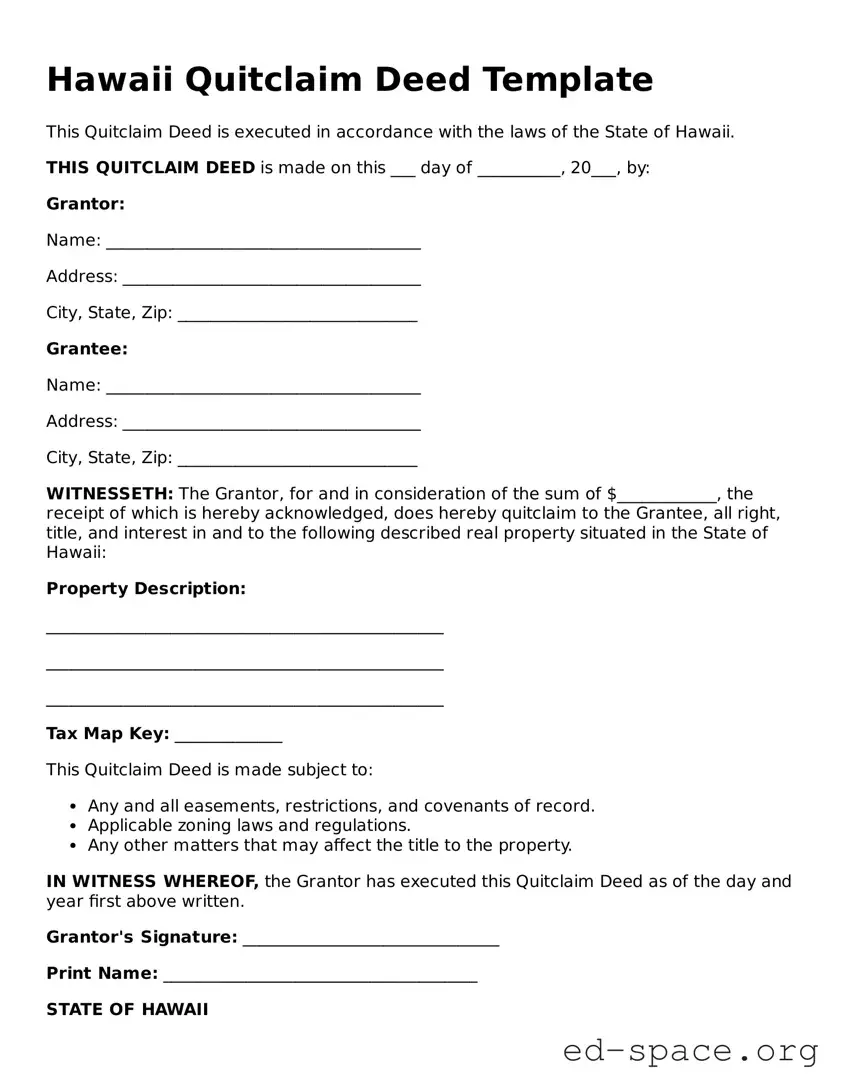
When it comes to transferring property ownership in Hawaii, the Quitclaim Deed form serves as a practical tool for many individuals. This document allows one party, known as the grantor, to relinquish any interest they may have in a property to another party, referred to as the grantee. Unlike other types of deeds, a Quitclaim Deed does not guarantee that the grantor holds clear title to the property; instead, it simply conveys whatever rights the grantor possesses, if any. This makes it particularly useful in situations like transferring property between family members, resolving estate issues, or clearing up title defects. The form must be completed with specific information, including the names of the parties involved, a legal description of the property, and the signature of the grantor. Once executed, the Quitclaim Deed must be recorded with the local county clerk to ensure public notice of the transfer. Understanding the nuances of this form can help individuals navigate property transactions more smoothly and with greater confidence.
Hawaii Quitclaim Deed Template
This Quitclaim Deed is executed in accordance with the laws of the State of Hawaii.
THIS QUITCLAIM DEED is made on this ___ day of __________, 20___, by:
Grantor:
Name: ______________________________________
Address: ____________________________________
City, State, Zip: _____________________________
Grantee:
Name: ______________________________________
Address: ____________________________________
City, State, Zip: _____________________________
WITNESSETH: The Grantor, for and in consideration of the sum of $____________, the receipt of which is hereby acknowledged, does hereby quitclaim to the Grantee, all right, title, and interest in and to the following described real property situated in the State of Hawaii:
Property Description:
________________________________________________
________________________________________________
________________________________________________
Tax Map Key: _____________
This Quitclaim Deed is made subject to:
IN WITNESS WHEREOF, the Grantor has executed this Quitclaim Deed as of the day and year first above written.
Grantor's Signature: _______________________________
Print Name: ______________________________________
STATE OF HAWAII
County of _______________
On this ___ day of __________, 20___, before me, a Notary Public in and for said State, personally appeared ______________________, known to me to be the person whose name is subscribed to the within instrument, and acknowledged that he/she executed the same.
Witness my hand and official seal.
Notary Public Signature: ________________________
My Commission Expires: ______________________
| Fact Name | Details |
|---|---|
| Definition | A quitclaim deed is a legal document used to transfer ownership of real estate from one party to another without any warranties. |
| Use in Hawaii | In Hawaii, a quitclaim deed is commonly used to transfer property between family members or to clear up title issues. |
| Governing Law | The use of quitclaim deeds in Hawaii is governed by Hawaii Revised Statutes, Chapter 501. |
| Requirements | The deed must be signed by the grantor (the person transferring the property) and notarized to be valid. |
| Consideration | While consideration (payment) is not always required, it is often included to make the transfer official. |
| Filing | After execution, the quitclaim deed must be filed with the Bureau of Conveyances in Hawaii to be effective against third parties. |
| Tax Implications | There may be tax implications when transferring property, even with a quitclaim deed. Consulting a tax professional is advisable. |
| Limitations | A quitclaim deed does not guarantee that the grantor has clear title to the property. It simply transfers whatever interest the grantor may have. |
| Common Uses | Quitclaim deeds are often used in divorce settlements, estate transfers, or when correcting a property title. |
After obtaining the Hawaii Quitclaim Deed form, individuals can proceed to fill it out accurately. This process involves providing specific information about the property and the parties involved. Once completed, the form will require signatures and may need to be notarized before submission.
What is a Quitclaim Deed in Hawaii?
A Quitclaim Deed is a legal document used to transfer ownership of real estate from one party to another in Hawaii. This type of deed conveys whatever interest the grantor has in the property without making any guarantees about the title. It is often used among family members or in situations where the parties know each other well, as it does not provide the same level of protection as a warranty deed. The recipient receives the property "as is," which means they accept any potential claims or issues that may exist with the title.
When should I use a Quitclaim Deed?
People commonly use a Quitclaim Deed in several scenarios. For example, it is often used in divorce settlements when one spouse transfers their interest in a property to the other. It can also be utilized to add or remove a name from the title, such as when a family member wishes to gift property. Additionally, Quitclaim Deeds may be appropriate in situations involving property held in a trust or when resolving title issues among co-owners. However, it is important to consider the implications of using this type of deed, especially regarding the lack of title guarantees.
How do I complete a Quitclaim Deed in Hawaii?
Completing a Quitclaim Deed in Hawaii involves several steps. First, the grantor must fill out the form with the necessary information, including the names of the parties involved, a legal description of the property, and the date of transfer. After filling out the form, it must be signed by the grantor in the presence of a notary public. Once notarized, the Quitclaim Deed should be filed with the appropriate county office to officially record the transfer of ownership. It is advisable to keep a copy for personal records.
Are there any fees associated with filing a Quitclaim Deed in Hawaii?
Yes, there are typically fees associated with filing a Quitclaim Deed in Hawaii. The exact amount can vary by county, so it is important to check with the local recording office for specific fee schedules. Additionally, there may be costs related to notarization and potential title searches, depending on the circumstances surrounding the property transfer. It is wise to budget for these expenses when planning to execute a Quitclaim Deed.
What are the risks of using a Quitclaim Deed?
Using a Quitclaim Deed carries certain risks. Since this type of deed does not guarantee clear title, the recipient may inherit any existing liens, encumbrances, or other issues related to the property. This lack of protection can lead to disputes or financial burdens down the line. It is essential for the recipient to conduct thorough due diligence before accepting a property through a Quitclaim Deed. Consulting with a real estate attorney or professional can provide valuable insights and help mitigate potential risks.
Incorrect Property Description: One common mistake is failing to provide a complete and accurate description of the property. This includes not specifying the correct parcel number or omitting details that identify the property. A vague description can lead to confusion and potential legal issues.
Missing Signatures: All parties involved in the transaction must sign the Quitclaim Deed. Sometimes, individuals overlook the need for all necessary signatures, which can invalidate the document. Ensure that every grantor signs the form before submission.
Not Notarizing the Document: A Quitclaim Deed must be notarized to be legally binding. Failing to have the document notarized can result in it being rejected by the county recorder’s office. Always check that a notary public has properly witnessed the signatures.
Improper Filing: After completing the Quitclaim Deed, it must be filed with the appropriate county office. Some individuals forget this crucial step or submit it to the wrong office. Confirm that you are filing in the correct jurisdiction to avoid delays.
The Hawaii Quitclaim Deed form is essential for transferring property ownership without any guarantees. However, several other documents are often used in conjunction with it to ensure a smooth transaction. Below is a list of these forms, each serving a unique purpose in the property transfer process.
Understanding these documents will streamline the property transfer process and help avoid potential complications. Ensure you have all necessary forms ready to facilitate a successful transaction.
When filling out the Hawaii Quitclaim Deed form, it is important to follow certain guidelines to ensure accuracy and compliance. Below is a list of things you should and shouldn't do.
Following these guidelines can help facilitate a smoother process when submitting the Quitclaim Deed in Hawaii.
Understanding the Hawaii Quitclaim Deed form is crucial for anyone involved in property transactions in the state. However, several misconceptions can lead to confusion. Here are five common misunderstandings:
Many people believe that a quitclaim deed transfers full ownership of a property. While it does transfer whatever interest the grantor has, it does not guarantee that the grantor owns the property outright or that there are no liens or claims against it.
Some think quitclaim deeds are exclusively used for transferring property between family members. In reality, they can be used in various situations, including transferring property between friends, business partners, or even in divorce settlements.
There is a common belief that quitclaim deeds and warranty deeds serve the same purpose. However, warranty deeds provide a guarantee of clear title and protection against future claims, while quitclaim deeds do not offer such assurances.
Some individuals assume that using a quitclaim deed removes all financial responsibilities related to the property. This is incorrect; the grantor may still be liable for any debts associated with the property, even after the transfer.
It is a misconception that quitclaim deeds can be executed without notarization. In Hawaii, like many states, a quitclaim deed must be notarized to be legally valid and recognized by the county.
Being aware of these misconceptions can help individuals make informed decisions regarding property transfers in Hawaii. Always consider consulting a legal professional for personalized advice.
When dealing with property transfers in Hawaii, understanding the Quitclaim Deed form is essential. Here are ten key takeaways to keep in mind:
Understanding these key points can help facilitate a smoother property transfer process in Hawaii. Knowledge empowers individuals to navigate the complexities of real estate transactions with confidence.