Planning for the future is an essential step for couples considering marriage, and a Hawaii Prenuptial Agreement serves as a valuable tool in this process. This legal document allows partners to outline their financial rights and responsibilities before tying the knot. Key aspects of the agreement include the identification of separate and marital property, the division of assets in the event of divorce, and provisions for spousal support. Couples can also address debt responsibilities, ensuring clarity and fairness in financial matters. By establishing these terms in advance, both parties can minimize conflicts and protect their interests, fostering a more secure foundation for their relationship. Understanding the components of a Hawaii Prenuptial Agreement can empower couples to make informed decisions that align with their unique circumstances and goals.
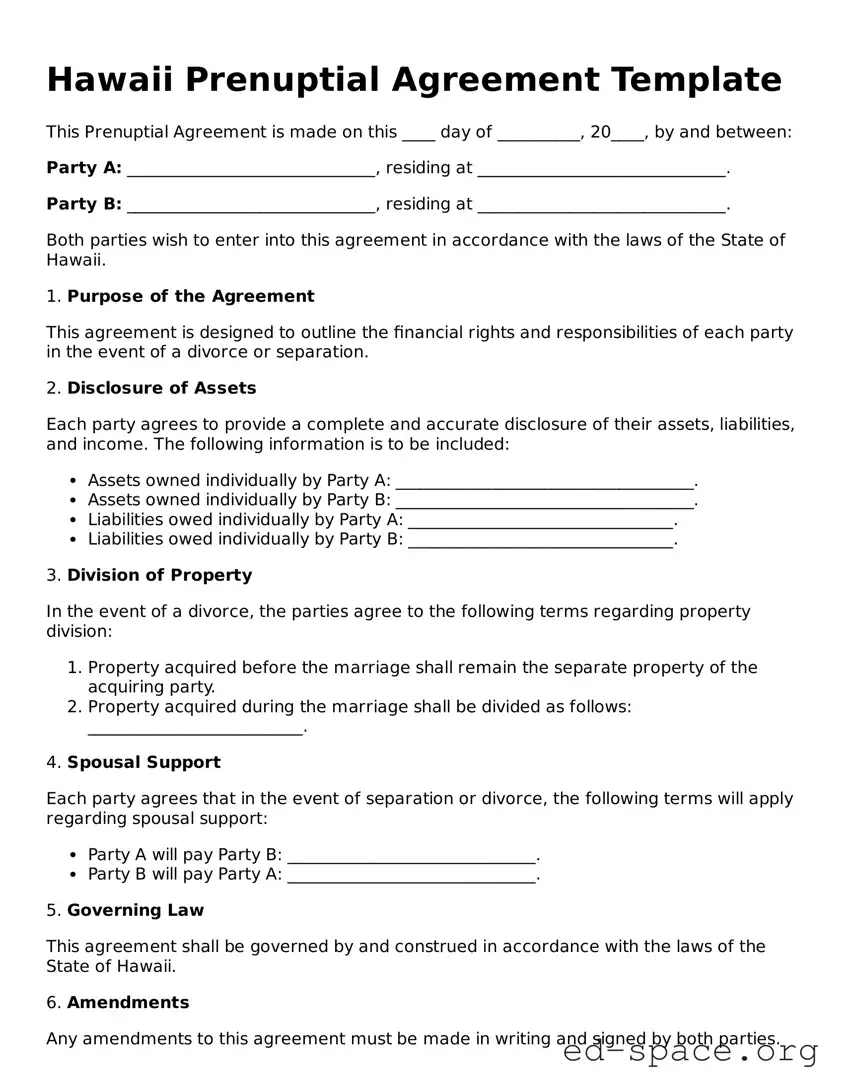
Hawaii Prenuptial Agreement Template
This Prenuptial Agreement is made on this ____ day of __________, 20____, by and between:
Party A: ______________________________, residing at ______________________________.
Party B: ______________________________, residing at ______________________________.
Both parties wish to enter into this agreement in accordance with the laws of the State of Hawaii.
1. Purpose of the Agreement
This agreement is designed to outline the financial rights and responsibilities of each party in the event of a divorce or separation.
2. Disclosure of Assets
Each party agrees to provide a complete and accurate disclosure of their assets, liabilities, and income. The following information is to be included:
3. Division of Property
In the event of a divorce, the parties agree to the following terms regarding property division:
4. Spousal Support
Each party agrees that in the event of separation or divorce, the following terms will apply regarding spousal support:
5. Governing Law
This agreement shall be governed by and construed in accordance with the laws of the State of Hawaii.
6. Amendments
Any amendments to this agreement must be made in writing and signed by both parties.
7. Signatures
By signing below, both parties acknowledge that they have read and understood this Prenuptial Agreement and agree to its terms:
______________________________ Party A
______________________________ Party B
______________________________ Date
| Fact Name | Description |
|---|---|
| Governing Law | The Hawaii Prenuptial Agreement is governed by Hawaii Revised Statutes, Chapter 572. |
| Definition | A prenuptial agreement is a contract between two people before they get married, outlining the division of assets and responsibilities. |
| Enforceability | For a prenuptial agreement to be enforceable in Hawaii, it must be in writing and signed by both parties. |
| Full Disclosure | Both parties must fully disclose their assets and liabilities for the agreement to be valid. |
| Independent Counsel | It is advisable for each party to have independent legal counsel to ensure fairness and understanding of the agreement. |
| Modification | Changes to the prenuptial agreement must be made in writing and signed by both parties. |
| Judicial Review | A court may review and invalidate a prenuptial agreement if it finds it was unconscionable or signed under duress. |
Filling out the Hawaii Prenuptial Agreement form is an important step for couples looking to outline their financial arrangements before marriage. This process ensures that both parties have a clear understanding of their rights and responsibilities. Below are the steps to guide you through completing the form effectively.
What is a prenuptial agreement in Hawaii?
A prenuptial agreement, often called a prenup, is a legal contract created by two individuals before they get married. In Hawaii, this agreement outlines the division of assets and responsibilities in the event of a divorce or separation. It can also address issues such as spousal support. The goal is to provide clarity and protection for both parties, ensuring that there are no misunderstandings in the future.
Why should couples consider a prenuptial agreement?
Couples may consider a prenup for various reasons. It can protect individual assets acquired before marriage, clarify financial responsibilities, and provide peace of mind. For those entering a second marriage or blending families, a prenup can help safeguard children’s inheritances. It encourages open communication about finances, which is crucial for a healthy relationship.
What are the legal requirements for a prenuptial agreement in Hawaii?
In Hawaii, for a prenuptial agreement to be legally binding, it must be in writing and signed by both parties. Each person should have the opportunity to consult with their own attorney before signing. This ensures that both parties fully understand the terms and implications of the agreement. Full disclosure of assets and liabilities is also essential to prevent future disputes.
Can a prenuptial agreement be modified or revoked?
Yes, a prenuptial agreement can be modified or revoked after marriage. Both parties must agree to any changes, and these modifications should be documented in writing and signed by both individuals. It’s important to keep the agreement updated, especially if there are significant life changes, such as the birth of a child or a change in financial status.
What happens if a prenuptial agreement is challenged in court?
If a prenuptial agreement is challenged in court, the judge will evaluate its validity based on several factors. These may include whether both parties had adequate representation, if there was full disclosure of assets, and whether the agreement was signed voluntarily. If the court finds the prenup to be unfair or signed under duress, it may be deemed unenforceable.
How can couples create a prenuptial agreement in Hawaii?
Creating a prenuptial agreement in Hawaii typically involves several steps. Couples should start by discussing their financial situation and what they want to include in the agreement. It’s advisable to consult with attorneys who specialize in family law to ensure that the agreement complies with state laws. After drafting the agreement, both parties should review it carefully before signing. This process can help ensure that both partners feel secure and respected in their financial arrangements.
Failing to provide complete financial disclosures. Both parties should fully disclose their assets, debts, and income. Incomplete information can lead to disputes later.
Not seeking independent legal advice. Each party should consult their own attorney to ensure that they understand the implications of the agreement.
Using vague language. Clearly defining terms and conditions is crucial. Ambiguities can create confusion and lead to legal challenges.
Neglecting to consider future changes. Prenuptial agreements should account for potential life changes, such as the birth of children or significant career shifts.
Overlooking the need for notarization. A valid prenuptial agreement in Hawaii must be signed in the presence of a notary public.
Failing to update the agreement. Life circumstances change, and it’s important to revisit and revise the agreement as necessary.
Not including a sunset clause. Some couples may wish to set a time limit on the agreement, which can provide a sense of security.
Rushing the process. Taking time to discuss and negotiate terms can prevent misunderstandings and foster a healthier relationship.
Ignoring state laws. Each state has its own requirements for prenuptial agreements. Familiarity with Hawaii's specific regulations is essential.
When preparing for marriage, many couples consider a prenuptial agreement to clarify financial matters. However, there are other important documents that often accompany this agreement. These documents help ensure that both parties are on the same page regarding their rights and responsibilities. Here are four common forms and documents used alongside a Hawaii Prenuptial Agreement:
These documents work together to provide clarity and protection for both partners. Taking the time to prepare them can lead to a more secure and harmonious marriage.
When filling out the Hawaii Prenuptial Agreement form, it is essential to follow certain guidelines to ensure the document is valid and meets the needs of both parties. Below is a list of things to do and avoid during this process.
By following these guidelines, both parties can create a prenuptial agreement that is fair, clear, and legally binding.
Here are 10 common misconceptions about the Hawaii Prenuptial Agreement form, along with clarifications for each:
Filling out and using a prenuptial agreement in Hawaii can be an important step for couples planning to marry. Here are some key takeaways to consider:
By keeping these points in mind, couples can create a prenuptial agreement that serves their interests and fosters a sense of security as they embark on their marriage journey.