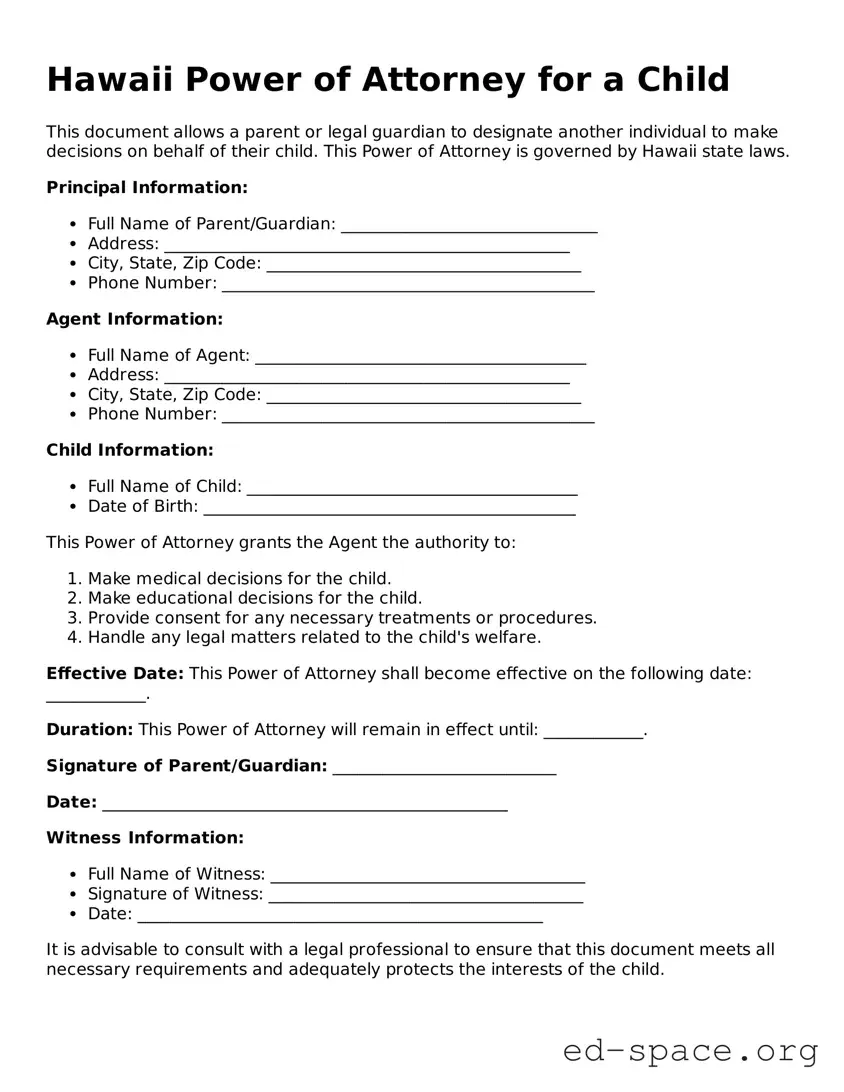
In Hawaii, the Power of Attorney for a Child form serves as a vital legal document that empowers a designated individual to make decisions on behalf of a minor. This arrangement is particularly useful for parents or guardians who may need to delegate authority temporarily due to travel, medical needs, or other circumstances. The form outlines the specific powers granted, which can include decisions related to education, health care, and general welfare. It is important to note that the authority can be tailored to fit the unique needs of the child and the situation at hand. The document must be signed by the parent or legal guardian and typically requires notarization to ensure its validity. By establishing this legal framework, parents can ensure that their child’s needs are met even in their absence, providing peace of mind during times of uncertainty.
Hawaii Power of Attorney for a Child
This document allows a parent or legal guardian to designate another individual to make decisions on behalf of their child. This Power of Attorney is governed by Hawaii state laws.
Principal Information:
Agent Information:
Child Information:
This Power of Attorney grants the Agent the authority to:
Effective Date: This Power of Attorney shall become effective on the following date: ____________.
Duration: This Power of Attorney will remain in effect until: ____________.
Signature of Parent/Guardian: ___________________________
Date: _________________________________________________
Witness Information:
It is advisable to consult with a legal professional to ensure that this document meets all necessary requirements and adequately protects the interests of the child.
| Fact Name | Description |
|---|---|
| Purpose | The Hawaii Power of Attorney for a Child form allows a parent or legal guardian to appoint someone else to make decisions for their child in their absence. |
| Governing Law | This form is governed by Hawaii Revised Statutes, Chapter 551, which outlines the laws regarding powers of attorney. |
| Duration | The power granted through this form can be temporary or long-term, depending on the parent's wishes. |
| Notarization | To be valid, the form must be signed in the presence of a notary public. |
| Revocation | A parent can revoke the power of attorney at any time, as long as they provide written notice to the appointed agent. |
After obtaining the Hawaii Power of Attorney for a Child form, you will need to fill it out carefully. This process involves providing specific information about the child and the individual who will be given authority. Make sure to have all necessary details on hand to ensure a smooth completion.
Once the form is completed and signed, make copies for your records and provide a copy to the attorney-in-fact. Keep the original in a safe place. This will ensure that the designated person has the authority to act on behalf of the child when needed.
What is a Power of Attorney for a Child in Hawaii?
A Power of Attorney for a Child in Hawaii is a legal document that allows a parent or legal guardian to designate another individual to make decisions on behalf of their child. This can include decisions related to education, healthcare, and general welfare. It is particularly useful in situations where the parent is unable to be present, such as during travel or extended absences. The designated person, often referred to as an "agent," must act in the best interest of the child and has the authority to manage specific responsibilities as outlined in the document.
Who can serve as an agent in the Power of Attorney for a Child?
The agent can be any responsible adult, such as a relative, friend, or trusted neighbor. However, it is essential that the person chosen is someone the parent trusts to make decisions in the child's best interest. The agent should also be aware of their responsibilities and be willing to accept them. It is advisable to discuss the role with the potential agent beforehand to ensure they are prepared for the commitment.
How long does a Power of Attorney for a Child remain in effect?
The duration of the Power of Attorney for a Child can vary based on the preferences of the parent or guardian. Typically, the document can remain in effect until a specific date, until the parent revokes it, or until the child reaches a certain age. Parents should clearly specify the duration in the document to avoid any confusion. It is also important to note that the Power of Attorney can be revoked at any time, as long as the parent is competent to do so.
Do I need to have the Power of Attorney for a Child notarized?
Yes, in Hawaii, the Power of Attorney for a Child must be notarized to be legally valid. This means that the parent or guardian must sign the document in the presence of a notary public, who will then affix their seal to confirm the authenticity of the signature. Notarization helps to ensure that the document is recognized by schools, healthcare providers, and other institutions that may need to rely on it.
What happens if the Power of Attorney for a Child is not used correctly?
If the Power of Attorney for a Child is not used correctly, it can lead to confusion or disputes regarding the child's care. For instance, if the agent makes decisions that are not in line with the parent's wishes or if the document lacks clarity, it may result in legal challenges. To prevent such issues, parents should ensure that the document is well-drafted, clearly outlines the agent's authority, and is communicated effectively to all parties involved, including the child, if appropriate.
Not specifying the duration of authority: One common mistake is failing to clearly state how long the Power of Attorney will be in effect. It’s important to specify whether the authority is temporary or indefinite. Without this clarity, misunderstandings may arise.
Omitting necessary signatures: The form requires signatures from both the parent and the agent. Forgetting to have all required signatures can render the document invalid. Always double-check that everyone involved has signed the form.
Failing to provide detailed information: Another frequent error is not including enough detail about the child and the agent. Full names, addresses, and contact information should be provided. This information helps to avoid confusion and ensures that the document is legally sound.
Not understanding the powers granted: Some individuals may not fully grasp the extent of the authority they are granting. It’s crucial to understand what decisions the agent can make on behalf of the child. Take time to review these powers to ensure they align with your intentions.
Ignoring local laws: Each state has its own requirements regarding Power of Attorney forms. Failing to adhere to Hawaii’s specific regulations can lead to complications. Always check the latest state guidelines to ensure compliance.
When considering a Power of Attorney for a Child in Hawaii, it’s important to be aware of other documents that may complement this form. These documents can provide additional clarity and support for guardianship and parental authority. Here’s a list of commonly used forms that you might find helpful.
Each of these documents plays a significant role in ensuring the well-being of the child while providing clarity for everyone involved. By preparing these forms alongside the Power of Attorney for a Child, you can create a solid foundation for the child’s care and support.
The Power of Attorney for a Child form has similarities with several other legal documents. Here are four documents that share similar purposes or functions:
When completing the Hawaii Power of Attorney for a Child form, it is essential to follow specific guidelines to ensure the document is valid and effective. Below is a list of things you should and shouldn't do during this process.
Understanding the Hawaii Power of Attorney for a Child form is crucial for parents and guardians. However, several misconceptions can lead to confusion. Here are seven common misconceptions, clarified for better understanding:
Many believe that the Power of Attorney for a Child form is only necessary in emergency situations. In reality, it can be used for planned events, such as vacations or extended trips, where a parent or guardian may be unavailable.
While legal advice can be beneficial, it is not mandatory to have a lawyer complete the form. Parents can fill it out themselves, as long as they understand the responsibilities involved.
Some think that signing this form means they are relinquishing their parental rights. This is not the case; the form temporarily grants authority to another adult without terminating parental rights.
Although the form is specific to Hawaii, it may be recognized in other states under certain conditions. Always check local laws if traveling or relocating.
While parents can choose someone they trust, that person must be an adult. Additionally, it’s wise to select someone who is capable of fulfilling the responsibilities outlined in the form.
Many assume that once the form is signed, it remains in effect indefinitely. In truth, it can be revoked at any time by the parent or guardian who created it.
Some think the Power of Attorney grants broad authority over all aspects of a child's life. However, it is limited to specific areas outlined in the document, such as medical care or educational decisions.
By addressing these misconceptions, parents and guardians can make informed decisions about the care and legal authority concerning their children.
When considering the Hawaii Power of Attorney for a Child form, there are several important aspects to keep in mind. This document can provide peace of mind and clarity in various situations. Here are some key takeaways:
By understanding these key points, you can ensure that the Power of Attorney for a Child form serves its intended purpose effectively.