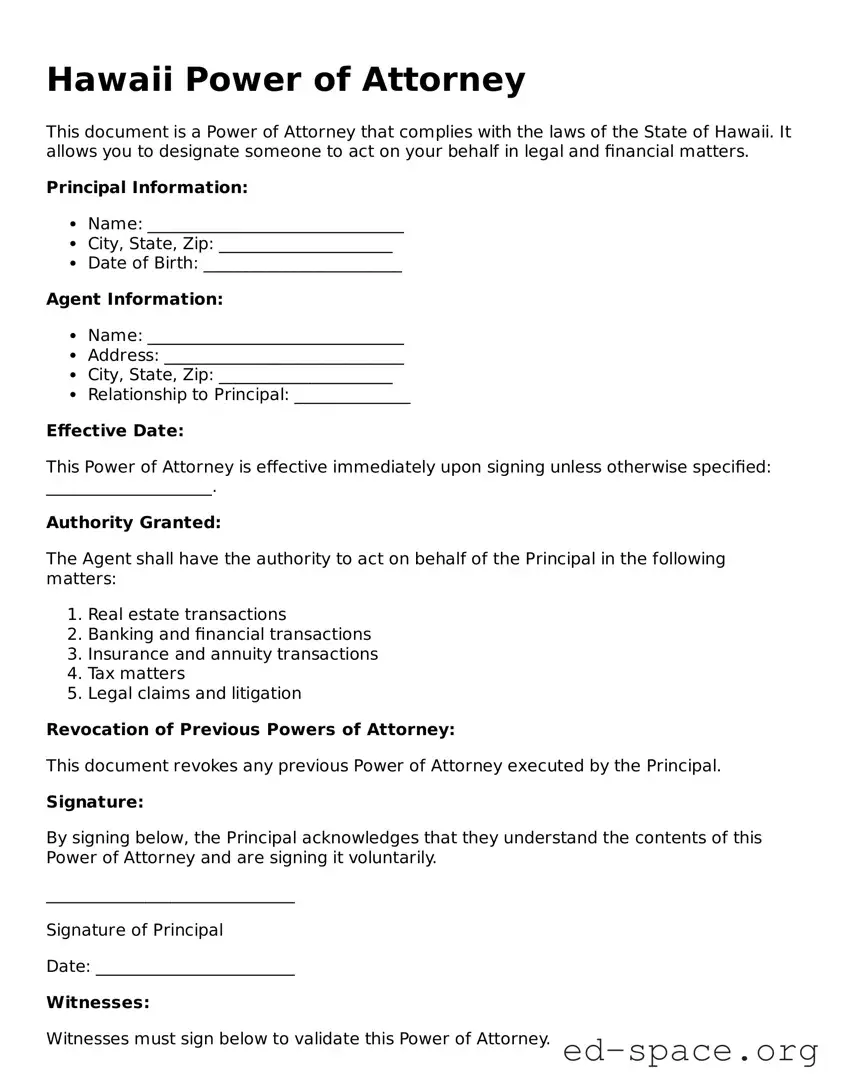
In Hawaii, the Power of Attorney (POA) form serves as a vital legal tool that allows individuals to appoint someone they trust to make decisions on their behalf. This form is essential for managing financial affairs, healthcare decisions, and other important matters when one is unable to act for themselves. The appointed person, known as the agent or attorney-in-fact, gains the authority to handle a variety of tasks, which may include managing bank accounts, signing contracts, or making medical decisions. It is crucial to choose an agent who is reliable and understands your wishes. The Hawaii POA form also provides options for durability, meaning it can remain effective even if the principal becomes incapacitated. Additionally, it can be tailored to fit specific needs, allowing for broad or limited powers. Understanding the nuances of this form can help ensure that your preferences are respected and that your affairs are managed according to your wishes, especially in times of crisis.
Hawaii Power of Attorney
This document is a Power of Attorney that complies with the laws of the State of Hawaii. It allows you to designate someone to act on your behalf in legal and financial matters.
Principal Information:
Agent Information:
Effective Date:
This Power of Attorney is effective immediately upon signing unless otherwise specified: ____________________.
Authority Granted:
The Agent shall have the authority to act on behalf of the Principal in the following matters:
Revocation of Previous Powers of Attorney:
This document revokes any previous Power of Attorney executed by the Principal.
Signature:
By signing below, the Principal acknowledges that they understand the contents of this Power of Attorney and are signing it voluntarily.
______________________________
Signature of Principal
Date: ________________________
Witnesses:
Witnesses must sign below to validate this Power of Attorney.
Notarization:
This Power of Attorney must be notarized to be valid.
______________________________
Notary Public Signature
Date: ________________________
| Fact Name | Description |
|---|---|
| Governing Law | The Hawaii Power of Attorney form is governed by Hawaii Revised Statutes, Chapter 551E. |
| Types of Authority | This form allows the principal to grant various powers, including financial and healthcare decisions. |
| Durability | The Power of Attorney can be durable, meaning it remains effective even if the principal becomes incapacitated. |
| Signing Requirements | The form must be signed by the principal and witnessed by two individuals or notarized. |
Filling out the Hawaii Power of Attorney form is a straightforward process that allows you to designate someone to act on your behalf in various matters. Once you have completed the form, it will need to be signed and witnessed to ensure its validity.
What is a Power of Attorney in Hawaii?
A Power of Attorney (POA) in Hawaii is a legal document that allows one person, known as the "principal," to appoint another person, called the "agent" or "attorney-in-fact," to make decisions on their behalf. This authority can cover a wide range of decisions, including financial matters, healthcare decisions, and property management. The principal can specify the powers granted and can limit or revoke the authority at any time, as long as they are mentally competent.
What types of Power of Attorney are available in Hawaii?
In Hawaii, there are several types of Power of Attorney. The most common include:
1. **General Power of Attorney** - This grants broad powers to the agent, allowing them to handle a variety of affairs for the principal.
2. **Limited Power of Attorney** - This restricts the agent's authority to specific tasks or decisions, such as managing a particular property or handling a single transaction.
3. **Durable Power of Attorney** - This remains effective even if the principal becomes incapacitated. It is often used for long-term planning.
4. **Healthcare Power of Attorney** - This specifically allows the agent to make medical decisions on behalf of the principal if they are unable to do so themselves.
How do I create a Power of Attorney in Hawaii?
Creating a Power of Attorney in Hawaii involves several steps. First, the principal must decide which type of POA they need. Next, they should complete the appropriate form, which can be found online or through legal resources. It’s important to clearly outline the powers granted to the agent. After filling out the form, the principal must sign it in the presence of a notary public. This notarization is essential for the document to be valid. Finally, it’s advisable to provide copies to the agent and any relevant institutions, such as banks or healthcare providers.
Can I revoke a Power of Attorney in Hawaii?
Yes, a Power of Attorney can be revoked in Hawaii. The principal must do so in writing, and it is recommended to notify the agent and any institutions that may have relied on the POA. The revocation document should also be notarized for clarity and effectiveness. If the principal becomes incapacitated, a Durable Power of Attorney will remain in effect, but they can revoke it while still competent.
What should I consider before appointing an agent for my Power of Attorney?
Choosing an agent for your Power of Attorney is a significant decision. You should consider the person’s reliability, trustworthiness, and understanding of your wishes. It is crucial that the agent is someone you trust to act in your best interests. Additionally, discuss your intentions and expectations with them beforehand to ensure they are willing to accept the responsibility. It may also be wise to appoint a backup agent in case your primary choice is unable or unwilling to serve.
Not specifying the type of Power of Attorney: Individuals often fail to indicate whether they are creating a general or limited Power of Attorney. This can lead to confusion about the authority granted.
Omitting necessary details: Important information such as the names and addresses of both the principal and the agent may be left out. This omission can invalidate the document.
Failing to sign and date: A Power of Attorney must be signed by the principal. Not signing or dating the document can render it ineffective.
Not having witnesses or notarization: Hawaii law requires that certain Powers of Attorney be witnessed or notarized. Skipping this step can lead to legal challenges.
Using outdated forms: Some individuals may use old versions of the Power of Attorney form. Always ensure you are using the most current version to avoid complications.
Not understanding the scope of authority: It's crucial to clearly define what powers are granted. Failing to do so can lead to misunderstandings and misuse of authority.
Ignoring state-specific requirements: Each state has its own rules regarding Powers of Attorney. Ignoring Hawaii's specific requirements can invalidate the document.
When considering a Power of Attorney in Hawaii, it's essential to understand that this document often works in conjunction with other important forms. Each of these documents serves a specific purpose and can help ensure that your legal and financial affairs are managed according to your wishes. Below is a list of commonly used forms alongside the Hawaii Power of Attorney.
Understanding these documents can help individuals make informed decisions about their legal and financial planning. Each form plays a vital role in ensuring that personal wishes are honored and that loved ones are protected in times of need.
When filling out the Hawaii Power of Attorney form, it is important to approach the task with care and attention to detail. Below is a list of things you should and shouldn't do during this process.
Understanding the Hawaii Power of Attorney (POA) form is essential for anyone considering its use. However, several misconceptions can lead to confusion and potentially significant issues. Below is a list of common misunderstandings about the Hawaii Power of Attorney form.
This is not true. While many people associate POA with financial decisions, it can also cover health care and other personal matters, depending on how it is drafted.
This is incorrect. A POA can be revoked at any time by the principal, as long as they are mentally competent to do so.
This is a common belief, but the agent can be anyone the principal trusts, including friends or professional fiduciaries.
This misconception overlooks the fact that anyone, regardless of age, can benefit from having a POA in place for various situations, such as travel or medical emergencies.
This is false. A POA becomes invalid upon the death of the principal. After that, the estate will be handled according to the will or state laws.
This is misleading. Each state, including Hawaii, has specific requirements and forms for POA, so it is crucial to use the correct form for your state.
This is not accurate. In Hawaii, a POA must be in writing and signed by the principal to be valid.
Addressing these misconceptions is vital for ensuring that individuals make informed decisions about their legal and financial affairs. If you have further questions or need assistance, consider consulting with a legal professional who specializes in this area.
Filling out and using a Power of Attorney form in Hawaii is a crucial step in ensuring your financial and legal matters are handled according to your wishes. Here are some key takeaways to keep in mind: