When starting a business in Hawaii, one essential document to consider is the Operating Agreement. This form plays a crucial role in outlining the management structure and operational guidelines for a Limited Liability Company (LLC). It serves as a blueprint for how the business will be run, detailing the roles and responsibilities of members, decision-making processes, and the distribution of profits and losses. Additionally, the Operating Agreement can address various scenarios, such as what happens if a member wants to leave the company or if new members are introduced. By clearly laying out these terms, the agreement helps prevent misunderstandings and disputes among members, providing a solid foundation for the company’s operations. While not legally required in Hawaii, having an Operating Agreement is highly recommended as it reinforces the LLC's limited liability status and enhances credibility with banks and investors.
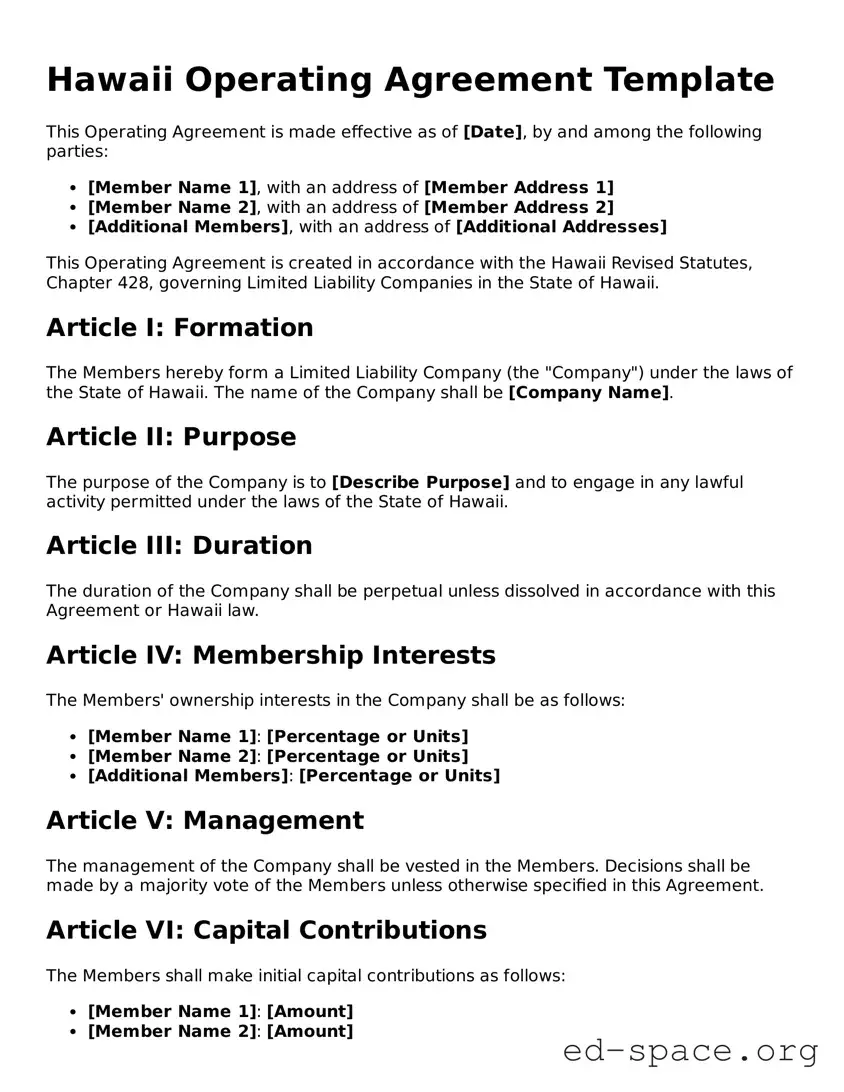
Hawaii Operating Agreement Template
This Operating Agreement is made effective as of [Date], by and among the following parties:
This Operating Agreement is created in accordance with the Hawaii Revised Statutes, Chapter 428, governing Limited Liability Companies in the State of Hawaii.
Article I: Formation
The Members hereby form a Limited Liability Company (the "Company") under the laws of the State of Hawaii. The name of the Company shall be [Company Name].
Article II: Purpose
The purpose of the Company is to [Describe Purpose] and to engage in any lawful activity permitted under the laws of the State of Hawaii.
Article III: Duration
The duration of the Company shall be perpetual unless dissolved in accordance with this Agreement or Hawaii law.
Article IV: Membership Interests
The Members' ownership interests in the Company shall be as follows:
Article V: Management
The management of the Company shall be vested in the Members. Decisions shall be made by a majority vote of the Members unless otherwise specified in this Agreement.
Article VI: Capital Contributions
The Members shall make initial capital contributions as follows:
Article VII: Distributions
Distributions of profits and losses shall be made to the Members in proportion to their respective ownership interests.
Article VIII: Indemnification
The Company shall indemnify the Members to the fullest extent permitted by Hawaii law against any losses or liabilities incurred in connection with the Company.
Article IX: Amendments
This Operating Agreement may be amended only by a written agreement signed by all Members.
Article X: Governing Law
This Agreement shall be governed by and construed in accordance with the laws of the State of Hawaii.
IN WITNESS WHEREOF, the Members have executed this Operating Agreement as of the date first above written.
______________________________
[Member Name 1]
______________________________
[Member Name 2]
______________________________
[Additional Members]
| Fact Name | Description |
|---|---|
| Governing Law | The Hawaii Operating Agreement is governed by the Hawaii Revised Statutes, specifically Chapter 428, which outlines the laws related to Limited Liability Companies (LLCs) in the state. |
| Purpose | This form serves to outline the internal operations of an LLC, detailing the rights and responsibilities of members and managers. |
| Flexibility | Hawaii allows significant flexibility in the terms of an Operating Agreement, enabling members to tailor provisions to meet their specific needs. |
| Required Information | While not mandatory, it is highly advisable to include details such as the LLC’s name, address, member contributions, and profit distribution methods. |
| Amendments | The Operating Agreement can be amended as necessary, provided that the process for amendments is clearly defined within the document itself. |
| Legal Standing | An Operating Agreement, although not filed with the state, holds legal significance and can be enforced in court if disputes arise among members. |
Completing the Hawaii Operating Agreement form is a crucial step for any business owner looking to establish clear guidelines and responsibilities within their company. After filling out this form, you will have a structured framework that outlines how your business will operate, ensuring all members are on the same page.
What is a Hawaii Operating Agreement?
A Hawaii Operating Agreement is a legal document that outlines the management structure and operational guidelines for a limited liability company (LLC) in Hawaii. It serves as an internal agreement among the members of the LLC, detailing their rights, responsibilities, and how the business will be run.
Is an Operating Agreement required in Hawaii?
No, an Operating Agreement is not legally required in Hawaii. However, it is highly recommended. Having an Operating Agreement can help clarify the roles of each member, prevent misunderstandings, and protect the limited liability status of the LLC.
Who should create the Operating Agreement?
The members of the LLC should create the Operating Agreement. It can be drafted by the members themselves or with the help of a legal professional. Each member should have input to ensure that the agreement reflects their intentions and expectations.
What should be included in the Operating Agreement?
The Operating Agreement should cover several key areas, including the management structure, member roles, voting rights, profit distribution, and procedures for adding or removing members. It may also include guidelines for resolving disputes and what happens if the LLC is dissolved.
Can the Operating Agreement be changed?
Yes, the Operating Agreement can be amended. Changes should be made according to the procedures outlined in the agreement itself. It’s important for all members to agree to any modifications to maintain clarity and prevent conflicts.
How does the Operating Agreement affect liability?
The Operating Agreement helps reinforce the limited liability protection of the LLC. By clearly defining the roles and responsibilities of each member, it can help prevent personal liability for business debts and obligations, as long as the members adhere to the terms of the agreement.
Where should the Operating Agreement be kept?
The Operating Agreement should be kept in a safe place, such as with other important business documents. All members should have access to a copy. It’s also a good idea to keep it updated and review it regularly to ensure it remains relevant.
What if there is no Operating Agreement?
If there is no Operating Agreement, the LLC will be governed by Hawaii's default laws for LLCs. This may not align with the members' intentions and could lead to disputes or misunderstandings. It is advisable to create an Operating Agreement to avoid these issues.
Can an Operating Agreement be used in court?
Yes, an Operating Agreement can be used in court if there are disputes among members or if the terms of the agreement are challenged. Courts may refer to the Operating Agreement to understand the intentions of the members and how the LLC is supposed to operate.
Failing to include all members' names and addresses. Every member of the LLC must be listed clearly. Omitting a member can lead to confusion and legal issues.
Not specifying the management structure. It's important to indicate whether the LLC will be member-managed or manager-managed. This decision affects how the business operates.
Overlooking the distribution of profits and losses. The agreement should clearly outline how profits and losses will be shared among members. Ambiguity here can lead to disputes later.
Neglecting to include a procedure for adding new members. As the business grows, new members may join. Having a clear process for this can prevent misunderstandings.
Not addressing the exit strategy for members. It's crucial to outline what happens if a member wants to leave the LLC. This can include buyout procedures or other exit terms.
Using vague language. Clear and precise language is essential. Ambiguities can lead to different interpretations, resulting in potential conflicts.
When forming a Limited Liability Company (LLC) in Hawaii, several documents may accompany the Hawaii Operating Agreement. Each of these documents serves a specific purpose and helps ensure that the business operates smoothly and in compliance with state regulations.
Having these documents prepared and organized can help establish a solid foundation for your LLC in Hawaii. Each plays a vital role in the overall governance and operation of the business.
An Operating Agreement is a vital document for a limited liability company (LLC), but it shares similarities with several other legal documents. Here’s a look at four documents that are comparable to an Operating Agreement:
When filling out the Hawaii Operating Agreement form, it is important to be careful and thorough. Here are some guidelines to help you navigate the process.
Following these guidelines will help ensure that your Operating Agreement is filled out correctly and completely. Best of luck with your business!
Many people have misconceptions about the Hawaii Operating Agreement form. Understanding these misconceptions can help ensure that individuals and businesses comply with legal requirements effectively. Here are eight common misconceptions:
While not legally required, having an Operating Agreement is highly recommended. It outlines the management structure and operational procedures of the LLC, providing clarity and protection for all members.
This is false. Even small LLCs benefit from having an Operating Agreement. It helps set clear expectations among members, regardless of the size of the business.
This is a misconception. Members can amend the Operating Agreement as needed, provided they follow the amendment process outlined in the document.
While it is best practice for all members to sign, the agreement can still be enforceable even if not all members sign, depending on the circumstances.
This is incorrect. The Operating Agreement is an internal document and does not need to be filed with the state of Hawaii.
This misconception overlooks the broader scope of the document. It can also cover management structure, voting rights, and procedures for member changes.
While templates can be helpful, they may not address specific needs or circumstances of your LLC. Customization is often necessary to ensure it meets all members' needs.
This is misleading. The Operating Agreement should be reviewed regularly and updated as the business evolves or as laws change.
When filling out and using the Hawaii Operating Agreement form, there are several important considerations to keep in mind. Below are key takeaways that can help ensure a smooth process.
By paying attention to these key points, individuals can create a comprehensive and effective Operating Agreement that serves the needs of their LLC.