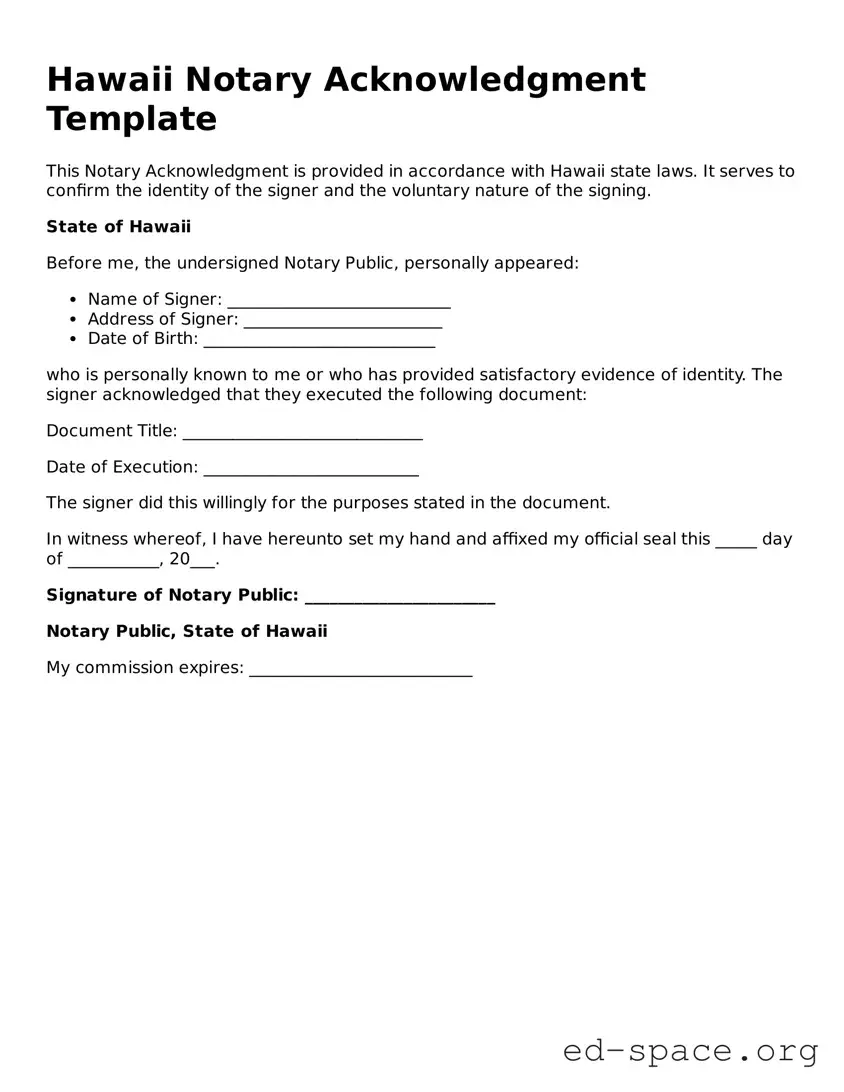
The Hawaii Notary Acknowledgment form plays a crucial role in the notarization process, ensuring that documents are properly authenticated and verified. This form is essential for various legal transactions, including property transfers, contracts, and affidavits. It serves as a written declaration by a notary public, confirming that the signer of the document appeared before them and acknowledged their signature willingly. The form typically includes details such as the date of notarization, the name of the signer, and the notary's signature and seal. Additionally, it may require information about the type of identification presented by the signer to verify their identity. Understanding the purpose and components of the Hawaii Notary Acknowledgment form can help individuals navigate the notarization process more effectively, ensuring that their documents hold legal weight and are recognized by courts and other institutions.
Hawaii Notary Acknowledgment Template
This Notary Acknowledgment is provided in accordance with Hawaii state laws. It serves to confirm the identity of the signer and the voluntary nature of the signing.
State of Hawaii
Before me, the undersigned Notary Public, personally appeared:
who is personally known to me or who has provided satisfactory evidence of identity. The signer acknowledged that they executed the following document:
Document Title: _____________________________
Date of Execution: __________________________
The signer did this willingly for the purposes stated in the document.
In witness whereof, I have hereunto set my hand and affixed my official seal this _____ day of ___________, 20___.
Signature of Notary Public: _______________________
Notary Public, State of Hawaii
My commission expires: ___________________________
| Fact Name | Description |
|---|---|
| Purpose | The Hawaii Notary Acknowledgment form is used to verify the identity of the signer and confirm that they signed the document voluntarily. |
| Governing Law | This form is governed by the Hawaii Revised Statutes, specifically Section 456-1 to 456-8. |
| Signature Requirement | The signer must be physically present when the notary public acknowledges their signature. |
| Identification | The notary must confirm the identity of the signer, typically through a government-issued ID. |
| Notary Seal | A notary public must affix their official seal to the acknowledgment form to validate it. |
| Record Keeping | Notaries are required to maintain a journal of all acknowledgments performed, ensuring a record of transactions. |
| Validity | The acknowledgment remains valid as long as it meets the requirements set forth by state law. |
After obtaining the Hawaii Notary Acknowledgement form, it is essential to complete it accurately to ensure it serves its intended purpose. Follow the steps outlined below to fill out the form correctly.
What is a Hawaii Notary Acknowledgement form?
The Hawaii Notary Acknowledgement form is a legal document used to verify the identity of individuals signing a document. It serves as proof that the signer appeared before a notary public, who then confirms their identity and willingness to sign the document. This form is commonly used for various legal transactions, including real estate deeds and contracts.
Why is a Notary Acknowledgement necessary?
A Notary Acknowledgement is necessary to ensure the authenticity of signatures on important documents. It helps prevent fraud by confirming that the signer is who they claim to be and that they are signing willingly. Many institutions, including banks and courts, require notarized documents for legal validity.
Who can act as a notary public in Hawaii?
In Hawaii, a notary public must be a resident of the state and at least 18 years old. They must complete the required training and pass a background check. Once commissioned, a notary can perform notarial acts, including acknowledgements, throughout the state.
How do I complete a Notary Acknowledgement form?
To complete a Notary Acknowledgement form, the signer must appear in person before the notary. The notary will verify the signer's identity, typically by checking a government-issued ID. After confirming their identity and willingness to sign, the notary will complete the form, including their signature and seal.
Is there a fee for notarization in Hawaii?
Yes, notaries in Hawaii may charge a fee for their services. The maximum allowable fee is set by state law. It is advisable to confirm the fee with the notary before the service is provided, as some notaries may offer lower rates or special services.
What documents require a Notary Acknowledgement?
Various documents may require a Notary Acknowledgement, including real estate transactions, powers of attorney, and certain court documents. It is important to check with the relevant authority or legal counsel to determine if notarization is necessary for your specific document.
How long is a Notary Acknowledgement valid?
A Notary Acknowledgement does not have a specific expiration date. However, the validity of the underlying document may be subject to its own terms or the relevant laws. It is advisable to ensure that the document is executed and recorded within a reasonable time frame to avoid any issues.
Failing to include the date of the acknowledgment. This is crucial for the validity of the document.
Not providing the signer's name correctly. Ensure that the name matches the identification presented.
Omitting the notary's signature. This is necessary to authenticate the acknowledgment.
Using the wrong notary seal. Make sure the seal is clear and legible.
Not checking the jurisdiction section. The acknowledgment must specify the correct state and county.
Leaving out the capacity in which the signer is acting. This helps clarify the authority of the signer.
Failing to witness the signing. The notary must observe the signer completing the document.
Not keeping a record of the acknowledgment in the notary journal. This is important for maintaining accurate records.
In the context of notarization in Hawaii, several forms and documents are commonly utilized alongside the Hawaii Notary Acknowledgement form. These documents serve various purposes, from verifying identities to facilitating legal transactions. Below is a list of some frequently used forms that may accompany the Notary Acknowledgement.
Understanding these documents and their purposes can help individuals navigate the notarization process more effectively. Each form plays a crucial role in ensuring that legal transactions are conducted smoothly and in compliance with applicable laws.
The Notary Acknowledgment form serves a specific purpose in the realm of legal documentation. Several other documents share similarities with it, each playing a crucial role in verifying signatures and affirming the authenticity of agreements. Below are four documents that are similar to the Notary Acknowledgment form:
When filling out the Hawaii Notary Acknowledgment form, there are important guidelines to follow. Here are seven things to do and not to do:
Notary acknowledgments are important in Hawaii, but there are some common misconceptions about the Hawaii Notary Acknowledgment form. Here are four of those misconceptions explained:
Understanding these misconceptions can help ensure a smoother notarization process. Always check with a notary if you have questions about their services or the requirements in Hawaii.
When filling out and using the Hawaii Notary Acknowledgement form, there are several important points to consider. Below are key takeaways that can guide you through the process.
Understanding these key points can help ensure that the notary acknowledgment process is completed correctly and efficiently.