In the vibrant and diverse business landscape of Hawaii, protecting sensitive information is crucial for maintaining competitive advantages and fostering trust between parties. The Hawaii Non-disclosure Agreement (NDA) form serves as a vital tool for individuals and businesses alike, enabling them to safeguard confidential information from unauthorized disclosure. This legally binding document outlines the obligations of the parties involved, specifying what constitutes confidential information and the circumstances under which it may be shared. It typically includes essential elements such as the duration of confidentiality, the permitted uses of the disclosed information, and the consequences of breaching the agreement. By establishing clear expectations and responsibilities, the NDA not only helps in preventing potential disputes but also encourages open communication and collaboration among parties, fostering an environment where innovative ideas can thrive while ensuring that proprietary information remains protected.
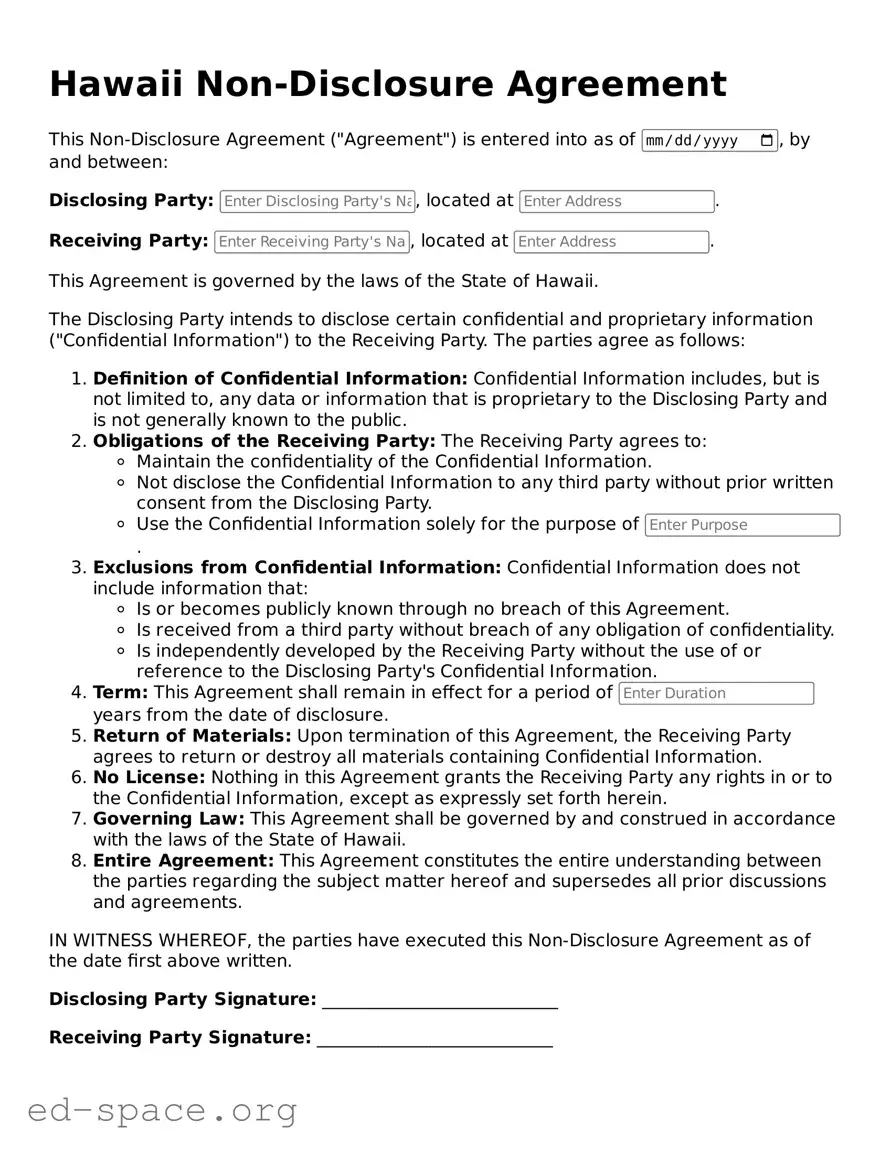
Hawaii Non-Disclosure Agreement
This Non-Disclosure Agreement ("Agreement") is entered into as of , by and between:
Disclosing Party: , located at .
Receiving Party: , located at .
This Agreement is governed by the laws of the State of Hawaii.
The Disclosing Party intends to disclose certain confidential and proprietary information ("Confidential Information") to the Receiving Party. The parties agree as follows:
IN WITNESS WHEREOF, the parties have executed this Non-Disclosure Agreement as of the date first above written.
Disclosing Party Signature: ___________________________
Receiving Party Signature: ___________________________
| Fact Name | Details |
|---|---|
| Definition | A Hawaii Non-disclosure Agreement (NDA) is a legal contract that protects confidential information shared between parties. |
| Purpose | The primary purpose of an NDA is to prevent the unauthorized disclosure of sensitive information. |
| Governing Law | The NDA is governed by the laws of the State of Hawaii. |
| Parties Involved | Typically, an NDA involves at least two parties: the disclosing party and the receiving party. |
| Duration | The duration of confidentiality obligations can vary, often lasting several years or until the information becomes public. |
| Enforcement | If breached, the disclosing party may seek legal remedies, including injunctions or monetary damages. |
| Types of Information | Information protected under an NDA can include trade secrets, business plans, and proprietary data. |
| Mutual vs. Unilateral | NDAs can be mutual, where both parties share confidential information, or unilateral, where only one party discloses information. |
Filling out the Hawaii Non-disclosure Agreement form is an important step in protecting confidential information. Ensure you have all necessary details ready before starting the process. This will help streamline your experience and ensure accuracy in your submissions.
After completing the form, ensure that all parties have received their copies. This will help maintain clarity and uphold the agreement's terms. Keeping track of the signed document is essential for future reference.
What is a Non-disclosure Agreement (NDA) in Hawaii?
A Non-disclosure Agreement (NDA) is a legal contract that protects confidential information shared between parties. In Hawaii, it is commonly used in business settings to prevent the unauthorized disclosure of sensitive information, such as trade secrets or proprietary data.
Why should I use an NDA?
Using an NDA helps safeguard your business interests. It ensures that any confidential information shared with another party remains protected. This can be crucial when discussing potential partnerships, investments, or any situation where sensitive information is exchanged.
What types of information can be protected by an NDA?
An NDA can protect various types of information, including business plans, financial data, customer lists, marketing strategies, and any other proprietary information that you want to keep confidential. The key is that the information must be clearly defined in the agreement.
Who can enter into an NDA?
Any individual or business entity can enter into an NDA. This includes companies, freelancers, employees, and contractors. Both parties must agree to the terms outlined in the NDA for it to be enforceable.
How long does an NDA last?
The duration of an NDA can vary. Typically, it lasts for a specific period, often ranging from one to five years. However, some agreements may specify that confidentiality obligations continue indefinitely, especially for trade secrets.
What happens if someone breaches the NDA?
If a party breaches the NDA, the injured party may seek legal remedies. This can include monetary damages or injunctive relief, which is a court order to stop the breach. The specific consequences should be outlined in the NDA itself.
Can I modify an NDA?
Yes, an NDA can be modified if both parties agree to the changes. It is important to document any modifications in writing to ensure clarity and enforceability. Verbal agreements may not hold up in court.
Do I need a lawyer to draft an NDA?
While it is not legally required to have a lawyer draft an NDA, it is advisable. A legal professional can help ensure that the agreement is comprehensive and tailored to your specific needs, minimizing the risk of future disputes.
Is an NDA enforceable in Hawaii?
Yes, NDAs are generally enforceable in Hawaii as long as they meet certain legal requirements. These include having a clear definition of confidential information and reasonable terms regarding duration and scope. It is essential to ensure that the NDA complies with state laws.
Not reading the entire agreement thoroughly. Many individuals rush through the document, missing important clauses that outline their obligations and rights.
Failing to identify all parties involved. It is essential to clearly state who is bound by the agreement. Omitting a party can lead to complications later.
Inaccurate or incomplete descriptions of confidential information. Providing vague or overly broad definitions can weaken the agreement's effectiveness.
Neglecting to specify the duration of confidentiality. Without a clear timeframe, it may be unclear how long the obligations last, leading to potential disputes.
Overlooking the consequences of breach. Not including specific penalties or remedies can leave parties unprotected if the agreement is violated.
Not consulting with legal counsel. Many people attempt to fill out the form without professional guidance, which can result in misunderstandings of the terms.
Forgetting to sign and date the agreement. A missing signature can render the document unenforceable, negating the intended protections.
When entering into a Non-disclosure Agreement (NDA) in Hawaii, several other forms and documents may be relevant to ensure comprehensive protection of sensitive information. Each of these documents plays a specific role in facilitating clear communication and understanding between parties. Below is a list of commonly used forms that often accompany an NDA.
Understanding these documents can help individuals and businesses navigate the complexities of confidentiality and protect their interests effectively. By using the right combination of agreements, parties can foster trust and collaboration while safeguarding their valuable information.
A Non-disclosure Agreement (NDA) is a legal document that protects confidential information. Several other documents share similar purposes or functions. Here are four documents that are comparable to an NDA:
When filling out the Hawaii Non-disclosure Agreement (NDA) form, it's essential to approach the task with care. Here are some important dos and don'ts to consider:
By following these guidelines, you can help ensure that your Non-disclosure Agreement serves its intended purpose effectively.
When it comes to Non-disclosure Agreements (NDAs) in Hawaii, many people hold misconceptions that can lead to confusion or even legal issues. Here are eight common misunderstandings:
Many believe that NDAs are uniform across all states. In reality, each state, including Hawaii, has its own laws and requirements that can affect the enforceability of an NDA.
While businesses frequently use NDAs, individuals can also benefit from them. Personal relationships, such as those involving sensitive information, can also warrant an NDA.
This is misleading. NDAs typically protect specific information, not all conversations. It's essential to understand what is covered and what is not.
Many people think NDAs lack legal weight. However, when properly drafted and executed, they can be enforceable in court, provided they meet legal standards.
Some assume that NDAs are indefinite. In fact, many NDAs specify a duration for confidentiality, after which the obligations may expire.
While written agreements are the most common, verbal NDAs can also be enforceable in certain situations, although they are harder to prove.
Not all information qualifies for protection under an NDA. For example, public knowledge or information that is already widely known cannot be protected.
Some believe that NDAs are required in every business relationship. However, their necessity depends on the context and the sensitivity of the information being shared.
Understanding these misconceptions can help individuals and businesses navigate the complexities of NDAs in Hawaii more effectively. Always consider consulting a legal professional for personalized guidance.
When it comes to protecting sensitive information in Hawaii, understanding the Non-disclosure Agreement (NDA) form is essential. Here are some key takeaways to keep in mind:
By keeping these key points in mind, you can ensure that your NDA serves its purpose effectively, providing peace of mind as you share sensitive information.