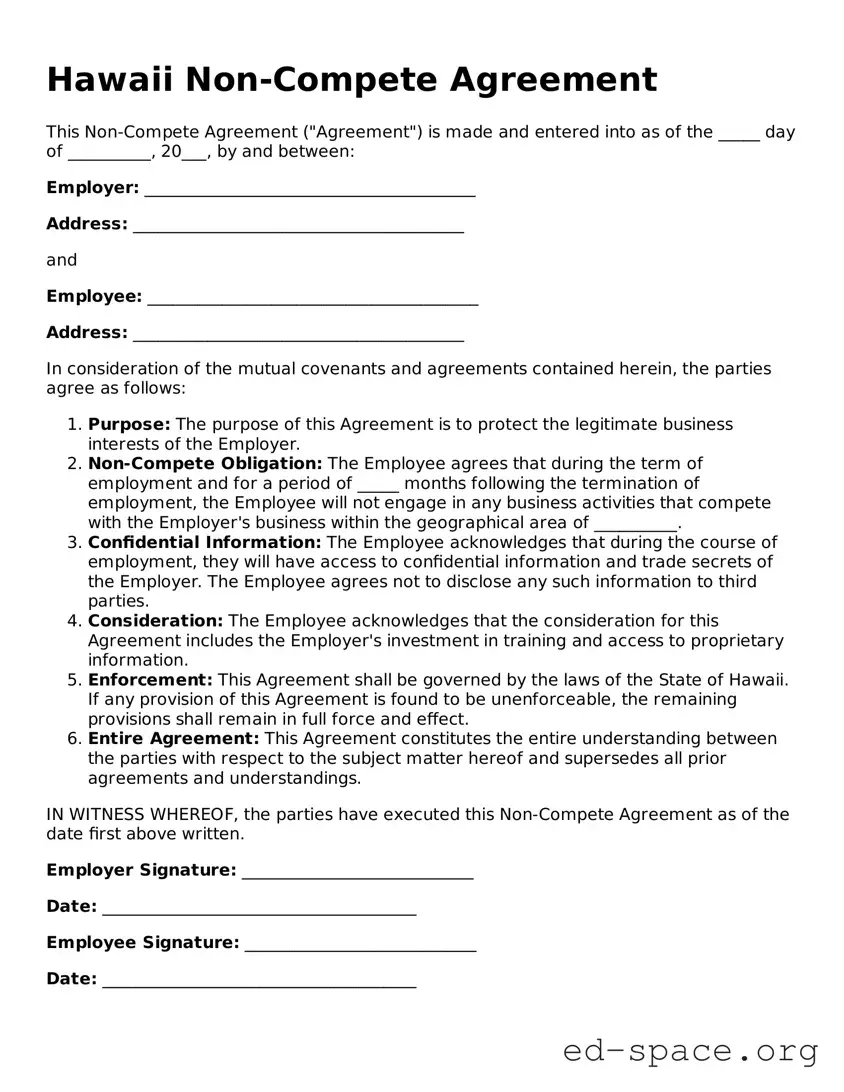
In the dynamic landscape of employment law, the Hawaii Non-compete Agreement form plays a crucial role in defining the boundaries of professional engagement between employers and employees. This legally binding document is designed to protect a company's proprietary information and trade secrets by restricting an employee's ability to work for competitors after leaving the organization. Key components of the form include the duration of the non-compete period, the geographic scope of the restrictions, and the specific activities that are prohibited. Employers must ensure that the terms are reasonable and not overly burdensome, as overly restrictive agreements may be deemed unenforceable by the courts. Additionally, employees should be aware of their rights and the implications of signing such an agreement, as it can significantly impact their future career opportunities. Understanding the nuances of the Hawaii Non-compete Agreement form is essential for both parties to navigate the legal landscape effectively and protect their interests.
Hawaii Non-Compete Agreement
This Non-Compete Agreement ("Agreement") is made and entered into as of the _____ day of __________, 20___, by and between:
Employer: ________________________________________
Address: ________________________________________
and
Employee: ________________________________________
Address: ________________________________________
In consideration of the mutual covenants and agreements contained herein, the parties agree as follows:
IN WITNESS WHEREOF, the parties have executed this Non-Compete Agreement as of the date first above written.
Employer Signature: ____________________________
Date: ______________________________________
Employee Signature: ____________________________
Date: ______________________________________
| Fact Name | Details |
|---|---|
| Definition | A non-compete agreement is a contract that restricts an employee from working for competitors or starting a competing business for a specified period after leaving a job. |
| Governing Law | Hawaii Revised Statutes § 480-4 governs non-compete agreements in Hawaii. |
| Enforceability | Non-compete agreements in Hawaii are enforceable only if they are reasonable in scope and duration. |
| Duration | The agreement should specify a reasonable time limit, typically not exceeding one to two years. |
| Geographic Scope | The geographic area covered by the agreement must be reasonable and directly related to the business interests being protected. |
| Consideration | For a non-compete agreement to be valid, there must be consideration, such as a job offer or promotion. |
| Employee Rights | Employees have the right to negotiate the terms of a non-compete agreement before signing. |
| Judicial Review | Courts in Hawaii may modify overly broad non-compete agreements to make them enforceable. |
| Exceptions | Non-compete agreements cannot restrict an employee from engaging in lawful employment after termination. |
| Industry Specifics | Certain industries, like healthcare and technology, may have additional considerations regarding non-compete agreements. |
After obtaining the Hawaii Non-compete Agreement form, you will need to complete it with specific information. This process involves providing details about the parties involved, the terms of the agreement, and any other necessary information. Following these steps will help ensure that the form is filled out correctly.
Once the form is completed, it is advisable to keep copies for both parties. This ensures that each party has a record of the agreement, which may be important for future reference.
What is a Hawaii Non-compete Agreement?
A Hawaii Non-compete Agreement is a legal document that restricts an employee from engaging in certain competitive activities after leaving a job. It aims to protect a business's confidential information, trade secrets, and customer relationships. Typically, the agreement specifies a time frame and geographical area where the former employee cannot work for a competing business or start their own competing venture.
Are Non-compete Agreements enforceable in Hawaii?
Yes, Non-compete Agreements can be enforceable in Hawaii, but they must meet specific criteria. The agreement should be reasonable in scope, duration, and geographic area. Courts in Hawaii will evaluate the necessity of the agreement to protect legitimate business interests. If the terms are overly broad or unfair to the employee, a court may refuse to enforce the agreement.
How long can a Non-compete Agreement last in Hawaii?
The duration of a Non-compete Agreement in Hawaii should be reasonable, typically ranging from six months to two years. However, the exact length can depend on the nature of the business and the employee's role. An agreement that lasts too long may be deemed unenforceable, so it's essential to strike a balance that protects the business while still allowing the employee to pursue their career.
What should I include in a Hawaii Non-compete Agreement?
A well-crafted Hawaii Non-compete Agreement should include several key elements. Start with a clear definition of what constitutes "competition." Specify the duration of the agreement and the geographic area it covers. It's also important to outline any exceptions or conditions that may apply. Lastly, ensure that both parties understand their rights and obligations under the agreement, and consider including a clause for dispute resolution.
Failing to clearly define the scope of the agreement. It’s essential to specify what activities are restricted and in what contexts.
Not specifying the geographical area of the non-compete. A vague location can lead to misunderstandings and disputes later on.
Neglecting to include a duration for the non-compete clause. Without a specified time frame, the agreement may be deemed overly broad.
Overlooking the consideration for the agreement. It is important to ensure that something of value is exchanged for the restrictions imposed.
Using overly complex language that may confuse the parties involved. Clear and straightforward language helps prevent misinterpretation.
Not consulting with a legal professional before signing. Expert advice can help identify potential issues and ensure compliance with state laws.
Failing to understand the impact on future employment. Individuals should consider how the agreement may limit their job opportunities.
Ignoring the possibility of modifications to the agreement. It’s important to acknowledge that terms may need to be adjusted over time.
When dealing with a Hawaii Non-compete Agreement, several other documents may accompany it to ensure clarity and enforceability. Each of these documents serves a specific purpose in the context of employment and business relationships.
Each of these documents plays a crucial role in defining the expectations and responsibilities of the parties involved. Together, they create a framework that helps protect business interests and maintain professional integrity.
When filling out the Hawaii Non-compete Agreement form, it's important to approach the process carefully. Here are some key dos and don'ts to keep in mind:
Following these guidelines can help ensure that you complete the form correctly and protect your interests.
Understanding non-compete agreements in Hawaii can be challenging. Here are five common misconceptions about these agreements that people often have:
By understanding these misconceptions, individuals can better navigate their rights and obligations regarding non-compete agreements in Hawaii.
When filling out and using the Hawaii Non-compete Agreement form, keep these key takeaways in mind: