The Hawaii Motor Vehicle Power of Attorney form serves as a crucial legal document that allows individuals to designate another person to act on their behalf regarding motor vehicle transactions. This form is particularly important for those who may be unable to handle these matters personally due to various reasons such as health issues, travel, or time constraints. By completing this form, the principal grants authority to an agent to perform specific tasks, such as transferring vehicle ownership, registering a vehicle, or obtaining title documents. The agent's powers can be tailored to meet the principal's needs, ensuring that the designated individual can manage the motor vehicle affairs effectively. It is essential to understand that the authority granted through this form is limited to the actions specified, providing a clear framework for both the principal and the agent. Additionally, the form requires signatures and may need to be notarized, depending on the specific requirements set forth by Hawaii state law. Understanding these key elements helps individuals navigate the process smoothly, ensuring that their motor vehicle transactions are handled efficiently and in accordance with their wishes.
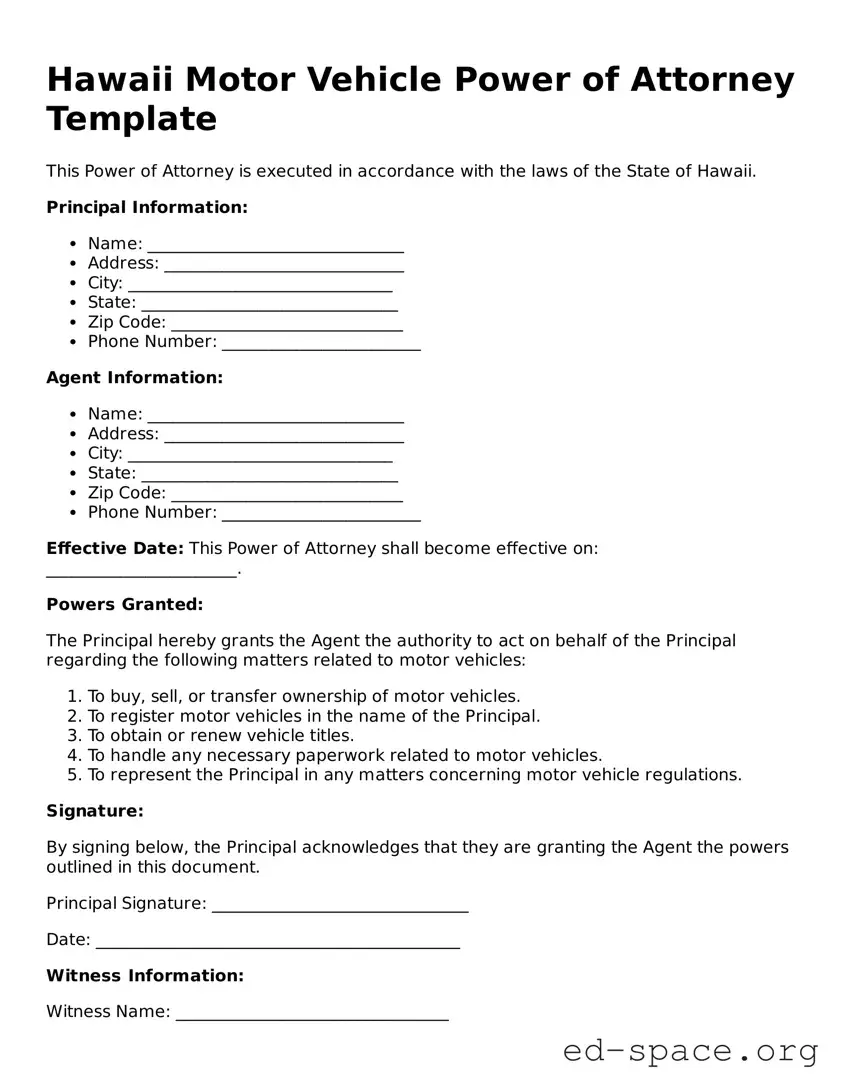
Hawaii Motor Vehicle Power of Attorney Template
This Power of Attorney is executed in accordance with the laws of the State of Hawaii.
Principal Information:
Agent Information:
Effective Date: This Power of Attorney shall become effective on: _______________________.
Powers Granted:
The Principal hereby grants the Agent the authority to act on behalf of the Principal regarding the following matters related to motor vehicles:
Signature:
By signing below, the Principal acknowledges that they are granting the Agent the powers outlined in this document.
Principal Signature: _______________________________
Date: ____________________________________________
Witness Information:
Witness Name: _________________________________
Witness Signature: ______________________________
Date: ____________________________________________
This document must be signed in the presence of a witness or notary public to be valid.
| Fact Name | Details |
|---|---|
| Definition | The Hawaii Motor Vehicle Power of Attorney form allows an individual to designate another person to act on their behalf regarding motor vehicle transactions. |
| Governing Law | This form is governed by the Hawaii Revised Statutes, specifically HRS § 486-134. |
| Purpose | It is primarily used for transferring ownership, registering vehicles, and handling other motor vehicle-related matters. |
| Requirements | The form must be signed by the principal (the person granting authority) and may need to be notarized for certain transactions. |
| Validity | The Power of Attorney remains valid until revoked by the principal or until the principal's death. |
| Revocation | A written notice of revocation must be provided to the agent and any relevant parties to terminate the authority granted. |
| Use Cases | This form is commonly used when the principal cannot be present for vehicle transactions, such as during travel or illness. |
After obtaining the Hawaii Motor Vehicle Power of Attorney form, you will need to fill it out carefully. This form allows you to designate someone to act on your behalf regarding your motor vehicle. Follow these steps to complete the form accurately.
Once the form is filled out and signed, keep a copy for your records. You can then provide the completed form to your attorney-in-fact, allowing them to act on your behalf regarding your motor vehicle matters.
What is a Hawaii Motor Vehicle Power of Attorney form?
The Hawaii Motor Vehicle Power of Attorney form is a legal document that allows one individual, known as the "principal," to authorize another person, called the "agent," to act on their behalf regarding motor vehicle matters. This can include tasks such as transferring ownership, registering a vehicle, or handling any other necessary paperwork related to motor vehicles in Hawaii.
Who should use this form?
This form is particularly useful for individuals who may be unable to manage their vehicle-related affairs due to reasons such as being out of state, illness, or other personal circumstances. It is often used by those who need someone else to handle transactions or legal obligations related to their vehicles.
What powers can be granted through this form?
The powers granted through the Hawaii Motor Vehicle Power of Attorney can vary based on the specific needs of the principal. Generally, the agent may be authorized to sign documents, transfer titles, register vehicles, and perform other tasks necessary for managing the motor vehicle. It is essential to clearly outline the powers you wish to grant to avoid any confusion.
How do I complete the form?
To complete the form, you will need to provide your name and contact information, as well as that of your agent. Additionally, you should specify the powers you are granting and any limitations, if applicable. After filling out the form, both the principal and the agent should sign it. Depending on the situation, you may also need to have the document notarized for added legal validity.
Is notarization required for the form?
While notarization is not always required for the Hawaii Motor Vehicle Power of Attorney, it is highly recommended. Having the document notarized can help ensure its acceptance by the Department of Motor Vehicles and other entities. It adds an extra layer of authenticity and can prevent potential disputes regarding the validity of the document.
Can I revoke the Power of Attorney once it is granted?
Yes, you can revoke the Power of Attorney at any time, as long as you are mentally competent. To do this, you must create a written revocation document and provide a copy to your agent and any relevant parties, such as the Department of Motor Vehicles. It is advisable to keep a record of the revocation to prevent any future misunderstandings.
Where can I obtain the Hawaii Motor Vehicle Power of Attorney form?
You can obtain the Hawaii Motor Vehicle Power of Attorney form from the official website of the Hawaii Department of Transportation or through local DMV offices. Additionally, various legal resource websites may provide templates for this form. Ensure that you are using the most current version of the form to comply with any recent legal changes.
Failing to provide accurate information about the principal. The principal's name, address, and contact details must be correct to avoid any legal complications.
Not identifying the attorney-in-fact clearly. The individual designated to act on behalf of the principal should be named explicitly, with their full name and contact information included.
Omitting the specific powers granted. The form should clearly outline the powers being conferred to the attorney-in-fact, such as the ability to sell or transfer a vehicle.
Neglecting to sign the document. A signature from the principal is essential for the form to be valid. Without it, the authority granted is ineffective.
Failing to date the form. Including the date of signing is crucial, as it establishes the timeline of authority.
Using incorrect or outdated forms. Always ensure that the most recent version of the Hawaii Motor Vehicle Power of Attorney form is being utilized.
Not having the document notarized when required. Some situations may necessitate notarization for the form to be legally binding.
Overlooking the need for witnesses. Depending on the circumstances, having witnesses present during the signing may be necessary to validate the document.
Leaving sections blank. Every applicable section should be filled out completely to prevent ambiguity or misunderstandings.
Not reviewing the completed form before submission. A thorough review can help catch any errors or omissions that could invalidate the document.
When dealing with the Hawaii Motor Vehicle Power of Attorney form, several other documents may be required or beneficial to facilitate the process. These documents help clarify the authority granted, ensure compliance with state regulations, and provide necessary information for vehicle transactions.
Each of these documents plays a significant role in the vehicle transfer process in Hawaii. Understanding their purpose can help ensure a smooth transaction and compliance with state laws.
When filling out the Hawaii Motor Vehicle Power of Attorney form, it’s important to follow certain guidelines to ensure everything is completed correctly. Here’s a list of what to do and what to avoid:
Following these guidelines will help ensure that your Power of Attorney form is processed smoothly and without issues.
Many people have misunderstandings about the Hawaii Motor Vehicle Power of Attorney form. Here are four common misconceptions:
Understanding these points can help clarify how the Hawaii Motor Vehicle Power of Attorney form works and what it can do for you.
When dealing with the Hawaii Motor Vehicle Power of Attorney form, it is essential to understand its purpose and how to use it effectively. Here are some key takeaways:
Understanding these key points can help ensure that the process goes smoothly and that your vehicle-related matters are handled as intended.