Homepage Free Medical Power of Attorney Form for Hawaii
Article Guide

In Hawaii, a Medical Power of Attorney (MPOA) is an essential legal document that allows individuals to designate a trusted person to make healthcare decisions on their behalf when they are unable to do so. This form empowers an agent to communicate with medical professionals and ensure that the individual's healthcare preferences are honored, particularly in critical situations where the person may be incapacitated. The MPOA covers a range of medical decisions, from routine treatments to end-of-life care, providing clarity and direction in times of uncertainty. Importantly, the form must be signed and witnessed to be valid, ensuring that the individual’s wishes are legally recognized. Understanding the nuances of this document is crucial for anyone looking to safeguard their health care rights and ensure that their voice is heard, even when they cannot speak for themselves.

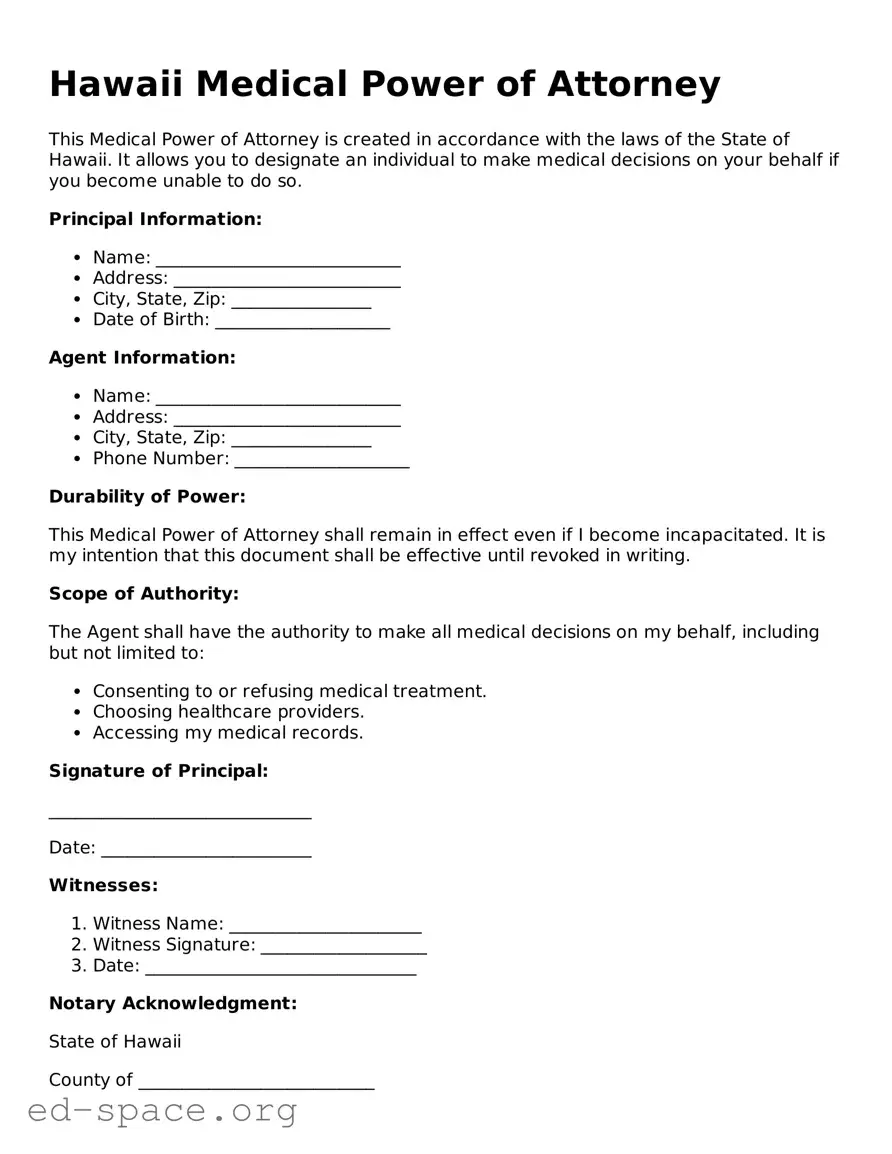
Document Preview

Hawaii Medical Power of Attorney

This Medical Power of Attorney is created in accordance with the laws of the State of Hawaii. It allows you to designate an individual to make medical decisions on your behalf if you become unable to do so.

Principal Information:

  • Name: ____________________________
  • Address: __________________________
  • City, State, Zip: ________________
  • Date of Birth: ____________________

Agent Information:

  • Name: ____________________________
  • Address: __________________________
  • City, State, Zip: ________________
  • Phone Number: ____________________

Durability of Power:

This Medical Power of Attorney shall remain in effect even if I become incapacitated. It is my intention that this document shall be effective until revoked in writing.

Scope of Authority:

The Agent shall have the authority to make all medical decisions on my behalf, including but not limited to:

  • Consenting to or refusing medical treatment.
  • Choosing healthcare providers.
  • Accessing my medical records.

Signature of Principal:

______________________________

Date: ________________________

Witnesses:

  1. Witness Name: ______________________
  2. Witness Signature: ___________________
  3. Date: _______________________________

Notary Acknowledgment:

State of Hawaii

County of ___________________________

On this _____ day of __________, 20__, before me, a Notary Public, personally appeared __________________________, known to me to be the person whose name is subscribed to this document.

______________________________

Notary Public Signature

My commission expires: ________________

PDF Form Details

Fact Name Description
Purpose The Hawaii Medical Power of Attorney form allows individuals to appoint someone to make medical decisions on their behalf if they become unable to do so.
Governing Law This form is governed by the Hawaii Revised Statutes, specifically HRS § 327E.
Requirements The form must be signed by the principal (the person granting authority) and two witnesses or a notary public to be valid.
Revocation The principal can revoke the Medical Power of Attorney at any time, as long as they are mentally competent to do so.

Hawaii Medical Power of Attorney: Usage Guidelines

Filling out the Hawaii Medical Power of Attorney form is an important step in ensuring that your healthcare wishes are respected. Once you have completed the form, it should be signed and dated in the presence of a notary public or two witnesses to make it legally valid.

  1. Obtain a copy of the Hawaii Medical Power of Attorney form. You can find it online or through healthcare providers.
  2. Begin by filling in your full name and address at the top of the form. This identifies you as the principal.
  3. Designate an agent by writing their full name and address. This person will make medical decisions on your behalf if you are unable to do so.
  4. Consider adding an alternate agent. This is someone who can step in if your primary agent is unavailable.
  5. Specify any limitations or specific wishes regarding your medical care. Be clear about your preferences.
  6. Review the form carefully to ensure all information is accurate and complete.
  7. Sign and date the form in front of a notary public or two witnesses. Make sure they also sign the document.
  8. Keep a copy of the completed form for your records and provide copies to your agent and healthcare providers.

Your Questions, Answered

What is a Hawaii Medical Power of Attorney?

A Hawaii Medical Power of Attorney is a legal document that allows an individual to designate another person, known as an agent, to make medical decisions on their behalf if they become unable to do so. This document is crucial for ensuring that your healthcare preferences are respected when you cannot communicate them yourself.

Who can be designated as an agent in a Hawaii Medical Power of Attorney?

In Hawaii, you can choose any competent adult to serve as your agent. This can be a family member, friend, or trusted individual. However, it is important to select someone who understands your healthcare wishes and is willing to advocate for them. Certain individuals, such as healthcare providers involved in your treatment, cannot serve as your agent to avoid conflicts of interest.

How do I create a Medical Power of Attorney in Hawaii?

To create a Medical Power of Attorney in Hawaii, you must complete the appropriate form, which can often be found online or through legal resources. After filling out the form, you need to sign it in the presence of a notary public or two witnesses who are not related to you or named in the document. This ensures that the document is valid and legally binding.

Can I revoke my Medical Power of Attorney in Hawaii?

Yes, you can revoke your Medical Power of Attorney at any time as long as you are competent to do so. To revoke the document, you should create a written notice stating your intention to revoke and share it with your agent and any healthcare providers who may have a copy of the original document. This helps prevent any confusion regarding your medical decision-making authority.

What happens if I do not have a Medical Power of Attorney?

If you do not have a Medical Power of Attorney and become incapacitated, medical decisions will be made by your family members or, in some cases, by a court-appointed guardian. This can lead to disagreements among family members and may not reflect your personal wishes. Having a Medical Power of Attorney in place ensures that your preferences are honored and can help ease the burden on your loved ones during difficult times.

Common mistakes

  1. Failing to Choose a Reliable Agent: One of the most critical mistakes is not selecting someone trustworthy to act as your agent. This person will make significant medical decisions on your behalf, so it is essential to choose someone who understands your values and wishes.

  2. Not Clearly Specifying Medical Preferences: Many individuals overlook the importance of detailing their medical preferences. It is vital to articulate your wishes regarding life-sustaining treatments, organ donation, and other critical health care decisions. Vague instructions can lead to confusion and disputes among family members.

  3. Neglecting to Sign and Date the Document: A common oversight is failing to sign and date the Medical Power of Attorney form. Without your signature, the document may not be considered valid. Additionally, ensure that any witnesses required by state law are present during the signing.

  4. Not Reviewing the Document Periodically: Life circumstances change, and so may your preferences. Many people forget to review and update their Medical Power of Attorney regularly. It is advisable to revisit the document periodically to ensure it still reflects your current wishes and to make any necessary adjustments.

Documents used along the form

When creating a Hawaii Medical Power of Attorney, it is often beneficial to consider additional forms and documents that can complement your healthcare planning. These documents help ensure that your wishes are respected and that you are prepared for various medical situations.

  • Advance Health Care Directive: This document outlines your preferences for medical treatment and care in situations where you may be unable to communicate your wishes. It can include specific instructions about life-sustaining treatment and other healthcare decisions.
  • Living Will: A living will specifies what types of medical treatment you do or do not want if you become terminally ill or incapacitated. It provides guidance to healthcare providers and loved ones about your end-of-life care preferences.
  • Do Not Resuscitate (DNR) Order: A DNR order is a legal document that instructs medical personnel not to perform CPR if your heart stops or you stop breathing. This document can be vital in ensuring your wishes regarding resuscitation are honored.
  • Health Care Proxy: This document appoints someone to make healthcare decisions on your behalf if you are unable to do so. It is similar to a Medical Power of Attorney but may have different legal implications depending on state laws.
  • HIPAA Release Form: A HIPAA release allows designated individuals access to your medical records and information. This is important for ensuring that your healthcare agents can make informed decisions on your behalf.
  • Financial Power of Attorney: While not directly related to medical decisions, this document allows someone to manage your financial affairs if you become incapacitated. It can be crucial for covering medical expenses and other financial obligations.
  • Patient Advocate or Ombudsman Designation: This document appoints an advocate to assist you in navigating the healthcare system and to ensure that your rights and preferences are respected during your treatment.
  • Organ Donation Form: This form specifies your wishes regarding organ donation after your death. It ensures that your intentions are clear and can be honored by your family and medical providers.

Having these documents in place can provide peace of mind and clarity for you and your loved ones. It is advisable to review and update them regularly to reflect any changes in your preferences or circumstances.

Similar forms

  • Durable Power of Attorney: This document allows an individual to appoint someone to make financial decisions on their behalf if they become incapacitated. Like a Medical Power of Attorney, it grants authority to act in specific situations.
  • Living Will: A Living Will outlines an individual's wishes regarding medical treatment in end-of-life situations. While the Medical Power of Attorney designates someone to make decisions, the Living Will specifies what those decisions should be.
  • Health Care Proxy: Similar to a Medical Power of Attorney, a Health Care Proxy allows a person to appoint someone to make health care decisions. The focus is on health care, emphasizing the authority to speak for someone when they cannot.
  • Advance Directive: This broad term encompasses both the Medical Power of Attorney and Living Will. An Advance Directive provides guidance on medical care preferences and appoints someone to ensure those preferences are honored.
  • Do Not Resuscitate (DNR) Order: A DNR order instructs medical personnel not to perform CPR if a patient stops breathing. While it is more specific, it aligns with the goals of the Medical Power of Attorney in guiding medical treatment preferences.
  • Guardian Appointment: This legal document allows an individual to designate someone to make personal and health care decisions for them if they become unable to do so. It shares similarities with the Medical Power of Attorney in terms of decision-making authority.
  • Patient Advocate Designation: This document enables a person to choose someone to advocate for their health care needs. It serves a similar purpose as the Medical Power of Attorney, focusing on health care decisions.
  • HIPAA Authorization: While primarily concerned with privacy, this document allows individuals to designate who can access their medical records. It complements the Medical Power of Attorney by ensuring that the appointed agent has the necessary information to make informed decisions.

Dos and Don'ts

When filling out the Hawaii Medical Power of Attorney form, it’s essential to be careful and thorough. Here are some important dos and don'ts to keep in mind:

  • Do choose a trustworthy agent who understands your wishes.
  • Do discuss your medical preferences with your agent beforehand.
  • Do ensure the form is signed and dated in front of a notary public.
  • Do keep a copy of the completed form for your records.
  • Do review the form periodically to ensure it reflects your current wishes.
  • Don't leave any sections of the form blank.
  • Don't choose an agent who may have conflicting interests.
  • Don't sign the form without fully understanding its implications.
  • Don't forget to inform your healthcare providers about your agent.

Misconceptions

Understanding the Hawaii Medical Power of Attorney form can be challenging. Here are some common misconceptions that people may have about this important document:

  • It only applies to elderly individuals. Many believe that only seniors need a Medical Power of Attorney. However, anyone over the age of 18 can benefit from this document, as medical emergencies can happen at any age.
  • It is the same as a living will. While both documents deal with medical decisions, a Medical Power of Attorney specifically designates someone to make decisions on your behalf, whereas a living will outlines your wishes regarding medical treatment.
  • It is only necessary in case of terminal illness. This form is useful not only for terminal conditions but also for any situation where you may be unable to communicate your medical preferences, such as during surgery or after an accident.
  • It must be notarized to be valid. In Hawaii, a Medical Power of Attorney can be valid without notarization if it is signed by two witnesses who meet specific criteria.
  • Once signed, it cannot be changed. Individuals can revoke or update their Medical Power of Attorney at any time, as long as they are mentally competent to do so.
  • It only covers medical decisions. While primarily focused on healthcare, this document can also include decisions about mental health treatment and other related areas.
  • Only lawyers can create a Medical Power of Attorney. While legal assistance can be helpful, individuals can create this document on their own using the appropriate forms, as long as they follow state guidelines.
  • It becomes effective immediately upon signing. A Medical Power of Attorney can be set to take effect only when a person is incapacitated, allowing for flexibility in its use.

Key takeaways

Filling out a Medical Power of Attorney form in Hawaii is an important step in ensuring that your healthcare wishes are respected when you are unable to communicate them yourself. Here are some key takeaways to keep in mind:

  • Understand the Purpose: A Medical Power of Attorney allows you to designate someone to make healthcare decisions on your behalf.
  • Choose Your Agent Wisely: Select a trusted person who understands your values and preferences regarding medical treatment.
  • Be Specific: Clearly outline your wishes regarding medical treatments, interventions, and end-of-life care to guide your agent.
  • Sign and Date: Ensure the form is signed and dated in the presence of a notary public or witnesses, as required by Hawaii law.
  • Keep Copies: Make multiple copies of the signed document. Share them with your agent, healthcare providers, and family members.
  • Review Regularly: Periodically review and update your Medical Power of Attorney to reflect any changes in your preferences or circumstances.
  • Understand Revocation: Know that you can revoke your Medical Power of Attorney at any time, as long as you are mentally competent to do so.

By following these guidelines, you can ensure that your healthcare decisions are in the hands of someone you trust, even when you cannot voice them yourself.