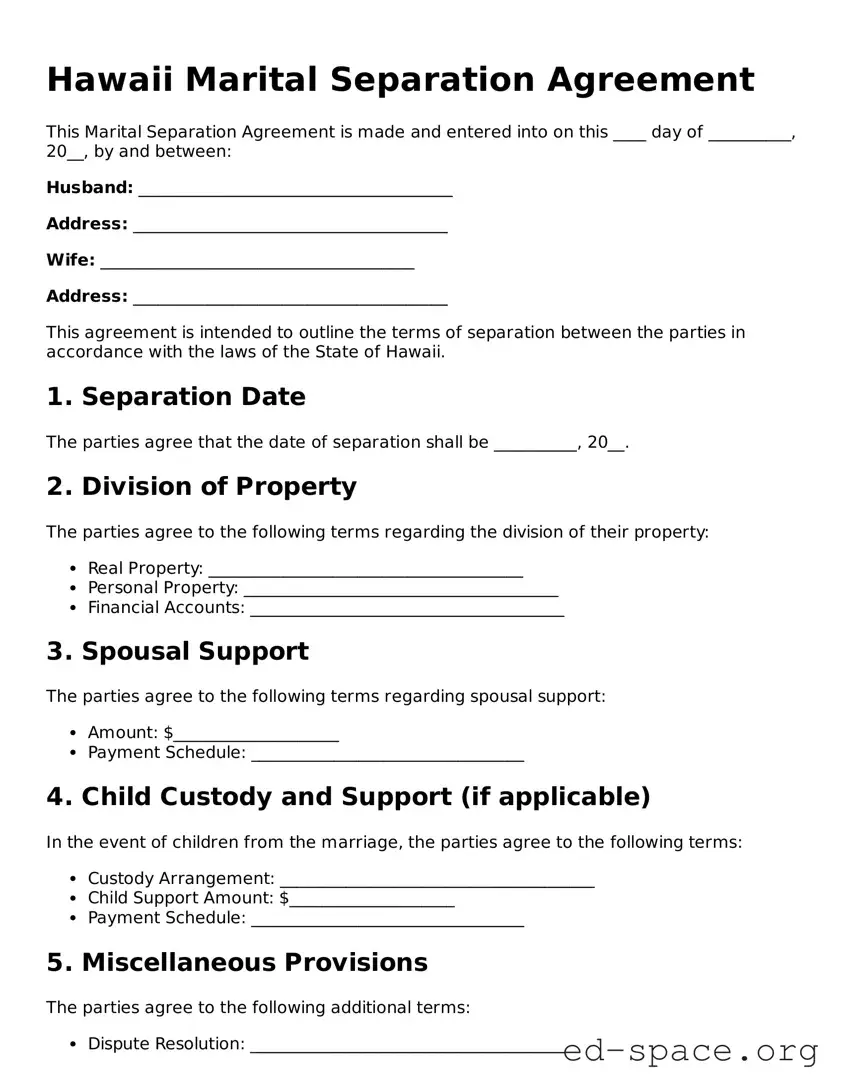
In the context of marital separation, the Hawaii Marital Separation Agreement form serves as a crucial tool for couples navigating the complexities of their relationship. This document outlines the rights and responsibilities of each party during the separation period, addressing key issues such as property division, spousal support, and child custody arrangements. It provides a structured framework for couples to articulate their mutual agreements, ensuring that both parties have a clear understanding of their obligations. By detailing financial arrangements and living situations, the form helps to minimize conflict and promote cooperation. Furthermore, it can play a significant role in protecting individual interests, as it formalizes the terms agreed upon, making them enforceable in a court of law if necessary. Overall, the Hawaii Marital Separation Agreement is an essential component for couples seeking clarity and organization during a challenging time in their lives.
Hawaii Marital Separation Agreement
This Marital Separation Agreement is made and entered into on this ____ day of __________, 20__, by and between:
Husband: ______________________________________
Address: ______________________________________
Wife: ______________________________________
Address: ______________________________________
This agreement is intended to outline the terms of separation between the parties in accordance with the laws of the State of Hawaii.
1. Separation Date
The parties agree that the date of separation shall be __________, 20__.
2. Division of Property
The parties agree to the following terms regarding the division of their property:
3. Spousal Support
The parties agree to the following terms regarding spousal support:
4. Child Custody and Support (if applicable)
In the event of children from the marriage, the parties agree to the following terms:
5. Miscellaneous Provisions
The parties agree to the following additional terms:
This agreement shall be binding upon the parties and may only be modified in writing, signed by both parties.
IN WITNESS WHEREOF, the parties have executed this Marital Separation Agreement as of the date first above written.
Husband's Signature: ___________________________ Date: _______________
Wife's Signature: ___________________________ Date: _______________
| Fact Name | Description |
|---|---|
| Purpose | The Hawaii Marital Separation Agreement form outlines the terms of separation between spouses, addressing issues such as property division, child custody, and support obligations. |
| Governing Law | This agreement is governed by the Hawaii Revised Statutes, particularly Chapter 580, which covers divorce and separation matters. |
| Mutual Agreement | Both parties must voluntarily agree to the terms outlined in the separation agreement for it to be valid. |
| Notarization | Although notarization is not required, having the agreement notarized can provide an additional layer of authenticity and can be beneficial in legal proceedings. |
| Child Custody | The agreement should clearly specify arrangements for child custody, visitation, and child support to ensure the best interests of the children are prioritized. |
| Property Division | It is essential to detail how marital property and debts will be divided to avoid future disputes. |
| Modification | The terms of the separation agreement can be modified later if both parties agree to the changes in writing. |
After obtaining the Hawaii Marital Separation Agreement form, you will need to complete it accurately to ensure that all necessary information is included. This form serves as a record of the terms agreed upon by both parties during the separation process. Below are the steps to guide you through filling out the form.
Once the form is completed, you may want to make copies for your records. It is advisable to keep the original document in a safe place. Following this, you can proceed with the next steps as outlined by your local court or legal advisor.
What is a Hawaii Marital Separation Agreement?
A Hawaii Marital Separation Agreement is a legal document that outlines the terms of a couple's separation. It details how assets, debts, and responsibilities will be divided while the couple is living apart. This agreement can help clarify expectations and reduce conflicts during the separation period.
Do I need a lawyer to create a Marital Separation Agreement in Hawaii?
While it's not required to have a lawyer, it is highly recommended. A legal professional can ensure that your agreement complies with Hawaii laws and adequately protects your interests. They can also help you navigate any complex issues related to child custody or support, property division, and other important matters.
How is a Marital Separation Agreement different from divorce?
A Marital Separation Agreement is not the same as a divorce. It allows couples to live apart while still legally married. This agreement can serve as a temporary arrangement until the couple decides to reconcile or proceed with a divorce. In contrast, divorce legally ends the marriage and requires a more formal legal process.
Can a Marital Separation Agreement be modified?
Yes, a Marital Separation Agreement can be modified if both parties agree to the changes. It's important to document any modifications in writing and, ideally, have them reviewed by a lawyer. This helps ensure that the new terms are clear and enforceable.
What happens if one party does not follow the terms of the agreement?
If one party fails to adhere to the terms of the Marital Separation Agreement, the other party may seek legal remedies. This could involve going to court to enforce the agreement or seeking damages. It’s essential to keep a copy of the agreement and any related communications to support your case.
Is a Marital Separation Agreement legally binding in Hawaii?
Yes, a Marital Separation Agreement is legally binding in Hawaii, provided that it meets certain legal requirements. Both parties must voluntarily sign the agreement, and it must be fair and reasonable. If disputes arise, a court can enforce the terms of the agreement, making it important to ensure all provisions are clear and agreed upon.
Neglecting to Include Full Names: Individuals often forget to write both spouses' full legal names. This can lead to confusion and potential legal issues.
Omitting Important Dates: Failing to provide the date of separation or other critical dates can complicate the agreement and affect legal standing.
Inaccurate Asset and Debt Disclosure: Some people do not list all assets and debts. Full transparency is necessary to ensure an equitable agreement.
Ignoring Child Custody Arrangements: Parents sometimes overlook specifying custody and visitation rights. This can lead to disputes later on.
Not Including Support Obligations: Failing to address child or spousal support can create financial uncertainty and conflict in the future.
Using Ambiguous Language: Vague terms can lead to misinterpretation. Clear, precise language is crucial for avoiding misunderstandings.
Forgetting Signatures: Some individuals neglect to sign the agreement. An unsigned document may not hold up in court.
Not Seeking Legal Advice: Many people skip consulting an attorney. Professional guidance can help navigate complex issues and ensure compliance with state laws.
When navigating the complexities of a marital separation in Hawaii, it's essential to have the right documents in place. Alongside the Hawaii Marital Separation Agreement, several other forms can help clarify rights and responsibilities. Here’s a brief overview of some important documents that are often used in conjunction with the separation agreement.
Having these documents prepared and understood can significantly ease the separation process. Each serves a unique purpose, ensuring that all aspects of the separation are addressed thoughtfully and thoroughly. Whether you are handling this on your own or with legal assistance, being informed is key to navigating this challenging time.
A Marital Separation Agreement is an important document for couples who are separating but not yet divorced. It outlines the rights and responsibilities of each party during the separation period. There are several other legal documents that share similarities with the Marital Separation Agreement. Here’s a list of nine such documents:
Understanding these documents can help individuals navigate the complexities of separation and ensure that their rights and responsibilities are clearly defined.
When filling out the Hawaii Marital Separation Agreement form, it's important to be thorough and careful. Here are some helpful tips on what to do and what to avoid:
By following these guidelines, you can help ensure that your Marital Separation Agreement is completed accurately and effectively. Remember, clarity and communication are key to a smoother process.
Misconceptions about the Hawaii Marital Separation Agreement form can lead to confusion and misinformed decisions. Below are ten common misconceptions, along with clarifications to help individuals better understand this important legal document.
A marital separation agreement is not a divorce. It is a legal document that outlines the terms of a couple's separation, while divorce formally ends the marriage.
This agreement is applicable to all couples, regardless of whether they have children. It addresses asset division, spousal support, and other matters.
While the agreement is binding, it can be modified if both parties agree to the changes and the modifications are documented appropriately.
Although it is highly recommended, a marital separation agreement is not legally required to separate. Couples may choose to separate informally.
A marital separation agreement does not automatically lead to a faster divorce process. The divorce must still be filed and finalized through the court system.
The agreement allows couples to negotiate asset division. It is not mandated that assets be split evenly; terms can be customized based on individual circumstances.
Even if both parties agree, having a written agreement is crucial. It provides clarity and can prevent future disputes.
While it is possible to create an agreement without legal help, consulting an attorney can ensure that both parties' rights are protected and that the document is legally sound.
A properly executed marital separation agreement is legally enforceable in Hawaii, provided it meets the necessary legal requirements.
The agreement is valid as a private contract between the parties once signed. However, filing it with the court can provide additional legal protections.
When considering a marital separation in Hawaii, understanding the Marital Separation Agreement form is crucial. This document outlines the rights and responsibilities of each spouse during the separation period. Here are some key takeaways to keep in mind:
Understanding these aspects can lead to a smoother separation process and help both parties navigate this challenging time with greater clarity.